
A British-Spanish space company most people have never heard of just pulled off the kind of round that usually goes to AI labs, not satellite builders.
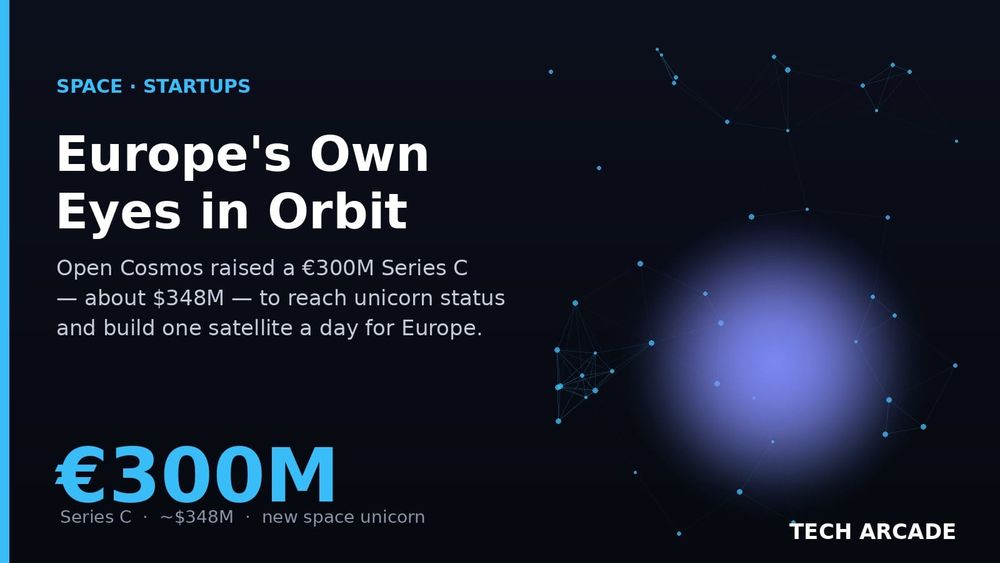
Let's get the number on the table first: €300 million — about $348 million — raised by Open Cosmos in a Series C that reportedly pushed the company past a $1 billion valuation, minting Europe a fresh space unicorn (SatNews).
The money is only half the story. The other half is why European pension funds, a Catalan public finance institute, and the UK's national-security investment fund all decided a company that builds one satellite a day was worth that check.
The short version: Europe is tired of renting its view of Earth from someone else. And Open Cosmos is selling it a way to own the whole stack.
🧠 Why This Matters
For years, if a European government wanted high-resolution imagery of a border, a wildfire, or a shipping lane, it often ended up leaning on American satellites and American cloud infrastructure to see and process it. That works fine — right up until the moment geopolitics makes "someone else's satellite" feel like a liability.
Open Cosmos is pitching the opposite: sovereign infrastructure that a government or enterprise controls end to end, from the spacecraft to the encrypted downlink to the AI that turns raw pixels into a decision.
"Space infrastructure is becoming as critical as energy, digital networks and transport. Governments and enterprises increasingly require secure communications and operational data delivered through resilient systems." — Rafel Jorda Siquier, Founder and CEO (Open Cosmos)
That framing is landing because the money agrees with it. Global venture investment in space hit $11.3 billion in the first half of 2026 alone — more than the $10.1 billion that went into the entire sector across all of 2025 (Tech.eu). Space stopped being a moonshot line item and started looking like a utility.
📊 Deep Dive
Open Cosmos was founded in 2015 and has spent the decade since doing something unfashionable in startup land: making a physical product, at scale, apparently without losing money. It now runs roughly 400 people across four countries and claims it can build one satellite per day across four European factories (Tech.eu).
Here's how the round and the business break down:
- The raise: €300M / ~$348M Series C, co-led by Lightrock and ETF Partners, with venture debt from Claret Capital Partners (SatNews).
- The backers: Institut Català de Finances, the UK's National Security Strategic Investment Fund, Convex, Phoenix Court, Entrepreneurs First, and two large pension funds — a telling mix of public, defense, and institutional money (TechFundingNews).
- The footprint: operations across the UK, Spain, Portugal, and Greece, with four manufacturing facilities (Open Cosmos).
- The traction: more than $370 million in new contracts signed over the past 3.5 years, and — per TechFundingNews — five straight years of profitability (TechFundingNews).
The product is really four products stacked together. OpenOrbit designs, builds, and flies the satellites. OpenConstellation is a shared Earth-observation network that pools sensor payloads from multiple European operators, so smaller countries can buy into a constellation instead of funding one alone. DataCosmos crunches the imagery with AI. And ConnectedCosmos is the ambitious one: a planned European sovereign Ka-band broadband constellation in low Earth orbit, built on spectrum filings acquired from Rivada Space Networks (SatNews).
Put plainly: Open Cosmos wants to be the company Europe calls whether it needs to watch the planet or talk across it.
⚠️ The Catch
A €300 million war chest sounds enormous until you remember what it's up against. Building a broadband constellation in low Earth orbit is one of the most capital-hungry games in tech, and ConnectedCosmos is still at the "deploy initial test satellites" stage (SatNews). The incumbents in that lane have already launched thousands of satellites and spent tens of billions. Catching up on €300 million means Open Cosmos will almost certainly be back for more.
There's also a valuation asterisk. The unicorn headline is real, but the company itself did not officially disclose the figure — several outlets, including Tech.eu and the company's own press release, listed the valuation as undisclosed. Treat the $1 billion as reported, not stamped.
And "sovereign" cuts both ways. Government-anchored demand is sticky and lucrative, but it's also slow, politically exposed, and prone to budget cycles. A constellation whose business case leans on national-security buyers lives and dies by procurement decisions Open Cosmos doesn't control.
🎯 What Happens Next
The near-term to-do list is concrete: scale the factories toward that satellite-a-day cadence, expand ground stations, and get the first ConnectedCosmos test birds into orbit to prove the Ka-band network is more than a spectrum filing.
Watch the contract line. The company grew on $370 million of signed work over 3.5 years; the next milestone is whether this raise converts into a step-change in backlog rather than just more capacity sitting in a clean room. If European governments keep writing checks for sovereign capacity, Open Cosmos has a clear runway. If they hesitate, that satellite-a-day factory becomes an expensive thing to keep busy.
🧩 Bigger Picture
This round is a small, sharp signal about where infrastructure spending is heading. The AI boom sucked up most of 2026's headlines and most of its venture dollars, but the quieter trend is that the physical layer underneath the digital one is suddenly investable again — chips, energy, and now orbit.
"By bringing together satellites, secure communications and AI-powered data services, we're creating a system that transforms information from orbit into something that governments and enterprises can act on." — Rafel Jorda Siquier, CEO (Tech.eu)
Every satellite Open Cosmos launches is also a data-generating machine that feeds the AI layer everyone else is racing to build. The company sitting where the pixels are made — not just where they're processed — is in a quietly powerful spot.
Europe spent years worrying it had no answer to the American and Chinese giants in space. It just wrote a €300 million check to a company promising to build one — one satellite at a time, one per day.
Sources
- Tech.eu — Open Cosmos secures €300M to expand satellite intelligence and connectivity
- SatNews — Open Cosmos Reaches $1B Unicorn Valuation Following $348M Series C Round
- Open Cosmos / GlobeNewswire — Official funding announcement
- TechFundingNews — Open Cosmos raises €300M to scale European satellite manufacturing