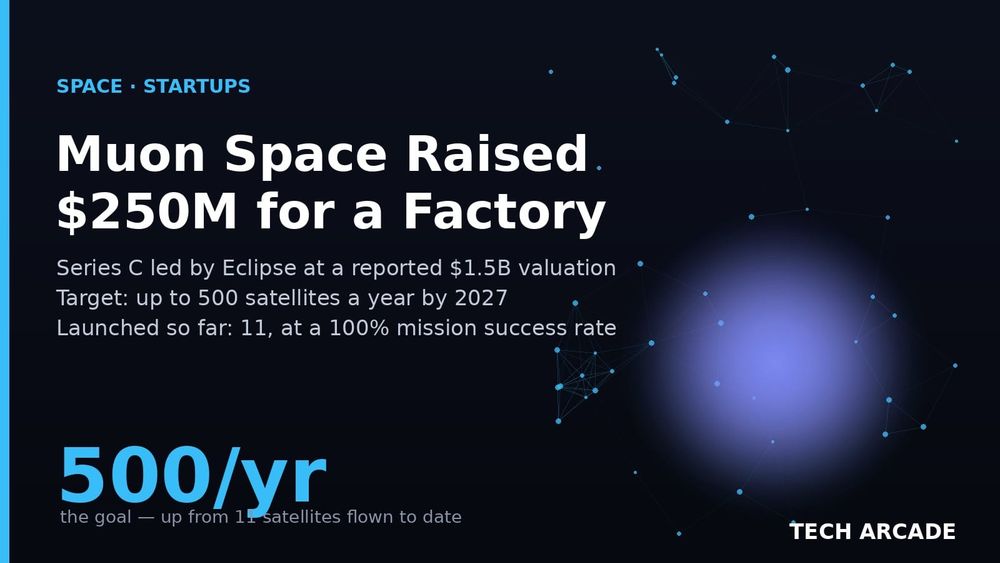

A satellite maker in Mountain View just told the market it plans to build 500 spacecraft a year. To date, it has put exactly 11 in orbit. Investors handed it a quarter of a billion dollars anyway.
Muon Space closed a $250 million Series C this week, led by Eclipse, at a reported $1.5 billion valuation (SpaceNews; SiliconANGLE). That single round is bigger than every dollar the company had raised in its life before it — total equity funding now sits above $386 million (Muon Space).
The pitch behind the check is a factory. Muon isn't selling one clever satellite; it's selling the ability to stamp out constellations on an assembly line, the way a foundry stamps out chips. The bet is that the next decade of space runs on manufacturing, not moonshots.
🧠 Why This Matters
For most of the space age, a satellite was a bespoke object — years of design, one launch, hold your breath. Muon is trying to kill that model. Its CEO, Jonny Dyer, ran engineering at Skybox Imaging, the smallsat startup Google bought for $500 million in 2014 (TechFundingNews). He's been building toward this exact idea for more than a decade.
"Space infrastructure needs to scale the way cloud infrastructure did. We've built the Mission Foundry to help customers deploy complete constellation systems in months instead of years." — Jonny Dyer, CEO, Muon Space
The money says the market believes him. New backers on the cap table include Google, Salesforce Ventures, Wellington Management, and infrastructure investor I Squared Capital, alongside lead Eclipse (Muon Space). When Wellington and a hard-asset fund show up next to a Google, you're no longer a science project — you're being priced like infrastructure.
📊 Deep Dive
Here's what the $250 million is actually buying. Muon runs a 148,000-square-foot plant in San Jose and wants it churning out up to 500 satellites a year by 2027. It employs 272 people today and plans to grow past that (TechFundingNews). The order book is the interesting part: management describes a sales pipeline "quite a bit above $10 billion," with 50+ satellites in development and 13 already booked to launch inside the next year (SiliconANGLE).
The flagship program is FireSat, a wildfire-detection constellation built with Google.org and the Earth Fire Alliance. It was named one of TIME's Best Inventions of 2025, and the first three operational satellites went up in July (TechFundingNews). Muon also builds for Sierra Nevada Corporation's Vindlér RF program, Hubble Network's Bluetooth-tracking satellites, and works with NASA and NOAA.
How the deal stacks up:
- Round size: $250M Series C — larger than Muon's entire prior fundraising history combined ($386M total to date).
- Valuation: ~$1.5B, per multiple reports (Reuters via Yahoo Finance).
- Track record: 11 satellites launched across six missions, 7 of them in the first half of 2026, at a stated 100% mission success rate.
- The gap: a target of 500 units a year — a roughly 45x jump over everything it has flown so far.
- Backing: Eclipse (lead), plus Google, Salesforce Ventures, Wellington, I Squared, Woven Capital and returning investors including Radical Ventures and Congruent.
⚠️ The Catch
That 45x gap is the whole story, and it cuts both ways. Building 11 satellites carefully is a very different discipline from building 500 repeatably, on schedule, without the yield problems that haunt any factory ramp. The $1.5 billion price tag is reported by outlets citing sources rather than confirmed line-by-line by the company (Reuters via Yahoo Finance), so treat the exact figure as an estimate.
And revenue is the number nobody is publishing. A $10 billion-plus pipeline is a pipeline, not a bank statement — booked, contracted, and delivered are three separate things in this business. Dyer himself splashed cold water on the exit talk, saying an IPO is "unlikely in 2027 without clearer revenue visibility" (SiliconANGLE). When the CEO is the one lowering expectations, listen.
🎯 What Happens Next
The near-term scoreboard is concrete. Watch whether those 13 manifested satellites actually fly on time over the next 12 months, and whether the San Jose line hits meaningful throughput in 2027 rather than slipping to 2028. FireSat's build-out — the Earth Fire Alliance wants dozens of satellites watching for wildfires globally — is the most visible proof point, and every fire season now doubles as a live demo.
The other thing to watch is the customer mix. Commercial work currently outweighs government contracts, but management expects government demand to grow and the split to move toward 50/50 (Tech Startups). Defense budgets are where the durable money is, and that's the balance investors will be tracking.
🧩 Bigger Picture
Muon is one entry in a crowded field. It competes with the likes of Loft Orbital and Lockheed Martin's Terran Orbital for the "we'll build and fly your constellation" business, while imaging players and the broader launch boom keep pushing the cost of getting to orbit down. Robotics and space startups have pulled in roughly $23 billion in 2026, near the full-year total for all of 2025 (Briefs.co) — capital is not the constraint right now. Execution is.
The genuinely new idea here isn't a satellite. It's the framing of orbit as a utility you rent by the constellation, provisioned in months, the same mental model that turned server rooms into cloud regions. If Muon's factory works, the company that wins space this decade may look less like a rocket builder and more like a contract manufacturer with a very good order book.
Five hundred satellites a year is either the boldest number in orbit right now or an expensive way to learn how hard factories are. Muon has 12 months and one very busy assembly line to tell us which.
Sources
- SpaceNews — Muon Space raises $250 million to ramp up satellite production
- SiliconANGLE — Muon Space raises $250M at $1.5B valuation to scale satellite output
- TechFundingNews — Muon Space lands $250M to build 500 satellites a year
- Muon Space — Company press release (Series C)
- Reuters via Yahoo Finance — Satellite maker Muon Space valued at $1.5 billion, source says
- Tech Startups — Muon Space raises $250 million at $1.5 billion valuation
- Briefs.co — Robotics startups raised $23B in 2026