
Five years ago, Astra Space was a stock-market darling with a rocket, a ticker symbol, and a pitch about launching so often it would feel like catching a bus. Then the rockets kept falling out of the sky, the stock cratered, and the whole thing got bought back by its own founders for pocket change.
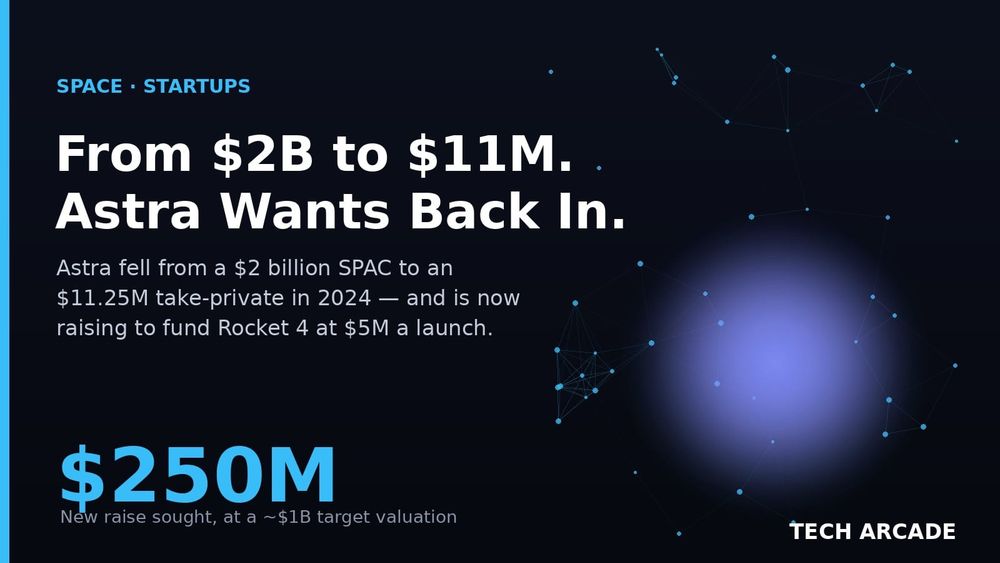
Let's get the number on the table first: $250 million. That's what Astra is now trying to raise, at a target valuation of roughly $1 billion, with the round expected to close this quarter (Reuters).
Here's why that number is wild. In 2021, Astra went public through a SPAC at a valuation north of $2 billion. In 2024, its founders took it private again for $11.25 million — roughly a 99.5% haircut (Reuters). So the company that cratered to eight figures now wants a valuation with ten digits again.
The comeback isn't built on hype this time — it's built on the boring business that kept the lights on.
🧠 Why This Matters
Astra is the clearest test yet of a question hanging over the whole small-launch industry: can a company that failed publicly and expensively come back on fundamentals instead of vibes?
Most SPAC-era space names either quietly died or are still burning cash with nothing flying. Astra took the more unusual route — it went private, shed the quarterly-earnings circus, and rebuilt around a part of the business nobody was paying attention to: little engines that steer satellites once they're in orbit.
That propulsion unit is now the thing carrying the story. Astra says it shipped 110 satellite engine systems since the start of 2025, hitting the 100-unit mark in just nine months, with what it describes as 100% mission reliability so far (Astra). Dull hardware, steady revenue. It's the opposite of the "watch us launch every week" swagger that got the company in trouble the first time.
📊 Deep Dive
The reason investors are even taking the call is that the numbers finally point up and to the right. Astra's engine business closed $13 million in new contracts in the fourth quarter of 2025 alone, covering 36 more systems slated for delivery in 2026 (Astra). For a company that used to measure success in explosions, "backlog" is a nice word to be using.
Here's the arc in six numbers:
- 2021 IPO valuation: more than $2 billion
- 2024 take-private price: $11.25 million
- 2025 raise: $80 million (spent largely on legal costs, shareholder settlements, and refinancing)
- 2025 revenue: about $45 million, up roughly 700% year over year — with breakeven EBITDA
- Now seeking: $250 million at ~$1 billion
- Rocket 4 target: about $5 million per launch, first orbital flight in 2027
The revenue jump — a forecast $45 million for 2025, roughly seven times the prior year, alongside its first breakeven EBITDA — is the line that turns a rescue story into a growth story (Astra). Co-founder and CEO Chris Kemp, who built the company with aerospace engineer Adam London and runs it out of Alameda, California with roughly 100 employees, has been leaning hard on that industrial angle.
"Shipping 100 systems in nine months proves we can industrialize space-qualified hardware with reliability and repeatability." — Chris Kemp, founder and CEO, Astra (Astra)
The $250 million is meant to fund the harder half: Rocket 4, a bigger expendable vehicle Astra is pitching at roughly $5 million a launch for fast, cheap satellite deployment — the kind of rapid-launch capability the U.S. military keeps saying it wants. A test flight is targeted for 2026, with operational launches from 2027 (American Bazaar).
⚠️ The Catch
That $250 million isn't in the bank. It's a round Astra is trying to raise, advised by Nasdaq Private Markets and Siebert, with no lead investor disclosed yet (Reuters). Announcing a target valuation and hitting it are very different things.
And the launch record is the elephant in the clean room. Astra's earlier rocket reached orbit just twice in six attempts (Reuters). Rocket 4 is a fresh design meant to fix that, but it has not flown. So investors are being asked to pay a billion-dollar price partly for a vehicle whose whole selling point — that it works — is still unproven.
There's also a mismatch worth naming: the profitable, growing part of Astra is the engines. The part that needs $250 million and carries the real risk is the rocket. If Rocket 4 slips or fails, you're left with a solid propulsion business wearing a launch-company valuation.
🎯 What Happens Next
Two milestones decide this story. The first is whether the round actually closes at or near $1 billion this quarter. The second, and bigger one, is that 2026 Rocket 4 test flight. Astra says the design is roughly 75% done on the first stage and past 90% on the upper stage, with dozens of engine test campaigns already run (Astra).
A clean test flight would validate the entire pitch and probably make the $250 million look cheap. Another failure would drag the whole comeback right back to where it started — except this time the money would be private, and quieter.
🧩 Bigger Picture
Astra is a live experiment in whether going private is a graveyard or a workshop. Plenty of SPAC casualties used the delisting to disappear. Astra used it to strip out the noise, grow a real product line to breakeven, and come back asking for capital on the strength of shipped units rather than slideware.
If it works, expect other beaten-down space and hardware names to study the playbook: go dark, fix the business, then re-raise once the numbers can do the talking. If it doesn't, it'll stand as the definitive lesson that in launch, valuation is just a promise you make to gravity — and gravity always collects.
Astra spent a billion dollars of credibility learning that rockets don't care about your ticker symbol. Now it wants a billion-dollar valuation to prove it finally listened.
Sources