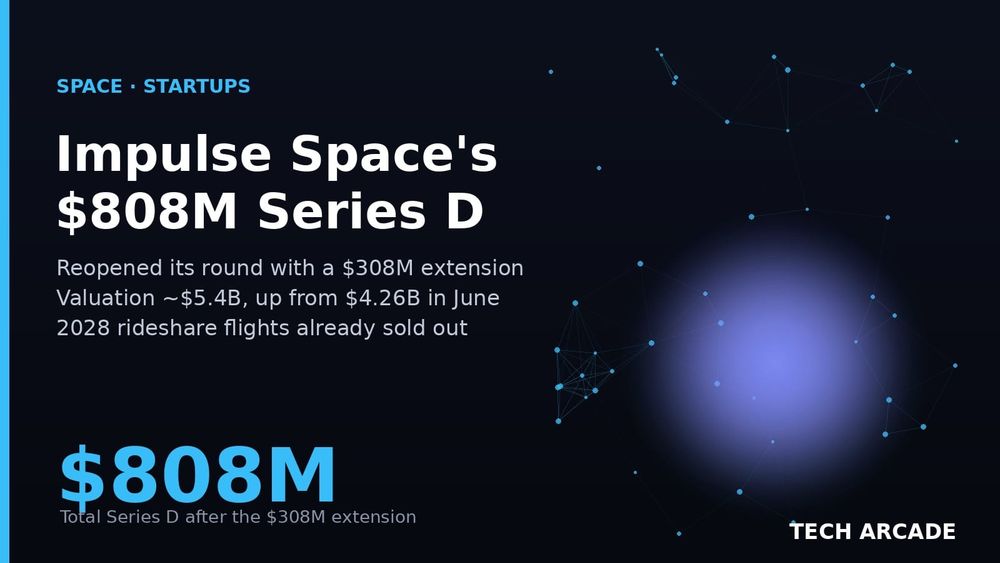

Three months ago, Impulse Space closed a $500 million Series D and called it a day. It wasn't. On September 16, the company tacked another $308 million onto the same round, dragging the Series D up to $808 million and its valuation from $4.26 billion in June to roughly $5.4 billion now (Payload).
That's a company re-opening a funding round mid-flight because the order book got too heavy to carry on the cash it already had. The extension was oversubscribed. The manifest, by the company's own account, is full.
Here's the number that actually explains the raise: Impulse's 2028 rideshare flights are already sold out (Reuters). When you've booked spacecraft that don't fly for two more years, capital stops being optional. Impulse isn't raising to find demand — it's raising to catch up to it.
🧠 Why This Matters
Everyone obsesses over the rocket that gets you to orbit. Almost nobody thinks about what happens after the fairing opens — and that gap is exactly the business Impulse is building.
Getting to low Earth orbit is close to a commodity now; a Falcon 9 rideshare seat is a line item. But a satellite dropped in LEO often needs to be somewhere else entirely — a higher orbit, a specific slot, the Moon. Moving it there is slow, fuel-hungry, and historically an afterthought. Impulse makes the tugs and kick stages that do that last leg, what founder Tom Mueller likes to call the "last mile" of space.
Mueller isn't a random founder, either. He was SpaceX's first employee and the propulsion engineer behind the Merlin engines that make the Falcon 9 go (Benzinga). When the person who designed a generation of rocket engines says the money is going into manufacturing and hiring, investors tend to listen.
📊 Deep Dive
Impulse runs a two-vehicle fleet, and the $308 million is meant to scale both.
Mira is the workhorse: a small, flight-proven maneuvering spacecraft that shuttles and positions payloads and has already flown. Helios is the muscle: a high-energy kick stage built around the company's Deneb engine, designed to haul payloads from LEO all the way to medium and geostationary orbit, and onward to lunar and planetary destinations (GlobeNewswire).
How this round stacks up against the company's own history:
- Series B (2023): $150 million (Impulse Space)
- Series C: $300 million
- Series D — initial (June 2026): $500 million at a $4.26 billion valuation (Reuters)
- Series D extension (September 2026): +$308 million, round now $808 million, valuation ~$5.4 billion (Payload)
The customers behind that backlog are real names, not slideware. Helios was selected as the first upper-stage prime under the Space Force's NSSL Phase 3 Lane 1 program — a big deal for a company whose kick stage hasn't flown yet. Mira picked up a $28 million contract extension from Space Systems Command for the VICTUS SALO 2 and 3 missions. Commercial operators Astranis and SES are lined up as early Helios customers, and Impulse has an interceptor partnership with defense contractor Anduril (Payload).
"We're really full on our manifest for Helios. So now we need to deliver on that for those customers." — Eric Romo, President & COO, Impulse Space (Reuters)
The company is staffing up hard to match — more than 600 employees and over 180 open roles, per Reuters — and just hired its first-ever CFO, Adam Townsend, formerly of VIZIO. Hiring a finance chief is the kind of quiet signal that a startup is thinking about what comes after the next round.
⚠️ The Catch
A sold-out manifest is a promise, and promises in aerospace have a way of slipping. Helios hasn't flown yet. The Deneb engine, the NSSL prime slot, the Astranis and SES flights — all of it rides on a vehicle that still has to prove it works in space, on schedule.
Booking 2028 flights is great for the balance sheet. It also means every delay now compounds into a customer waiting years for a ride they've already paid to reserve. The extension exists precisely because the company needs cash to build fast enough to keep those dates — which is another way of saying the schedule is tight enough to need $308 million of insurance against it.
And the valuation math is aggressive: a 27% markup in three months, on a company whose flagship product is still pre-flight. That's a bet on execution, priced as if the execution is already done.
🎯 What Happens Next
Watch the Helios first flight. That single milestone converts a backlog of reservations into a business — or turns a $5.4 billion valuation into a very awkward conversation. The Caravan 2 and Caravan 3 rideshare missions are targeted for 2028 and already booked, so the runway to prove the vehicle is measured in months of build, not years of runway.
Watch the hiring, too. Filling 180-plus roles while standing up a new manufacturing tempo is its own kind of engineering problem, and the fresh CFO suggests Impulse is bracing for the operational grind of becoming a real spacecraft factory rather than a demo shop.
🧩 Bigger Picture
The space economy spent a decade solving launch. Rides to orbit got cheap and frequent, and a whole layer of the market — in-space logistics — got left behind, because there was no point building tugs when getting to orbit was the hard part. That's flipped. Now the bottleneck is what you do once you're up there.
Impulse is one of a handful of companies betting that "in-space mobility" becomes its own infrastructure category, the orbital equivalent of trucking and last-mile delivery. The $808 million round is the clearest sign yet that investors think the plumbing of space — the boring, essential business of moving things from one orbit to another — is where the next durable margins live.
Reserving a spacecraft two years out used to sound like science fiction. Now it's a sold-out flight — and the company selling the tickets just raised $308 million because it can't build them fast enough.
Sources
- Impulse Space announcement — $308M Series D extension (GlobeNewswire, Sept 16, 2026)
- Impulse Space's Series D round grows to $808 million as backlog expands (Reuters via Yahoo Finance, Sept 16, 2026)
- Impulse Space Raises $308M Series D Extension (Payload)
- Tom Mueller's Impulse Space lands $500M round (Benzinga, June 2026)
- Impulse Space Series B — $150M (Impulse Space)