

Most brain-computer interfaces start with a drill. The pitch has always been the same: to read a brain well enough to do something useful, you have to get past the skull and into the tissue. Elon Musk's Neuralink threads flexible electrodes directly into the cortex. Precision Neuroscience wants you to believe you can skip that part entirely.
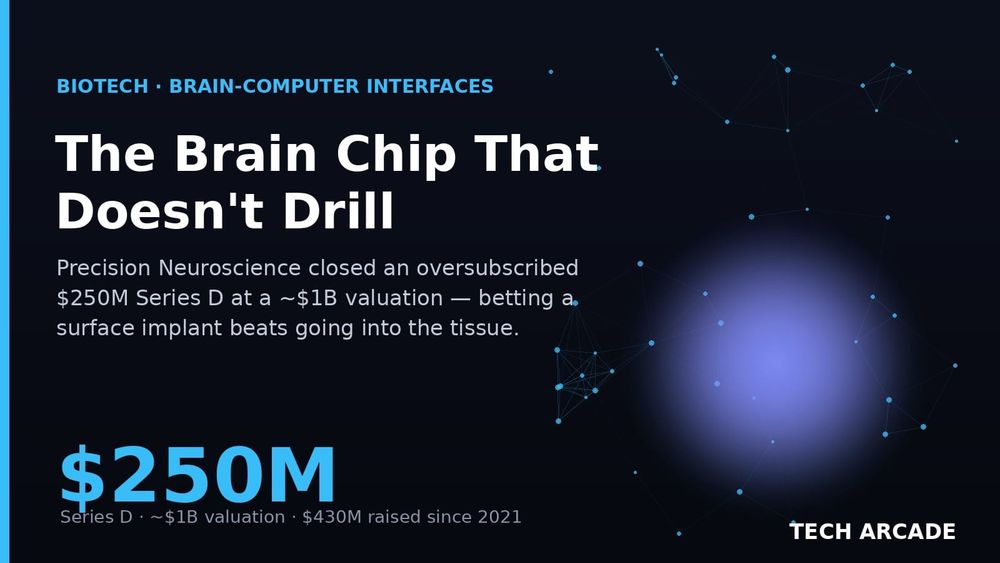
Let's get the number on the table first: $250 million. That's the oversubscribed Series D that Precision Neuroscience closed on September 24, led by Bill Ackman's Pershing Square Inc., the Ackman Oxman Institute, and an undisclosed life sciences fund ($250M raise (GlobeNewswire)). The round values the company at just over $1 billion and pushes its total funding to $430 million since it launched in 2021 (TechFundingNews).
The device that money is chasing is a film called the Layer 7 Cortical Interface — postage-stamp-sized, thinner than a human hair, packed with more than a thousand microelectrodes. Instead of penetrating the brain, it rests on the surface (MedTech Dive).
Here's the thesis: in a field obsessed with going deeper, the company betting on staying on top just raised a quarter of a billion dollars.
🧠 Why This Matters
Brain-computer interfaces have spent a decade stuck between two extremes. The invasive camp gets rich, high-fidelity signals by putting electrodes inside neural tissue — great data, real surgical risk, and implants that are difficult to remove. The non-invasive camp (think caps and headsets) is safe but reads brain activity through the skull, which is like trying to follow a conversation through a wall.
Precision is trying to live in the gap. Its array slides in through a micro-slit incision, sits on the cortex, and comes back out — no threads buried in tissue. And unlike most of its rivals, it already has a regulatory foothold: the company secured FDA 510(k) clearance last year for the Layer 7 interface, authorized for implantation of up to 30 days and cleared for uses including intraoperative brain mapping (MobiHealthNews).
That clearance is the whole game. It's the difference between a science project and a product a surgeon can actually use on a patient today.
📊 Deep Dive
Precision was co-founded by Michael Mager and Benjamin Rapoport — and Rapoport was a founding member of Neuralink before he left. So this isn't an outsider taking potshots at Musk's company; it's a co-architect of the invasive approach deciding the surface is the better bet. The company now runs its own MEMS manufacturing facility in Texas out of a New York headquarters, and says its device has been used in more than 100 procedures across 18 major medical institutions (GlobeNewswire).
How the two leading approaches stack up:
- Placement: Precision's array rests on the cortical surface; Neuralink threads electrodes into brain tissue (MedTech Dive).
- Reversibility: Precision's film goes in through a micro-slit and can be removed; Neuralink's threaded implant is designed to stay.
- Regulatory status: Precision holds FDA 510(k) clearance for up to 30-day use; Neuralink is still operating through investigational clinical trials.
- Money: Precision has raised $430M total at a ~$1B valuation; Neuralink raised $650M in June 2025 at a reported ~$9 billion pre-money valuation (SiliconANGLE).
- Traction: Precision cites 100+ procedures at 18 sites; the array carries over a thousand microelectrodes on a strip thinner than a hair.
Precision also has a distribution story most startups can only dream about: a partnership with Medtronic to fold its interface into an existing neurosurgical platform, which puts the technology inside operating rooms Medtronic already supplies (MedTech Dive).
"The next phase of BCI will be defined by more than technology alone. We have built the clinical network, regulatory position, and manufacturing base that leadership in this field requires." — Michael Mager, co-founder and CEO, Precision Neuroscience (MobiHealthNews)
⚠️ The Catch
Staying on the surface has a cost, and it's physical. Electrodes that sit above the cortex read a blurrier signal than electrodes threaded into it — you're picking up the sum of a lot of neurons rather than eavesdropping on individuals. For coarse tasks like moving a cursor or mapping regions during surgery, that can be plenty. For the sci-fi end of the spectrum — high-bandwidth typing, restoring fine motor control — the physics get harder the further you are from the source.
Then there's the clearance itself. A 30-day authorization for intraoperative use is a real milestone, but it is not the same as a permanent implant you live with for years. The gap between "cleared for a month in an operating room" and "cleared for life" is where most of the remaining risk sits, and closing it means longer trials, more patients, and more money.
And a $1 billion valuation next to Neuralink's ~$9 billion cuts both ways. Precision is either steeply undervalued or a reminder of how much further ahead the invasive camp's hype cycle is. The $250M has to answer that.
🎯 What Happens Next
Watch three things. First, whether Precision can convert 30-day surgical clearance into a longer-term implant pathway — that's the leap from tool to therapy. Second, the Medtronic partnership: if the interface starts showing up in routine neurosurgery, adoption could compound quietly while everyone stares at Neuralink. Third, talent and credibility signals — the company just added Dr. John Donoghue, the founder of the pioneering BrainGate program and a 2026 Queen Elizabeth Prize for Engineering laureate, as a scientific advisor (GlobeNewswire).
🧩 Bigger Picture
The money tells you the category has arrived. BCI funding has surged across the board in 2026, and Precision's raise lands in the same stretch that saw other neurotech companies pull in nine-figure rounds. Investors have stopped treating brain interfaces as a decade-away moonshot and started pricing them as a market with near-term products.
"Neurotechnology will be central to the next generation of cures, treatments, and rehabilitation." — Bill Ackman, CEO of Pershing Square and co-founder of the Ackman Oxman Institute (GlobeNewswire)
The deeper question Precision is forcing is a design one: how much brain do you actually need to touch to be useful? Neuralink's answer is "as much as it takes." Precision's answer is "as little as possible." For the next few years, both companies get to be right at once — and the surgeons, not the founders, will decide which answer scales.
The drill made brain-computer interfaces famous. Precision is betting the next $250 million goes to the company that learned to leave it in the drawer.
Sources
- Precision Neuroscience Series D press release — GlobeNewswire (Sept 24, 2026)
- Precision Neuroscience raises $250M for brain-computer interface work — MedTech Dive
- Precision Neuroscience raises $250M for brain-computer interface — MobiHealthNews
- Neuralink alum's Precision Neuroscience raises $250M — TechFundingNews
- Neuralink raises $650M at reported $9B pre-money valuation — SiliconANGLE