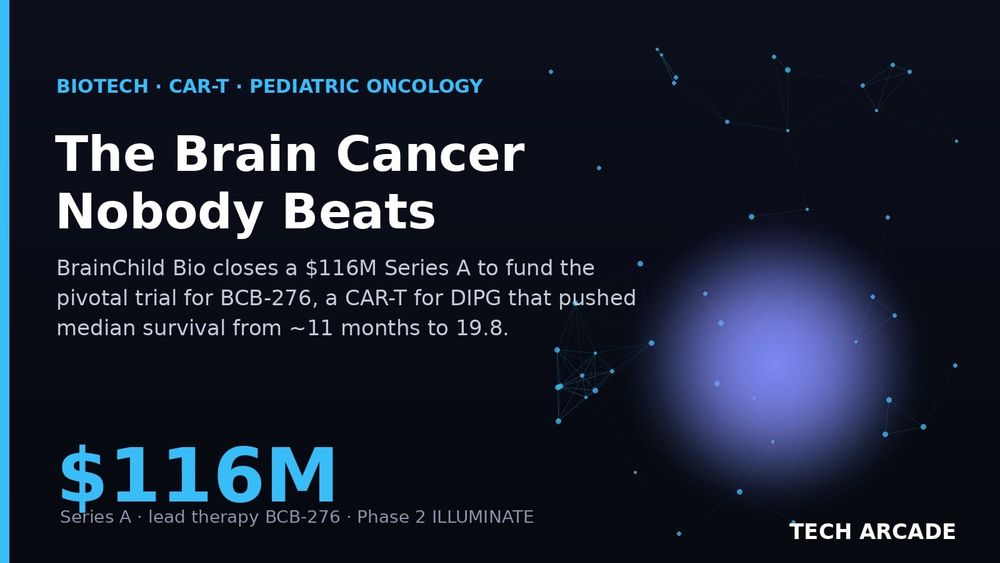

Let's get the number on the table first: 19.8 months.
That's the median survival, measured from diagnosis, for a small group of children who got an experimental CAR-T therapy for diffuse intrinsic pontine glioma — DIPG, a brain-stem tumor that has an ugly reputation for killing every child it touches. The standard of care, radiation, buys them about 11 months. Three of the treated kids are still alive at 44.6, 45.6, and 52.5 months.
On September 8, the Seattle startup built around that therapy, BrainChild Bio, closed a $116 million Series A ([GEN](https://www.genengnews.com/topics/cancer/with-116m-in-series-a-financing-brainchild-bio-targets-cns-tumors-starting-with-one-in-childrens-brainstems/)) to run the trial that could turn a research result into an actual approved drug.
Here's the thesis: DIPG has broken 50 years of clinical trials without a single win — and for the first time, a therapy has moved the survival number far enough that investors are willing to write a nine-figure check on it.
🧠 Why This Matters
DIPG is about as bad as pediatric oncology gets. Roughly 300 children in the U.S. are diagnosed each year, most between ages 5 and 10 ([BrainChild Bio](https://www.globenewswire.com/news-release/2026/09/08/3357486/0/en/brainchild-bio-closes-116-million-series-a-financing.html)). The tumor grows in the pons, the part of the brain stem that runs breathing and heartbeat, which means you can't cut it out — surgery there is a non-starter. Radiation shrinks it for a few months, then it comes back, and it wins. The disease has been called "uniformly fatal," and the word is not marketing.
What makes this raise notable isn't the size — it's where the money is going. Cell therapies like CAR-T rewired the treatment of blood cancers, but they've mostly bounced off solid tumors, and the brain has been especially hostile territory. A result that pushes DIPG survival from 11 months to nearly 20, published in Nature Medicine, is the kind of data that makes a family fund and a hospital's own investment arm put real capital behind it.
"In 50 years of clinical trials for DIPG, no drug had ever changed the 11-month overall survival mark before." — the framing behind the company's Phase 1 data
📊 Deep Dive
The drug is BCB-276, an autologous CAR-T — meaning it's made from each patient's own T cells — engineered to hunt a protein called B7-H3 that sits on the surface of these tumors. The clever part is delivery. Instead of an IV drip and hoping the cells cross the blood-brain barrier, doctors inject BCB-276 directly into the cerebrospinal fluid through an in-dwelling catheter, dosing the tumor's own neighborhood ([BrainChild Bio](https://www.globenewswire.com/news-release/2026/09/08/3357486/0/en/brainchild-bio-closes-116-million-series-a-financing.html)).
The Phase 1 trial, BrainChild-03, treated 21 of 23 enrolled DIPG patients. Here's how the numbers stack up:
- Median survival, radiation alone: ~11 months from diagnosis
- Median survival, BCB-276: 19.8 months from diagnosis ([Nature Medicine](https://www.nature.com/articles/s41591-024-03451-3))
- Long-term survivors: three patients alive at 44.6, 45.6, and 52.5 months
- Most common side effects: headache and nausea/vomiting (81% each), fatigue (62%), fever (57%)
- Serious safety events: one grade-4 intratumoral hemorrhage; notably, no cases of the neurotoxicity syndrome (ICANS) that dogs many CAR-T therapies
Behind the science is a familiar Seattle pedigree. BrainChild Bio spun out of Seattle Children's in December 2023, founded by longtime cell-therapy researcher Michael Jensen, MD, with Steven Brugger as CEO ([BioSpace](https://www.biospace.com/business/brainchild-bio-targets-deadly-brain-cancer-in-children-with-116m-series-a)). The $116M round was led by an undisclosed private family fund and foundation, with Seattle Children's and WRF Capital, the Washington Research Foundation's investment arm, both participating.
"Our team at BrainChild Bio is steadfast in its commitment to harness CAR T cell technology in CNS tumors and we are uniquely positioned to do so." — Michael Jensen, MD, founder and chief scientific officer
⚠️ The Catch
Phase 1 trials are small, single-arm, and enroll patients who often skew healthier than the full population. Twenty-one kids is a signal, not proof. A median of 19.8 months is a real improvement — but most of those children still died, and DIPG has humbled plenty of therapies that looked promising in early data and then flattened out in a bigger trial.
There's also the CAR-T tax. Autologous cell therapies are made-to-order, one patient at a time, which makes them slow and expensive to manufacture. Approved CAR-T products for blood cancers routinely carry list prices in the hundreds of thousands of dollars, and delivering this one requires a neurosurgically placed catheter and specialized centers — not something every children's hospital can offer on day one. The FDA has granted BCB-276 Breakthrough Therapy and Fast Track designations, which speeds the review, but designations aren't approvals.
🎯 What Happens Next
The $116 million is earmarked for ILLUMINATE, a pivotal Phase 2 study — open-label, single-arm — that aims to enroll 75 newly diagnosed DIPG patients across six pediatric oncology centers, with topline data expected around 2028 ([BioSpace](https://www.biospace.com/business/brainchild-bio-targets-deadly-brain-cancer-in-children-with-116m-series-a)). Because there's no approved therapy to compare against, regulators may accept a single-arm trial measured against DIPG's grim historical survival — which is exactly why nailing down that ~11-month baseline matters so much.
If ILLUMINATE holds the Phase 1 signal, BrainChild Bio has a path to the first-ever approved drug for DIPG. And it isn't stopping at the brain stem: a second candidate, BCB-214, targets three tumor proteins at once and is aimed at glioblastoma, the aggressive adult brain cancer that has its own long graveyard of failed trials.
🧩 Bigger Picture
For years, the CAR-T story was a blood-cancer story. Reprogrammed T cells transformed leukemias and lymphomas, then hit a wall the moment they were asked to fight solid tumors, which hide better and sit in tissue that's hard to reach. DIPG, buried in the brain stem, was supposed to be one of the hardest walls of all.
A verified survival jump there — delivered straight into the spinal fluid, sidestepping the blood-brain barrier — is a data point that reaches well beyond one rare disease. It's a real-world test of whether CAR-T can work in the central nervous system at all. The $116 million says a serious set of investors now think the answer might be yes. The kids in ILLUMINATE will settle it.
Radiation gave these children 11 months. A trial that starts now will decide whether 20 becomes the floor instead of the ceiling.
Sources
- GEN — With $116M in Series A Financing, BrainChild Bio Targets CNS Tumors
- BioSpace — BrainChild Bio targets deadly pediatric brain cancer with $116M Series A
- BrainChild Bio — $116 Million Series A Financing (press release)
- Nature Medicine — Intracerebroventricular B7-H3-targeting CAR T cells for DIPG: a phase 1 trial
- BioPharm International — BrainChild Bio Raises $116 Million, Launches Pivotal DIPG CAR-T Trial