
Eli Lilly, the most valuable drug company on the planet, just wrote a very large check for a company that has never sold anything. No approved drug. No revenue. One experimental antibody that started its first human trial in December.
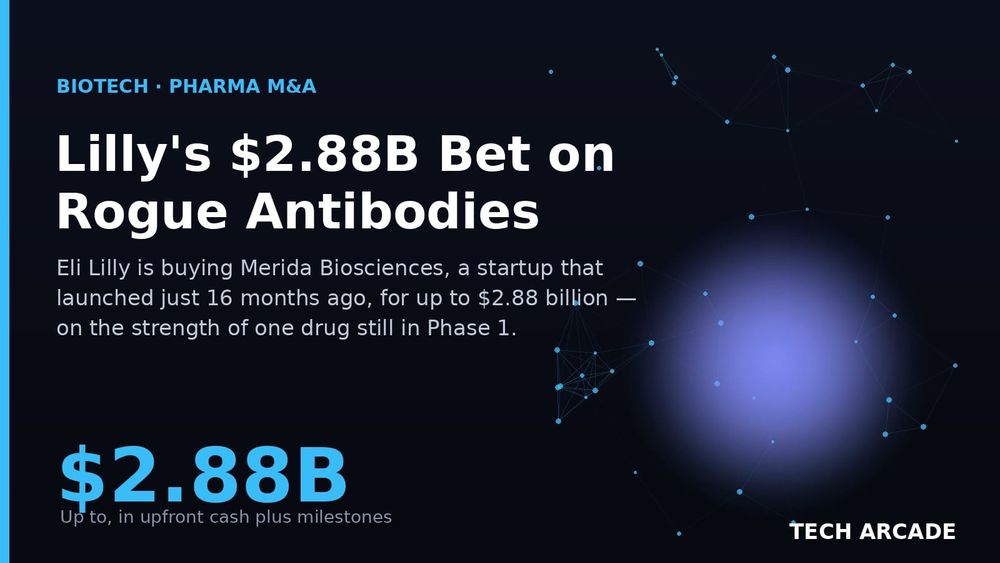
Let's get the number on the table first: up to $2.875 billion. That's what Lilly agreed to pay for Merida Biosciences, a startup that only came out of stealth in April 2025 with a $121 million Series A ($2.875B deal, $121M Series A — Fierce Biotech). Roughly sixteen months from launch to a nearly three-billion-dollar exit.
The deal is an upfront cash payment plus milestone payments tied to hitting development targets, so the full $2.875 billion only lands if Merida's science actually works ((GEN)). CNBC pegged the headline figure at $2.88 billion the day it broke on August 31 ((CNBC)).
Here's the thesis: Lilly is using its obesity billions to buy a shot at a smarter kind of autoimmune drug — one that deletes the specific antibodies causing a disease instead of dimming the whole immune system.
🧠 Why This Matters
Your immune system is supposed to attack invaders. In autoimmune disease, it turns on you — making autoantibodies that latch onto your own tissue. In Graves' disease, those rogue antibodies jam the thyroid's "on" switch, a receptor called TSHR, and the gland floods your body with hormone. Racing heart, weight loss, bulging eyes, the works.
The current playbook is blunt. You can poison the thyroid with antithyroid drugs like methimazole, destroy it with radioactive iodine, or cut it out. For the eye complications, there's teprotumumab (sold as Tepezza), which calms inflammation downstream. None of these remove the antibodies that started the fire. You're managing symptoms, often for life.
Merida's lead drug, MER511, goes after the arsonist directly. It's designed to selectively degrade the TSHR autoantibodies while leaving the rest of your immune system intact ((BioPharma Dive)). Lilly's immunology chief made the pitch plainly:
"Merida's lead program is designed to do exactly that: selectively and directly eliminating the autoantibodies causing Graves' disease and thyroid eye disease, while preserving normal immune function." — Francisco Ramírez-Valle, head of Lilly's immunology research and early clinical development
📊 Deep Dive
The market Merida is chasing is not small. Graves' disease affects roughly three million people in the U.S., and somewhere between 25% and 40% of them go on to develop thyroid eye disease ((GEN)). That's a large, chronic, underserved population — exactly the kind of base a Big Pharma likes to build a franchise on.
Here's how MER511's approach stacks up against what's on the shelf today:
- Antithyroid drugs (methimazole): block hormone production, but the autoantibodies keep coming — relapse is common when you stop.
- Radioactive iodine / surgery: destroy or remove the thyroid entirely, leaving most patients on hormone replacement for life.
- Teprotumumab (Tepezza): treats the eye inflammation of thyroid eye disease, downstream of the root cause.
- MER511 (Merida): aims to degrade the specific TSHR autoantibodies driving the disease, while sparing normal immunity.
And MER511 isn't the whole story. Merida also has MER769 for IgE-mediated allergic disease — think food allergy, asthma, chronic hives — plus a program in primary membranous nephropathy, a kidney condition ((Fierce Biotech)). The platform, not just one drug, is what Lilly paid for. If you can teach the body to hunt one rogue antibody, the same trick could work across a dozen diseases.
⚠️ The Catch
MER511 is in Phase 1. The trial only began in December 2025, and Phase 1 exists to answer one question: is the drug safe in humans at all ((BioPharma Dive)). It has not proven it treats Graves' disease. It has not run the large trials that decide whether regulators ever approve it. The early data showed "robust reductions" in thyroid-stimulating antibodies, which is encouraging — but a biomarker moving in a dish or a small trial is a long way from patients feeling better in the clinic.
Most drugs that enter Phase 1 never reach the market. That's why the deal is structured as an upfront payment plus milestones: Lilly is spreading its bet, paying the big money only if the science clears each hurdle. The $2.875 billion is a ceiling, not a guarantee.
🎯 What Happens Next
Watch the Graves' data. Merida needs to show MER511 doesn't just lower a lab value but actually restores normal thyroid function without wrecking the immune system — the whole selling point. Expect Lilly to push the program into larger, controlled trials and, if MER769 and the kidney program hold up, to treat the platform as a pipeline-in-a-box.
The bigger tell is Lilly's appetite. This was, by GEN's count, the company's 13th biotech acquisition of 2026 ((GEN)). A pharma buying at that clip is telling you where it thinks the next decade of growth lives.
🧩 Bigger Picture
Lilly became the world's most valuable drugmaker on the back of tirzepatide — Mounjaro for diabetes, Zepbound for obesity. That's a spectacular, and dangerous, place to be: one blockbuster franchise carrying the whole company. When patents expire and competitors pile in, concentration turns into risk.
So Lilly is doing what cash-rich incumbents do — spending the winnings to diversify before it has to. An analyst put the strategy bluntly:
"We see this acquisition as further evidence of mgmt's intent to diversify LLY's pipeline beyond obesity." — David Risinger, Leerink Partners
Zoom out and you see the pattern of this cycle: obesity money flowing into immunology, precision antibody science, and early-stage startups that can command billion-dollar price tags on the strength of a platform and a Phase 1 readout. It's the same reflex that's inflating AI valuations, just wearing a lab coat.
The risk is real, and so is the promise. If Merida's approach works, a lot of people who currently manage Graves' disease with a wrecked thyroid and a lifetime prescription might one day just delete the antibodies causing it.
Lilly didn't buy a drug. It bought a wager that the future of autoimmune medicine is a search-and-destroy mission — and it's willing to spend nearly three billion dollars to find out if it's right.
Sources
- Fierce Biotech — Eli Lilly inks $2.88B Merida buyout for autoimmune drugs against rogue antibodies
- BioPharma Dive — Lilly adds to immune drug pipeline with Merida buyout
- GEN — Lilly Looks Beyond Obesity With Up-to-$2.9B Acquisition of Merida Biosciences
- CNBC — Lilly to buy Merida Biosciences for up to $2.88 billion