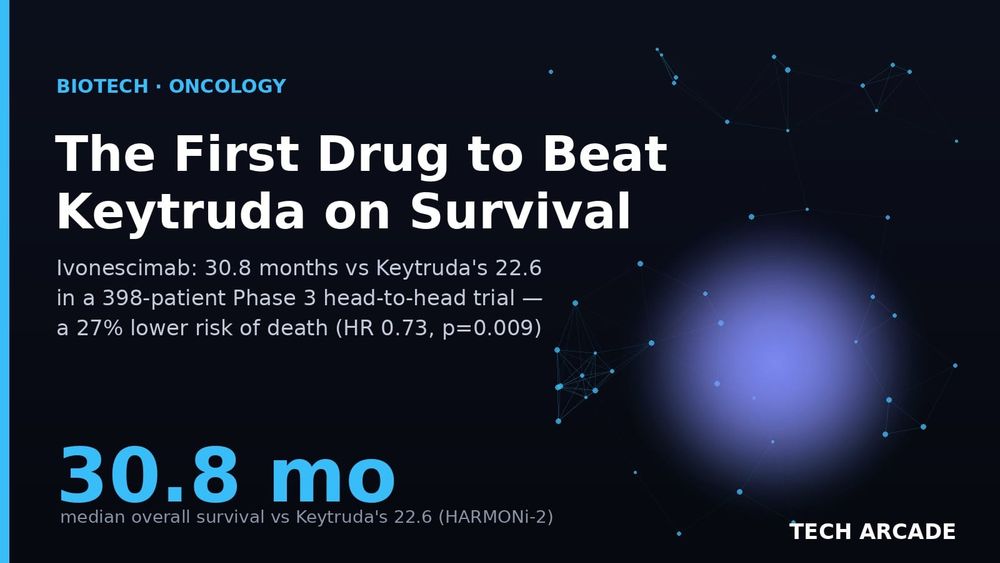

Let's get the number on the table first: 30.8 months versus 22.6 months. That's how long patients with advanced lung cancer lived on ivonescimab compared with Keytruda in a head-to-head Phase 3 trial — an 8.2-month gap in median overall survival, presented at the World Conference on Lung Cancer in Seoul (PRNewswire).
Keytruda is not a normal competitor to beat. Merck's cancer immunotherapy pulled in $31.7 billion in 2025, making it the single best-selling brand-name drug on the planet (Drug Discovery & Development). For a decade it has been the drug other cancer drugs are measured against. Plenty have matched it. Until now, in a first-line lung cancer trial, none had clearly beaten it on the metric that matters most — how long people actually live.
The drug that did it is ivonescimab, developed by China's Akeso and licensed outside China by Miami-based Summit Therapeutics. The thesis is simple: the ten-year Keytruda era just got its first genuine crack, and the data is hard to wave away.
🧠 Why This Matters
Keytruda works by taking the brakes off your immune system — it blocks a protein called PD-1 so your T-cells can see and attack the tumor. Ivonescimab is a bispecific antibody: it blocks PD-1 and VEGF, a second protein tumors use to grow their own blood supply, in a single molecule. The bet was that hitting two targets at once would beat hitting one.
The trial, called HARMONi-2 (AK112-303), enrolled 398 treatment-naïve patients with PD-L1-positive advanced non-small-cell lung cancer and pitted ivonescimab directly against Keytruda alone (FiercePharma). Two years ago the same trial showed ivonescimab nearly doubling the time before cancer got worse. The open question was whether that translated into people living longer. This week's answer: yes.
"We've become something of a bellwether for the entire PD-1xVEGF space." — Michelle Xia, CEO of Akeso (FiercePharma)
📊 Deep Dive
The overall-survival result cleared the bar with room to spare: a hazard ratio of 0.73 (95% CI 0.57–0.95), meaning a 27% lower risk of death, at a p-value of 0.009 — well past the threshold for statistical significance (Medical Xpress). The readout came from 234 death events at a 36-month median follow-up, presented by principal investigator Professor Caicun Zhou.
Here's how the two drugs stacked up:
- Median overall survival: ivonescimab 30.8 months vs. Keytruda 22.6 months
- Progression-free survival: 11.14 months vs. 5.82 months — hazard ratio 0.51, p<0.0001
- High PD-L1 patients (TPS ≥50%): 42% lower risk of death (HR 0.58)
- Lower PD-L1 patients (TPS 1–49%): 15% lower risk of death (HR 0.85)
- Squamous tumors: 35% lower risk of death (HR 0.65)
The progression-free survival number is the eye-catcher: patients went nearly twice as long before their cancer advanced. And the benefit held across subgroups, which is what regulators look for before they believe a result is real rather than a fluke of one lucky patient cluster.
⚠️ The Catch
Two big asterisks. First, HARMONi-2 was run entirely in Chinese patients. Western regulators will want to see the survival curves, the safety profile, and the subgroup consistency hold up in a broader population before they treat this as settled (talk.bio). Lung cancer biology and prior treatment patterns can differ across populations, so "beats Keytruda in China" is not automatically "beats Keytruda everywhere."
Second, the market's reaction was oddly cool. Summit's shares slid on the news rather than soaring — a classic sell-the-expectations move after a readout investors had already priced in, with attention snapping straight to the Western-applicability question (talk.bio). There are also safety signals worth watching with a VEGF-blocking drug: hypertension, bleeding, and immune-related toxicities. This is the fourth Phase 3 ivonescimab trial to hit its overall-survival endpoint, but confidence and a green light are not the same thing.
🎯 What Happens Next
The near-term catalyst is regulatory. The FDA has accepted Summit's application for ivonescimab plus chemotherapy in previously treated, EGFR-mutated non-squamous NSCLC, with a target decision date of November 14, 2026 (talk.bio). That's a narrower use than the first-line monotherapy win in HARMONi-2, but it would put the drug on the US market and give doctors real-world experience with it.
Watch for Merck's response, too. The maker of a $31.7 billion drug does not sit still. Expect fresh combination data and defense of Keytruda's dominance in the settings where it still leads — which is most of them, for now.
🧩 Bigger Picture
Summit paid to be here. In December 2022 it licensed ivonescimab rights outside China from Akeso for $500 million upfront and up to $5 billion in total payments (BioSpace). At the time, a half-billion-dollar bet on an unproven bispecific looked aggressive. A survival win over the best-selling drug in the world makes it look shrewd.
The wider signal is about the technology. PD-1-plus-VEGF bispecifics have moved from a lab curiosity to a category that could reshape first-line cancer treatment, and every major oncology player is now watching the space. Single-target checkpoint inhibitors defined the last decade of cancer care. The next fight is over whether two targets in one molecule can do better — and HARMONi-2 just put a real number on that question.
For patients staring down advanced lung cancer, the arithmetic is blunt and it is the whole point: eight extra months of median survival is eight months. That's the kind of number that outlasts a stock chart.
Sources
- HARMONi-2 overall survival results, presented at WCLC 2026 — PRNewswire
- Akeso, Summit's ivonescimab tops Keytruda in lung cancer survival — FiercePharma
- Ivonescimab significantly improves overall survival versus pembrolizumab — Medical Xpress
- Ivonescimab's Keytruda win raises the stakes for regulatory review — talk.bio
- Keytruda FY2025 revenue ($31.7B) — Drug Discovery & Development
- Summit–Akeso licensing deal (up to $5B) — BioSpace