
The man who convinced the world to stop paying for music just helped a five-year-old startup become the most valuable defense company Europe has ever venture-funded. And it doesn't make phones, chips, or ad software. It makes autonomous strike drones.
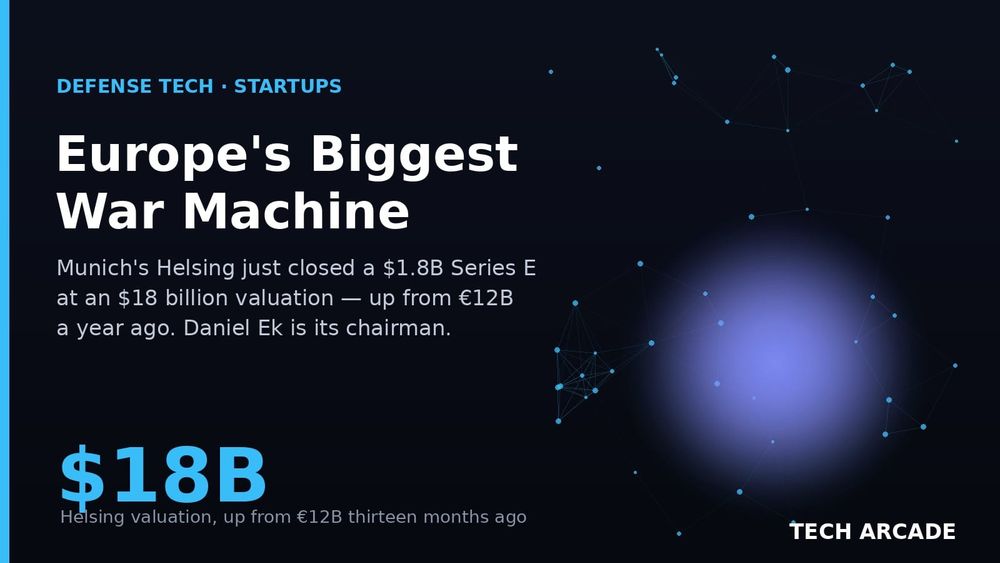
Let's get the number on the table first: $1.8 billion. That's the size of the Series E that Munich-based Helsing just closed, at an $18 billion valuation — a figure that vaults it past every other privately held defense-tech firm on the continent and lands it squarely in the same conversation as America's Anduril ($1.8B raise, $18B valuation ([DefenseNews](https://www.defensenews.com/global/europe/2026/07/13/helsing-raises-18-billion-in-europes-biggest-defense-startup-round/))).
Here's the part that should make you sit up: just thirteen months ago, in June 2025, Helsing was valued at €12 billion ([DefenseNews](https://www.defensenews.com/global/europe/2026/07/13/helsing-raises-18-billion-in-europes-biggest-defense-startup-round/)). It has now added roughly $5 billion in paper value in a little over a year — not by shipping a hit consumer gadget, but by building the software and hardware that a rearming Europe suddenly cannot buy fast enough.
The thesis: the hottest startup story in Europe is no longer a chatbot or a delivery app — it's a weapons company, and the money is voting with both hands.
🧠 Why This Matters
For a decade, "defense" was the sector venture capital wouldn't touch. Too slow, too political, too many ethics-committee headaches. Helsing just detonated that assumption. Its cap table now reads like a Davos guest list: Lightspeed, General Catalyst, Accel, Greenoaks, ICONIQ, JPMorgan Chase, Goldman Sachs, the Canada Pension Plan, and Daniel Ek's Prima Materia all wrote checks ([Tech.eu](https://tech.eu/2026/07/13/european-defence-ai-leader-helsing-secures-18b-series-e-at-18b-valuation/)).
That's not a niche defense fund topping up a favorite. That's mainstream, blue-chip capital deciding that European sovereignty is now an investable trend — and that the company writing the operating system for it is worth more than most of the continent's listed defense contractors.
This latest investment will accelerate Helsing's mission to develop and integrate entirely new AI platforms into the defense capabilities of its growing number of partner nations. — Helsing statement on the raise (Tech Startups)
📊 Deep Dive
Helsing was founded in 2021 by Torsten Reil, Dr. Gundbert Scherf, and Niklas Köhler ([Tech Startups](https://techstartups.com/2026/07/13/european-ai-defense-startup-helsing-raises-1-8-billion-at-18-billion-valuation/)). Reil's previous company made AI-driven animation for video games and Hollywood; now he builds the software that fuses drone, radar, satellite, and camera feeds into a single real-time picture of a battlefield. The pitch is that the decisive edge in modern war isn't a better missile — it's better software, and Helsing wants to be the layer everything else plugs into.
What sets this raise apart from your average AI megaround:
- The valuation curve: €12 billion (June 2025) → $18 billion (July 2026) — roughly a 50% step-up in thirteen months ([DefenseNews](https://www.defensenews.com/global/europe/2026/07/13/helsing-raises-18-billion-in-europes-biggest-defense-startup-round/)).
- The hardware is real: its HX-2 strike drone is in mass production, and Helsing has committed to building 6,000 of them for Ukraine ([Helsing](https://helsing.ai/newsroom/helsing-to-produce-6000-additional-strike-drones-for-ukraine)).
- The boardroom is stacked: co-chaired by Spotify's Daniel Ek and former Airbus CEO Tom Enders, with ex-NATO Supreme Allied Commander Gen. Denis Mercier as a director ([Tech.eu](https://tech.eu/2026/07/13/european-defence-ai-leader-helsing-secures-18b-series-e-at-18b-valuation/)).
- The comparison class: at $18B it now matches US rival Anduril's valuation — a stunning result for a company that's four years old.
The round was oversubscribed, meaning Helsing turned money away ([Tech.eu](https://tech.eu/2026/07/13/european-defence-ai-leader-helsing-secures-18b-series-e-at-18b-valuation/)). In a year when investors are agonizing over whether AI valuations have peaked, a European drone company had the luxury of picking its friends.
⚠️ The Catch
An $18 billion price tag on a company that was worth zero five years ago demands a hard question: is this durable, or is it a war premium?
Helsing's rise is inseparable from the moment. Europe is rearming at a pace unseen since the Cold War, Germany has torn up its debt brake to fund defense, and the war in Ukraine has turned cheap, smart drones into the single most-watched category in modern warfare. Those tailwinds are ferocious — and they are also, by definition, tied to conflict and political will that can shift.
There's execution risk, too. Fusing multi-source sensor data into reliable autonomy is genuinely hard, and a "software layer for war" only holds its premium if allied militaries actually standardize on it rather than build in-house or buy American. Helsing hasn't disclosed revenue, so public investors are, for now, buying the narrative as much as the numbers.
🎯 What Happens Next
Watch three things. First, contracts: the 6,000-drone Ukraine commitment is the proof point, and any expansion into new NATO members would validate the sovereignty thesis. Second, the IPO clock: at $18B with this investor roster, Helsing is now firmly on the shortlist of European tech companies that could actually go public and give the continent a homegrown defense-tech champion on its own exchanges. Third, the copycats: expect a wave of European founders to suddenly discover that defense is a respectable place to build.
🧩 Bigger Picture
Helsing is the clearest signal yet that the center of gravity in startup land is shifting from convenience to capability — from apps that shave a minute off your commute to systems that governments consider strategically vital. That's the same current pulling money into chips, energy, and now weapons.
It's also a very European story with a very Silicon Valley twist: the same Daniel Ek who spent a decade fighting to pay musicians as little as possible is now underwriting the software that could decide how the continent defends itself. Whether that makes you optimistic or uneasy, it's the trade of the year — and the market has already made up its mind.
Five years ago, "European defense unicorn" was an oxymoron. Today it's an $18 billion fact — and it flies.
Sources
- DefenseNews — Helsing raises $1.8 billion in Europe's biggest defense-startup round
- Tech.eu — Helsing secures $1.8B Series E at $18B valuation
- Tech Startups — European AI defense startup Helsing raises $1.8 billion at $18 billion valuation
- Axios — German defense company Helsing raises $1.8 billion
- Helsing — Helsing to produce 6,000 additional strike drones for Ukraine