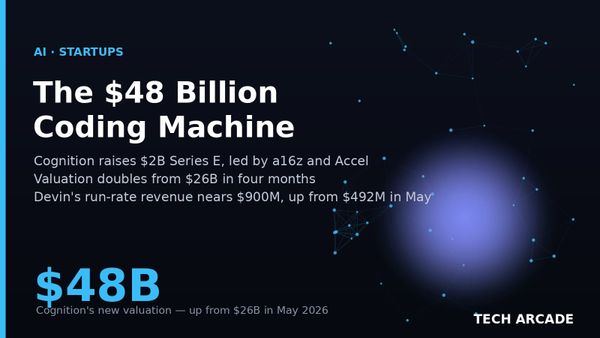
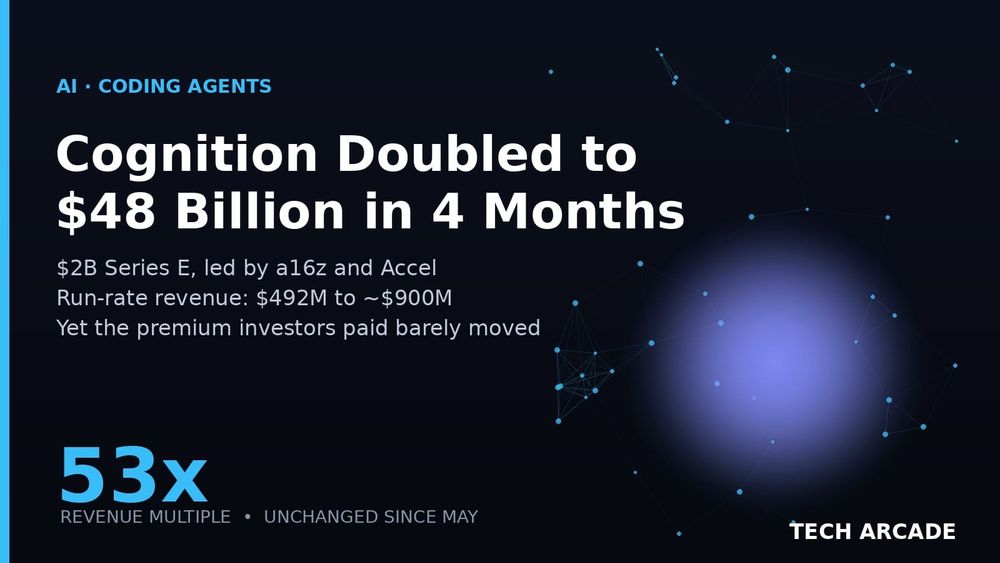

Four months ago, Cognition was worth $26 billion. This week, it's worth $48 billion. The startup behind Devin — the coding agent that writes, tests, and ships software while a human mostly supervises — just closed a $2 billion Series E, nearly doubling its price tag since May (TechCrunch).
Here's the figure that should make you sit up: its revenue multiple barely moved. In May, backers paid roughly 53 times run-rate revenue. In September, at nearly twice the valuation, they paid… roughly 53 times again (TheStreet).
That's not sloppy math. It's the whole point. Cognition's revenue grew fast enough to carry a doubled valuation while keeping the exact same premium. The market isn't saying the company got pricier. It's saying it got twice as big.
The valuations are going vertical, but the math underneath is holding oddly steady — and that's either the most reassuring or the most alarming thing about the AI-coding boom.
🧠 Why This Matters
Two years ago, "AI writes your code" meant autocomplete on caffeine. Cognition is selling something more ambitious: Devin, an agent meant to take a ticket, plan the work, write the code, run the tests, and open the pull request — with an engineer acting less like a typist and more like a manager.
Founded in 2024 by Scott Wu, Cognition has moved at a pace that's hard to process. It reached a $26 billion valuation in May 2026, bought the enterprise coding platform Windsurf, and now counts Citi and Mercedes-Benz among its customers (Tech Startups). The company frames the bet plainly:
"We started Cognition in 2024 to change that and build the future of software engineering. We believed engineers should operate more like architects and delegate execution to swarms of agents."— Cognition, in its funding announcement (Tech Startups)
When a company nearly doubles in value in a single business quarter, the reflex is to assume froth. The multiple says otherwise — which is exactly why this round is worth reading closely.
📊 Deep Dive
Line the two rounds up side by side and the pattern jumps out. Here's May versus September, four months apart:
- Valuation: $26B → $48B (up ~85%)
- Run-rate revenue: $492M → ~$900M (roughly doubled)
- Round size: $1B → $2B
- Revenue multiple: ~53x → ~53x (essentially flat)
- Elapsed time: four months
Run the arithmetic yourself: $26B on $492M is about 53x; $48B on $900M is about 53x. The valuation climbed because the revenue climbed, not because investors decided to pay a fatter premium (TheStreet).
The check-writers were not shy. The round was led by Andreessen Horowitz and Accel, with existing backers Founders Fund, General Catalyst, and Avenir returning, alongside a long bench that included Benchmark, Bessemer, Kleiner Perkins, Lightspeed, and T. Rowe Price (Unite.AI). Cognition has told investors it expects run-rate revenue to reach $4–5 billion by the end of 2026.
⚠️ The Catch
Start with the phrase doing the heavy lifting: run-rate revenue. That's a recent stretch of sales — often a single strong month — multiplied out to a full year. It is company-reported and unaudited, and a private company publishes whatever figure it chooses (Tech Startups). A number that annualizes your best stretch is not the same as a number that survives an auditor.
Then there's the burn. Cognition is estimated to be spending in the neighborhood of $800 million a year, a chunk of it on a leased Nvidia server cluster that reportedly costs hundreds of millions annually (TheStreet). And Nvidia sits on both sides of the table — investor and customer — which makes any single revenue line harder to read cleanly.
The 53x multiple "remains well above the 20-to-30-times range" that typically anchors AI startups — leaving Cognition exposed if run-rate revenue doesn't convert into audited annual revenue at scale.— TheStreet's analysis of the round (TheStreet)
A flat multiple is comforting only while the revenue that anchors it keeps compounding. The moment growth stalls, 53x stops looking disciplined and starts looking like a dare.
🎯 What Happens Next
The near-term test is whether that $4–5 billion year-end target actually lands. If it does, today's 53x quietly compresses into something the market can defend. If run-rate revenue plateaus around $900 million, the same number becomes the story's weak point.
Competition is the other variable, and it's fierce. In June, SpaceX acquired Cursor's parent, Anysphere, for $60 billion — a deal struck at roughly 15x revenue on around $4 billion of annualized sales (CNBC). That a rival commands a far lower multiple on far higher revenue is precisely the comparison skeptics keep circling.
🧩 Bigger Picture
The through-line investors seem to be drawing is that AI coding won't be winner-take-all. If it were, only one of these companies would be worth tens of billions. Instead, Cognition, Cursor, GitHub's Copilot, and a crowd of others are all being funded as if the pie is big enough to seat several giants (TechCrunch).
What makes this round genuinely useful to watch is the flat multiple itself. For once, a doubling isn't pure sentiment — it's tethered to a revenue figure that grew in lockstep. The catch is that the revenue figure is the one thing nobody outside the company can independently verify. Right now the market is treating $900 million of unaudited run-rate as if it were as solid as audited annual revenue. That assumption is the entire foundation under $48 billion.
Cognition didn't get more expensive this quarter. It just promised to be twice the company by Christmas — and $2 billion says the market believed it.
Sources
- TechCrunch — Cognition hits $48B valuation, signaling investors believe AI coding is far from a winner-take-all market
- TheStreet — Cognition AI's $48B round hides a flat revenue multiple
- Tech Startups — Cognition AI raises $2B at $48B valuation, nearly doubling its value in just four months
- Unite.AI — Cognition Raises Over $2B Series E at $48B Valuation to Scale Devin Agents
- CNBC — SpaceX to acquire the AI coding startup Cursor for $60 billion