
Every AI chip fight right now runs through one tiny, absurdly expensive component: high-bandwidth memory. It's the stuff stacked next to Nvidia's GPUs, it's in chronic short supply, and it's a big reason a single top-end AI server can cost as much as a house. A startup in Reno, Nevada just raised nearly a billion dollars on the bet that you don't actually need it.
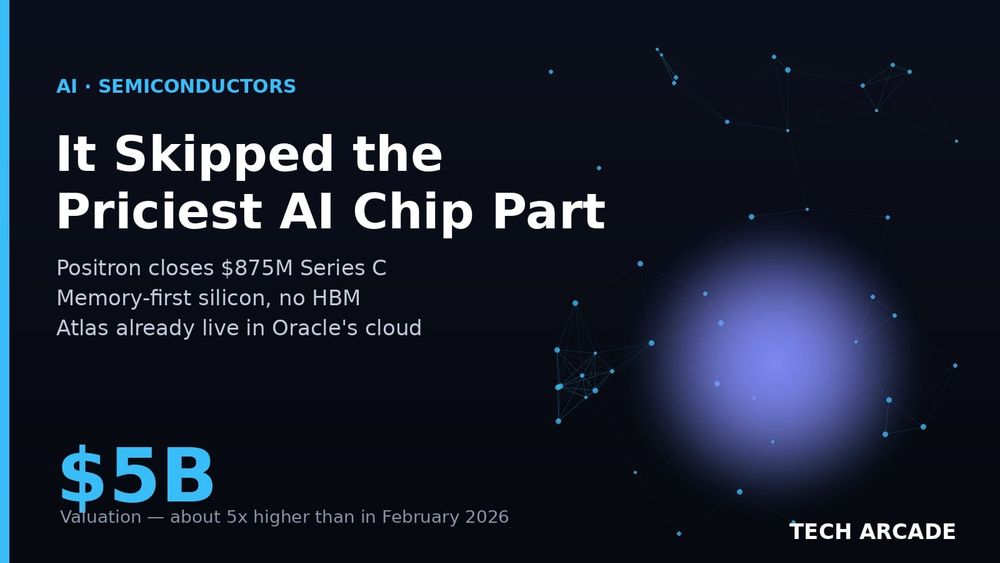
On September 10, Positron AI closed $875 million at a $5 billion valuation (PR Newswire). That's the number to sit with. In February the company was worth a little over $1 billion after a $230 million round (BusinessWire). Seven months later, investors have marked it up roughly five times.
What Positron sells isn't a faster GPU. It's a chip designed to skip the most contested part of the supply chain entirely — and to run AI models for a fraction of the electricity. The thesis in one line: the money in AI is quietly moving from training models to running them, and whoever runs them cheapest wins.
🧠 Why This Matters
Training a model is the flashy, one-time part. Inference — the chip actually answering your prompt — is the part that happens billions of times a day, forever. That's where the electricity bill lives, and it's the market Nvidia has near-total control of.
Positron is going straight at that bill. Its current chip, Atlas, ditches high-bandwidth memory (HBM) for LPDDR5X — the same broad family of memory that shows up in phones and laptops. It's cheaper, it's not rationed, and it sidesteps the packaging bottleneck (Nvidia's parts need TSMC's CoWoS advanced packaging, which is booked solid).
The company's own testing claims Atlas hits 280 tokens per second per user on Llama 3.1 8B inside a 2,000-watt power envelope, versus roughly 180 tokens for an Nvidia DGX H200 system drawing 5,900 watts — about three times the performance per watt and per dollar (Tom's Hardware). Hold onto that "own testing" — it matters later.
📊 Deep Dive
Positron was founded in 2023 and has climbed the funding ladder fast. The Series C actually came in two tranches — a $375 million round at a $3.5 billion pre-money, plus a Series C-1 of up to $500 million — co-led by NEA, with Jim Clark (the Netscape and Silicon Graphics founder) co-leading the second tranche, alongside Atreides, Valor Equity Partners, Andra Capital and Dylan Patel's SemiAnalysis Capital (Frontier Enterprise). Strategic checks came from Hudson River Trading, Cisco Investments and Naver Ventures.
The real proof point is that Atlas isn't a slide deck. There are 50-plus racks deployed inside Oracle Cloud Infrastructure, with customers including Jump Trading, i3d.net and inference provider Parasail actually buying the capacity (Converge Digest).
"Atlas is running at scale inside Oracle's cloud today." — Forest Baskett, Partner, NEA (PR Newswire)
The money, though, is really riding on what comes next — a chip called Asimov. Here's how the company frames the leap:
- Memory per chip: up to 2,304 GB on Asimov, versus 384 GB Positron cites for Nvidia's upcoming Rubin GPU — roughly 6× the on-device memory.
- Memory type: LPDDR5X instead of HBM, which Positron says lets it use more than 90% of available memory bandwidth.
- Efficiency claim: CEO Mitesh Agrawal says Asimov will deliver 5× more tokens per watt than Rubin in the company's core workloads (BusinessWire).
- Manufacturing: built on TSMC's N3P node, with tapeout targeted for the end of 2026 and production in the second half of 2027.
- Funding to date: $51.6M Series A (July 2025) → $230M Series B (Feb 2026) → $875M Series C (Sept 2026).
⚠️ The Catch
Start with those benchmarks. As Tom's Hardware flatly noted, the comparison was run by Positron and "requires verification by a third party." Vendor numbers in silicon are famously generous, and there's no independent audit yet.
Then there's timing. The valuation just quintupled, but Asimov hasn't taped out — it isn't scheduled for production until late 2027. Much of that $5 billion is priced on a chip that doesn't physically exist at scale. And the flattering comparison is against Nvidia's Rubin, which also isn't shipping yet. It's a future chip beating a future chip on a spec sheet.
LPDDR5X has its own tradeoff, too: raw bandwidth per stack is lower than HBM. Positron's whole pitch depends on its architecture squeezing enough out of cheaper memory to stay ahead — a real engineering claim, not a free lunch.
🎯 What Happens Next
Watch three things. First, whether a neutral party ever reproduces those efficiency numbers — that single benchmark is doing a lot of work. Second, whether the Oracle footprint grows past those 50 racks, because paying customers are the only claim Nvidia can't wave away. Third, the tapeout: if Asimov hits silicon on schedule at the end of 2026, the Series C looks cheap; if it slips, a $5 billion valuation on a pre-production chip starts to sweat.
"Speed matters in this market, both in how quickly we ship new generations of silicon and in how quickly they reach customers." — Mitesh Agrawal, CEO, Positron (Frontier Enterprise)
🧩 Bigger Picture
Positron is one entry in a crowded field of inference challengers — Groq, Cerebras, SambaNova, d-Matrix and others are all pitching some version of "cheaper than Nvidia for the part that runs constantly." What's notable here is the specific wager: not more compute, but less dependence on the one component everybody's fighting over. HBM shortages and CoWoS capacity have become the choke points of the entire AI buildout, and Positron is selling a way around both.
Nvidia still owns the room, and inference is exactly where it plans to defend hardest. But the investors writing these checks — a trading firm, a networking giant, the founder of Netscape — are betting the next decade of AI economics is decided less by who trains the smartest model and more by who can afford to keep it switched on. Positron just skipped the most expensive part of the chip and asked the market to reward it for the omission. This week, to the tune of five billion dollars, the market said yes.
Sources
- Positron AI Raises $875 Million at a $5 Billion Valuation — PR Newswire
- Positron AI raises $875 million Series C at $5 billion valuation — Quartz
- Positron AI raises US$875M to bring next-gen silicon to market — Frontier Enterprise
- Positron Raises $875M to Scale Memory-First Inference Silicon — Converge Digest
- Positron AI Raises $230 Million Series B at Over $1 Billion Valuation — BusinessWire
- Positron AI says its Atlas accelerator beats Nvidia H200 on inference at 33% of the power — Tom's Hardware