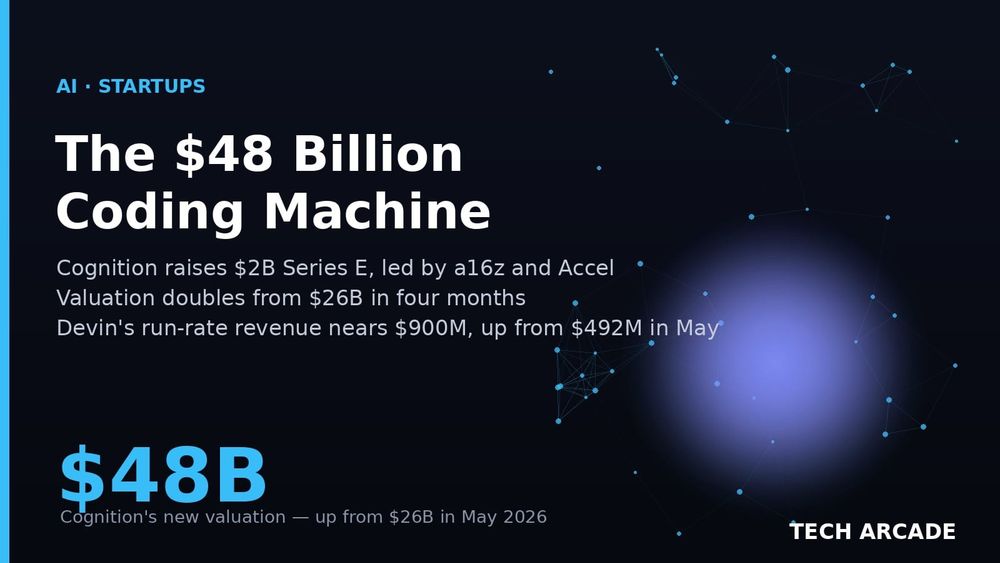

Four months ago, a startup whose main product is a robot that writes software was worth $26 billion. On September 8, it closed a round at $48 billion (TechCrunch). Same company, same summer, nearly double the tag.
The company is Cognition, and the $2 billion Series E it just raised is one of the largest ever written into an AI coding startup (Bloomberg). Andreessen Horowitz and Accel led it as new backers. Founders Fund, General Catalyst, Avenir, Nvidia, T. Rowe Price and more than thirty other firms piled into the rest (SiliconANGLE).
Here is the number that explains the enthusiasm: Cognition's annualized run-rate revenue went from $492 million in May to roughly $900 million by September (TechCrunch). It nearly doubled its revenue in the same window it nearly doubled its valuation.
The bet is simple and enormous: that companies will pay software engineers' salaries to software that engineers itself.
🧠 Why This Matters
Cognition's product is Devin, an autonomous coding agent. You give it a task in plain English — fix this bug, build this feature, migrate this codebase — and it goes off, writes the code, runs the tests, and comes back with a pull request. Not autocomplete that finishes your line. A worker you assign a ticket to.
For two years the AI coding story was about assistants — tools that sit next to a human and speed them up. The Cognition round is a wager that the next chapter is agents — tools that replace the ticket, not just the typing. When a business is billing near $900 million a year selling that, the wager stops being a pitch deck and starts being a market.
And it is a market with real buyers. Enterprise customers reportedly include names like Goldman Sachs, Citi, Mercedes-Benz and NASA (The AI Insider). These are not hobbyists trying a plugin. They are companies with security teams and procurement departments deciding that an agent can touch production code.
📊 Deep Dive
Cognition's climb has been unusually steep even by 2026 standards. Part of the leverage came from last year's acquisition of Windsurf, the coding startup Cognition bought in July 2025 after an OpenAI takeover bid collapsed and Google hired away its founders (SiliconANGLE). That deal folded a popular editor and its users into Cognition's agent business.
The headline figures, side by side:
- Raise: $2 billion, Series E
- Valuation: $48 billion, up from $26 billion in May 2026
- Run-rate revenue: ~$900 million, up from $492 million in May
- Headcount: roughly 200 employees (SiliconANGLE)
- Lead investors: Andreessen Horowitz and Accel, new to the cap table
- Core product: Devin, an autonomous coding agent
Do the arithmetic on that headcount line and it gets vivid: about $4.5 million of run-rate revenue per employee, against a valuation that works out to roughly $240 million of enterprise value per head. Whatever else Devin is, it is a lot of output behind a very small door.
"Cognition and Scott Wu saw the shift from autocomplete to autonomous agents before nearly everyone." — Avenir, which called it the largest check the firm has ever written (Tech Funding News)
⚠️ The Catch
Agents that write code are expensive to run. Cognition reportedly leases its Nvidia compute cluster rather than owning it, and its annual cash burn on compute alone could approach $800 million (Tech Funding News). Near-$900 million in run-rate revenue looks a lot thinner when the electricity bill for the machines is most of it.
Then there is the multiple. At $48 billion on ~$900 million of run-rate, buyers are paying more than fifty times revenue — and TechCrunch notes Cognition now commands a higher revenue multiple than rival Cursor did in the spring (TechCrunch). That only pencils out if the growth curve keeps bending the way it has all summer. Revenue that doubled in four months can also flatten in four.
And the crowded field cuts both ways. That investors are funding Cognition and Cursor and a dozen others is a sign they think AI coding is too big for one winner. It is also a sign that nobody has a moat yet.
🎯 What Happens Next
Cognition is telling investors it expects run-rate revenue to reach $4 to $5 billion by the end of 2026 (TechCrunch). That is a five-fold jump from today in under four months — the kind of target that either validates the $48 billion price or badly embarrasses it.
Watch two things. First, whether the enterprise logos turn into seat-count expansion — a bank running Devin on ten repos is a pilot; a bank running it on a thousand is a line item. Second, whether the compute math improves. If model costs fall faster than usage rises, the margins heal. If not, that $800 million burn keeps the fundraising treadmill running.
🧩 Bigger Picture
Step back and the round is a temperature reading on the whole AI economy. Money is flowing not to the labs building foundation models but to the companies wrapping those models into something a business will pay for on day one. Cognition does not have to invent the smartest AI. It has to be the one that turns a ticket into a merged pull request while a customer watches.
The uncomfortable part, for anyone who writes code for a living, is that the pitch is working precisely because the output is measurable. You cannot easily price a chatbot's cleverness. You can absolutely price a shipped feature. When the deliverable is that legible, the automation follows the money — and right now the money is moving fast.
Four months ago Cognition was a $26 billion promise. Today it's a $48 billion bet that the person who writes your next feature won't be a person at all.
Sources
- TechCrunch — Cognition hits $48B valuation, signaling AI coding is far from winner-take-all
- SiliconANGLE — Cognition raises $2B at $48B valuation as revenue nears $900M
- Bloomberg — AI Startup Cognition Raises $2 Billion at a $48 Billion Value
- Tech Funding News — Devin maker Cognition raises over $2B at $48B valuation
- The AI Insider — Cognition secures $2B at $48B valuation as AI coding race intensifies