
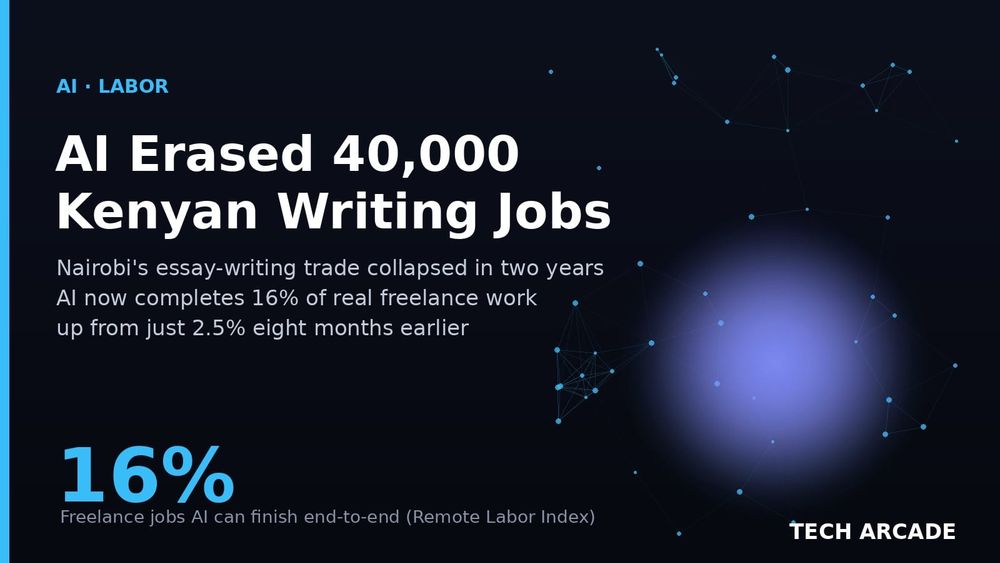

Here is a number that should stop you cold: 2.5%. That is the share of real, paid freelance jobs that top AI agents could finish start-to-finish in late 2025, according to the Remote Labor Index, a benchmark built by Scale AI and the Center for AI Safety. Tiny. Almost reassuring.
Eight months later, that number hit 16% (The Decoder). A sixfold jump in under a year, measured on actual gigs that people actually paid for.
You can debate what 16% means in a spreadsheet. Or you can ask the roughly 40,000 people in Nairobi who used to write college essays for American and British students, and who watched their entire industry evaporate in about two years (The Next Web). They are not reading the benchmark. They are living it.
The thesis: AI didn't disrupt this trade, the way ride-hailing disrupted taxis. It deleted it — and it's the clearest look yet at what "16% and climbing" does to real people.
🧠 Why This Matters
Most AI-jobs coverage is a forecast. This one already happened, and you can measure it.
Kenya spent 15 years building this. High-speed internet landed in 2009. The government started training graduates for online freelance platforms in 2016 and folded it into a National Digital Masterplan by 2022 (SBS). The pitch was simple and, for a while, true: a smart young Kenyan with decent English could earn in dollars, from a laptop, in a country where youth unemployment runs above 25% and roughly 80% of jobs are informal.
Essay-writing became the flagship of that dream. It paid, by one writer's account, at least five times what a public-health job would. Then ChatGPT launched in late 2022, and the same students who used to pay a human in Nairobi discovered they could get a B-plus paper for free, in ten seconds. Demand didn't dip. It fell off a cliff.
📊 Deep Dive
Take Teresios Bundi. Over 12 years he wrote more than 2,500 essays, charging $40 to $70 a paper — a real living built one assignment at a time (SBS). His first-ever gig, years back, paid $7 for three hours of work. He is not sentimental about what's coming next:
"A.I. is coming for bankers, for accountants, it's coming for engineers." — Teresios Bundi, former essay writer, to The New York Times
He's not alone. Richard Esilaba once managed 100 ghostwriters; he now does photo editing. Alex Munyua moved into data labeling and content moderation — ironically, helping train the very systems that ate his old job (SBS).
Here's the before-and-after, by the numbers:
- Peak workforce: ~40,000 essay writers in Nairobi alone, at the industry's early-2020s high (Business Standard / NYT).
- AI capability, late 2025: 2.5% of freelance projects completed end-to-end (Remote Labor Index).
- AI capability, mid-2026: 16% — a 6x rise in eight months (The Decoder).
- Academic verdict: an MIT committee concluded in August 2026 that AI can now answer almost any undergraduate assignment (SBS).
- The collapse window: roughly two years from ChatGPT's launch to the trade drying up (The Next Web).
Oxford internet researcher Mark Graham, who has tracked Kenya's gig economy for years, put the mechanism plainly:
"A.I. has come in and taken big chunks of these labor markets." — Mark Graham, Oxford Internet Institute, to The New York Times
⚠️ The Catch
Before you file this as a clean tragedy, sit with the awkward part: this was the contract-cheating economy. The product was a student paying someone else to fake their own coursework. Plenty of people will say a market for academic fraud getting wiped out is a feature, not a bug.
Fair. But the skill was real even if the use wasn't — research, structure, argument, fluent English on deadline. Those workers weren't unemployable; they were doing knowledge work at a knowledge-work price, and the price just went to zero. The moral fog around what they wrote shouldn't obscure the economic signal in how fast it vanished.
And notice where the survivors landed: data labeling, content moderation, photo editing — lower-paid digital piecework, much of it feeding the AI supply chain. The ladder didn't just lose a rung. It got shorter.
🎯 What Happens Next
Watch the Remote Labor Index like an earnings report. The line that matters is the slope: 2.5% to 16% in eight months is not a plateau, it's a takeoff. The categories closest to "text in, text out" — copywriting, basic research, first-draft code, translation, transcription — sit directly in the blast radius. Kenya already lost transcription work back around 2017; essays were simply next.
The near-term tell is whether the freelance platforms themselves react. If Upwork- and Fiverr-style marketplaces start posting falling volumes in writing and simple coding gigs through late 2026, that's the same story spreading beyond one city. If governments that sold "digital gig work" as a development strategy — Kenya among them — start quietly rewriting that pitch, that's the policy world catching up to the benchmark.
🧩 Bigger Picture
The comforting version of AI-and-jobs says machines take tasks, not roles, and humans float up to higher-value work. Nairobi is the stress test for that story, and so far the float-up isn't happening — people are floating sideways into cheaper work, or out.
What makes this one land is that it's legible. You don't need a labor economist to model it. You have a benchmark climbing from 2.5% to 16%, a real city with a real headcount, and named people describing exactly what disappeared and when. Most industries facing AI are still arguing about hypotheticals. This one already has a body count in jobs, and a timestamp.
Bundi's warning isn't really about essays. It's about the assumption, quietly held by most people with a laptop and a professional skill, that their 16% is still years away. Nairobi thought that too — right up until it was 40,000.
The robots can now do 16% of your job. Ask a Kenyan essay writer how the other 84% goes.
Sources
- "Kenyans Did College Students' Homework for Years. Then AI Arrived." — The New York Times (via Business Standard), Sept. 6, 2026
- "Writing College Essays for Students Used to Be Their Livelihood — Until AI Took It" — SBS
- "AI gutted Kenya's essay industry. 40,000 jobs went" — The Next Web
- Remote Labor Index — Scale AI & Center for AI Safety
- "AI agents can now complete 16 percent of freelance jobs, up from 2.5 percent eight months ago" — The Decoder
- "A Significant Increase in Digital Labor Automation" — Center for AI Safety