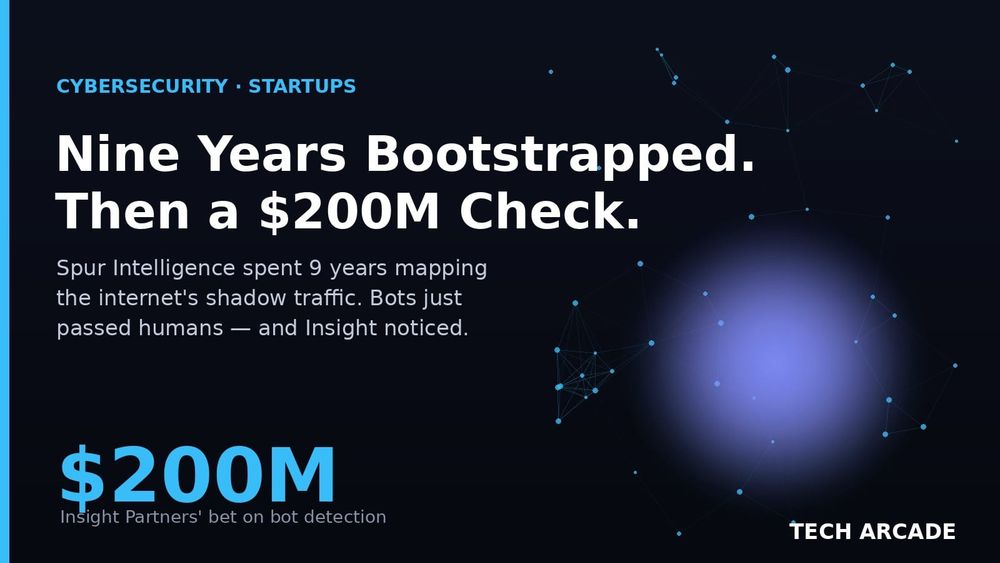

For nine years, Spur Intelligence quietly answered the one question most of the internet would rather not ask out loud: is the visitor on the other end of that connection an actual human, or a machine wearing a stranger's IP address like a mask? They did it without a single dollar of venture money. That just ended.
Let's get the number on the table first: $200 million. That's the check Insight Partners wrote to Spur in a round announced on July 28 — the first outside institutional funding the company has taken since two U.S. Department of Defense engineers, Riley Kilmer and Ethan Smith, founded it back in 2017 ($200M raise, TechCrunch).
Nine years bootstrapped, then one of the largest software investors on the planet drops nine figures in a single move. The timing isn't an accident. Somewhere in mid-2026, according to Cloudflare data cited in the coverage, bot traffic quietly overtook human traffic on the internet for the first time — and suddenly the boring plumbing of "where did this connection really come from" became one of the most valuable questions in security.
The thesis is simple: in a web where more than half the traffic isn't a person, proving which connections aren't is about to be worth a fortune.
🧠 Why This Matters
Spur sells what the industry calls IP intelligence — real-time data that flags whether a connection is riding through a commercial VPN, a residential proxy network, a mobile gateway, a bot farm, or some other layer of anonymization designed to look innocent. Boring on paper. Existential in practice.
The demand signal is loud. In the 2026 IP Intelligence Study cited alongside the raise, 94% of organizations said they ran into anonymizing VPNs or residential proxies during a security incident in the past year, and nearly half said they plan to buy or upgrade a commercial IP-intelligence tool within the next 12 months (TechFundingNews). When almost every enterprise has been burned by traffic it couldn't trace, a company that specializes in tracing it looks less like a nice-to-have and more like a utility bill.
"We're in the middle of a massive shift in fraud prevention. Spur has built one of the most comprehensive intelligence layers for understanding the true origin of internet traffic." — Thomas Krane, Managing Director, Insight Partners
📊 Deep Dive
The wild part isn't the $200 million. It's the shape of the company taking it. Spur reportedly runs on roughly 40 employees (TechFundingNews). Do the arithmetic and this round works out to about $5 million raised per head — the kind of ratio you normally only see on an AI lab's pitch deck, not a nine-year-old bootstrapped shop in Lake Mary, Florida.
Here's how the pieces stack up:
- Founded: 2017 — five years before ChatGPT put "is this a bot?" on every product manager's whiteboard.
- Funding history: roughly nine years with zero disclosed institutional capital → $200M in a single round.
- Headcount: ~40 people, per reporting — meaning revenue-per-employee had to be doing serious work to survive bootstrapped that long.
- The backer: Insight Partners, with $90B+ in regulatory assets under management as of December 31, 2025, more than 900 companies funded and 55+ IPO exits on its record (GlobeNewswire).
- The product: data feeds, APIs, and session enrichment that separate legitimate humans from anonymized, proxied, and obfuscated traffic in real time (SecurityWeek).
The founders' résumé is the tell. Two Defense Department software engineers spent five years before ChatGPT building a map of the internet's shadow infrastructure — the proxies, the VPN exit nodes, the residential IP networks that fraud rings rent by the hour. When the bot flood finally arrived, they already had the map.
"Demand for high-fidelity IP intelligence is accelerating as organizations struggle to understand the true source and intent behind internet traffic." — Kevin Hickey, CEO, Spur
⚠️ The Catch
Start with what nobody disclosed. There's no valuation attached to this round, no revenue figure, and no customer count — so from the outside you can't tell whether $200 million bought a slice or a controlling stake, or what multiple it's riding on. A big number without a valuation is a headline, not a scorecard.
Then there's the treadmill. IP intelligence is an arms race, and the other side is now armed with AI. As criminal VPNs, residential-proxy networks, and anonymization services get cheaper and better, yesterday's map goes stale fast. Spur's edge is only as durable as its ability to keep re-drawing it — which is a big part of why a bootstrapped 40-person shop suddenly needed a war chest.
And culture is a real risk. Companies that survive nine years on their own money tend to be allergic to burn. Bolting $200 million of growth expectations onto that DNA is not automatic; plenty of disciplined bootstrappers have tripped over their first mega-round.
🎯 What Happens Next
Expect the obvious moves first: aggressive hiring, deeper data coverage, and a sales motion built to spend rather than conserve. Insight's whole playbook — 900-plus investments and 55-plus IPOs deep — is to take a proven, capital-efficient product and pour fuel on distribution. Spur now has the fuel.
The competitive squeeze is coming too. Bot detection and fraud prevention is a crowded field, and a $200 million raise paints a target on Spur's back for every incumbent and every well-funded challenger. Watch for whether the company leans into the enterprise security stack or pushes toward the fast-growing world of AI agents — where distinguishing a legitimate automated visitor from a malicious one becomes its own multi-billion-dollar problem.
🧩 Bigger Picture
Step back and the raise is really a bet on a strange new baseline: the internet is now majority machine. Some of those bots are fraud. A growing share are legitimate AI agents doing errands for real people. Either way, the old assumption that a visitor is probably a human is dead, and every login page, checkout flow, and API endpoint has to be rebuilt around that fact.
That's the market Spur is standing in the middle of. Not teaching machines to act more human — the opposite. Building the ground truth that lets everyone else tell the difference. In a web drowning in synthetic traffic, "who is actually on the other end of this connection?" stops being a security question and starts being the foundation everything else is priced on.
The internet spent thirty years assuming you were a person. Spur just raised $200 million on the fact that, statistically, you're probably not.
Sources