
Google gives away Chrome. Microsoft gives away Edge. And a startup called Island just convinced investors that a browser is worth $6.4 billion — by charging enterprises for one.
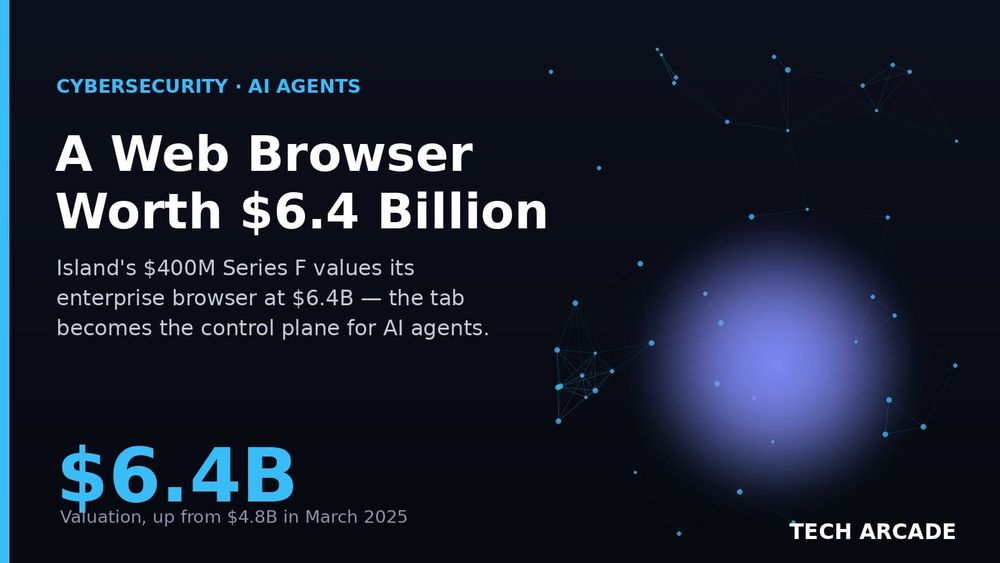
That's the number on the table. On September 24, Island closed a $400 million Series F led by Evolution Equity Partners, lifting its valuation to $6.4 billion — up from $4.8 billion in March 2025 (SiliconANGLE, CTech). A $1.6 billion bump in eighteen months, for software most people would struggle to tell apart from the Chrome tab they already have open.
The pitch used to be about security. Now it's about something stranger: who's on the other end of the keyboard.
The browser is quietly becoming the place companies police their AI agents — and Island wants to own the door.
🧠 Why This Matters
For most of computing history, the browser was the dumb window you looked through. IT locked down the network, the laptop, and the apps; the browser just rendered whatever showed up. Island's whole company is a bet that the window is now the most important thing in the building.
Here's the logic. Work moved into the browser — email, Salesforce, banking systems, internal dashboards, all of it running as tabs. Then AI agents arrived, and they don't log in through a special enterprise pipe. They click buttons, fill forms, and read screens through a browser, exactly like a human employee would. If you want to know what your agents are actually doing inside your bank's admin panel, the browser is the one place you can watch.
"We've entered a new era in which people and AI agents work side by side." — Mike Fey, CEO and co-founder, Island
Island builds a Chromium-based browser (the same engine under Chrome) with the controls baked in: what data can be copied, screenshotted, downloaded, or typed into an AI prompt, and by whom — human or bot. That governance layer is what turned a browser into a $6.4 billion company.
📊 Deep Dive
The growth is the part that made investors sign. According to CTech, Island is running at roughly $200 million in annual revenue and growing about 100% a year — and the company says its annual recurring revenue has doubled every fiscal year since it launched in 2022. The customer list is heavy where it counts: Island says eight of the world's ten largest banks run its browser.
How the valuation climbed, round by round:
- Series C (Oct 2023): $100 million — valuation $1.5 billion (BusinessWire)
- Series E (Mar 2025): $250 million — valuation $4.8 billion (SecurityWeek)
- Series F (Sep 2026): $400 million — valuation $6.4 billion (Island)
- Headcount: ~1,000 employees today, with plans to hire 500 more by mid-2027
That's more than $750 million raised across the last three rounds alone. The Series F investor roster reads like a cybersecurity who's-who: Evolution Equity Partners leading, with Sequoia Capital, Coatue, Insight Partners, J.P. Morgan Growth Equity Partners, Georgian, and Cyberstarts, plus a personal check from CrowdStrike co-founder Dmitri Alperovitch (Island).
CTO and co-founder Dan Amiga framed why a browser, of all things, ends up holding the leash:
"Agents do not operate in a single layer of the technology stack, so they cannot be governed from one." — Dan Amiga, CTO and co-founder, Island
⚠️ The Catch
Here's what should give you pause. Island is charging premium prices in a market where the two biggest browser makers on earth hand out enterprise controls for free. Google Chrome Enterprise and Microsoft Edge for Business both bundle management, policy, and data-loss controls at no extra cost, and Palo Alto Networks folded the startup Talon into its own Prisma Access Browser after acquiring it in 2023 (GovInfoSecurity). Island has to be meaningfully better to justify a line item that Chrome technically covers for zero.
Then there's the math. Roughly $200 million in revenue against a $6.4 billion valuation is about a 32x revenue multiple — rich even by 2026's generous standards, and it only pencils out if the AI-agent story plays out the way the deck says it will. If agents end up routing through APIs and dedicated pipes instead of clicking around browsers like people do, Island's chokepoint gets a lot less choke-y.
And the ground is shifting under everyone: AI-native browsers like Perplexity's Comet and OpenAI's newly launched browser are rethinking the tab from scratch. A company that bet the farm on "the browser is the control plane" has to hope the browser it built stays the one everyone uses.
🎯 What Happens Next
Watch the hiring. Adding 500 people by mid-2027 on top of 1,000 is the move of a company racing to plant its flag before Google and Microsoft wake up to how much enterprises will pay for the agent-governance layer. Expect Island to lean hard into the "manage your AI agents" message — that's the story that turns a security tool into infrastructure.
Watch the incumbents, too. If browser-based agent governance is real money, Chrome Enterprise and Edge for Business will build toward it, and Palo Alto will push Prisma harder. Island's window — pun intended — is the stretch before the giants treat this as a must-win.
🧩 Bigger Picture
Island's raise is a clean read on where the AI money is flowing in late 2026. It's not going to another chatbot. It's going to the boring, load-bearing plumbing that lets big, cautious institutions — banks, insurers, hospitals — actually turn agents loose without losing sleep. Enveda raised $311 million for AI drug discovery the same week (Tech Startups); the enterprise-security startup Island's own investors clearly see the same pattern: the agents are coming, and somebody has to watch them.
"Reaching a $6.4 billion valuation while doubling ARR each year is clear evidence that the entire Island team has built something the enterprise world genuinely needs." — Gili Raanan, Cyberstarts
The last decade of security was about guarding the network. The next one looks like it'll be fought one tab at a time — and Island just raised $400 million betting it owns the glass.
Sources
- Island — Series F announcement (press release)
- SiliconANGLE — Island raises $400M at $6.4B valuation
- CTech — Island raises $400M as AI agents reshape enterprise security
- SecurityWeek — Island's $250M Series E at $4.8B (March 2025)
- BusinessWire — Island Series C at $1.5B (2023)
- GovInfoSecurity — Palo Alto Networks to acquire Talon
- Tech Startups — Top Tech News, September 24, 2026