
Kevin Mandia has run this play before. In 2004 he founded Mandiant, the firm you called after you'd already been breached. In 2022, Google bought it for $5.4 billion (TechCrunch). His new company flips the timing: it shows up before the break-in, by breaking in first.
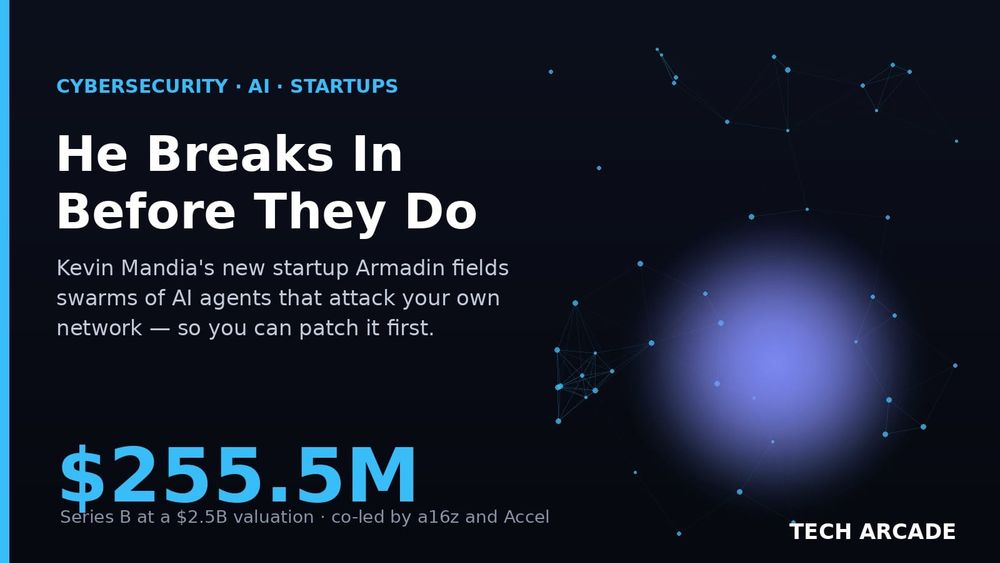
Let's get the number on the table first: $255.5 million. That's what Mandia's startup, Armadin, just raised in a Series B round co-led by Andreessen Horowitz and Accel, at a valuation above $2.5 billion (SiliconANGLE). The company has now pulled in $445.5 million since a $190 million Series A back in March — roughly six months of runway-raising (Crypto Briefing).
What is Armadin actually selling? Swarms of AI agents that behave exactly like attackers — mapping your network, chaining weaknesses together, and hacking in on purpose so you can patch the holes before someone less friendly finds them.
The thesis is uncomfortable and simple: the only way to survive AI-powered offense is to run AI-powered offense against yourself, every single day.
🧠 Why This Matters
Security testing has traditionally been a calendar event. You hire a team of human penetration testers, they poke at your systems for a week or two, you get a PDF, and everyone moves on until next year. In the meantime, your infrastructure changes daily and the gaps multiply.
Armadin's argument is that the attackers already stopped waiting for your annual review. AI lets a bad actor find and string together weaknesses faster than any human defense team can patch them — so the defense has to move at the same speed. That means always-on, autonomous, and adversarial by design.
The investor roster tells you who's betting on that worldview. Beyond a16z and Accel, the round drew in Bain Capital Ventures, Redpoint, 8VC, Ballistic Ventures, Kleiner Perkins, Menlo Ventures, and Google's GV — plus In-Q-Tel, the venture arm backed by the U.S. intelligence community (BankInfoSecurity). When the spy agencies' fund is on your cap table, the government market isn't a maybe.
"Offense is uniquely advantaged right now. AI lets an attacker find and chain weaknesses faster than any human team can respond. The only way to build a defense that keeps pace is to train it against the best offense available, every day." — Kevin Mandia, founder and CEO, Armadin (SiliconANGLE)
📊 Deep Dive
Here's how the machine works. Armadin deploys fleets of specialized AI agents inside sandboxed environments. The agents map your organization's systems, scan assets for vulnerabilities, and — critically — chain multiple weaknesses together into full attack paths, the way a real intruder would pivot from a forgotten test server to your crown-jewel database. Then it hands your team remediation guidance instead of just a scary list.
The scale is the headline. In one customer engagement, Armadin reportedly turned loose 26,000 agents that scanned more than 25,000 assets and surfaced 38 verified attack paths — which SiliconANGLE describes as the largest autonomous AI attack on record (SiliconANGLE). A human red team does not field 26,000 operatives.
How that compares to the old way of doing things:
- Cadence: Traditional pen tests happen once or twice a year. Armadin's swarms run continuously, 24/7.
- Scale: A human red team is a handful of specialists. Armadin counted 26,000 agents in a single run.
- Coverage: Manual testing samples a slice of your estate. The swarm scanned 25,000+ assets in one engagement.
- Output: A static report versus live attack paths plus automated remediation guidance.
- Cost curve: Human testing scales linearly with headcount; agent swarms scale with compute.
⚠️ The Catch
A $2.5 billion valuation on a company that only came out of stealth in early 2026 is a bet on Mandia's track record as much as on the product. Armadin hasn't disclosed revenue, named customers, or a headcount, so the multiple is running on reputation and momentum for now.
There's also the obvious double edge. A platform that can autonomously orchestrate tens of thousands of attacking agents is extraordinary defense — and a blueprint for extraordinary offense if the same capability leaks, is misused, or simply gets copied by people who skip the "sandboxed, with permission" part. "The largest autonomous AI attack on record" is a marketing line today; it's a category of threat tomorrow.
And the field is filling up fast. Autonomous security testing is one of the hottest corners of the AI-agent boom, which means Armadin is raising against well-funded rivals and in-house tools alike. The $255.5 million buys a lead, not a moat.
🎯 What Happens Next
Armadin says the cash goes toward platform expansion, model training, and a go-to-market push into large enterprises and government agencies (Crypto Briefing). With In-Q-Tel already in, watch for federal contracts and named enterprise logos — those are the proof points that justify a $2.5 billion sticker. The next real test is whether Armadin can convert reputation into recurring revenue before the competition catches up.
🧩 Bigger Picture
The arms race is now AI-versus-AI on both sides of the firewall, and this week made that vivid. The same day Armadin's round made headlines, Google's new flagship model, Gemini 4 Argon, began rolling out — and its first audience is cyber defenders, through a program called Fairwind, with a dedicated benchmark for vulnerability remediation (VentureBeat).
Put those together and the direction is clear: security is becoming one of the first places where autonomous AI gets pointed at a hard, measurable problem. If your defenses are still built around a human team and an annual report, the gap between you and a 26,000-agent swarm isn't going to shrink on its own.
Mandia's last company made its name cleaning up after the breach. His new one is betting the next $5 billion is in making sure the breach never happens — by hacking you first, politely, before breakfast.
Sources
- TechCrunch — Kevin Mandia's new 'agent swarm' security startup Armadin raises $255.5M at $2.5B valuation
- SiliconANGLE — Armadin nabs $255.5M to detect vulnerabilities with AI agent swarms
- BankInfoSecurity — Armadin Targets Autonomous Remediation With $255.5M Series B
- Crypto Briefing — Kevin Mandia's Armadin raises $255.5M for AI agent swarms
- VentureBeat — Google unveils Gemini 4 Argon