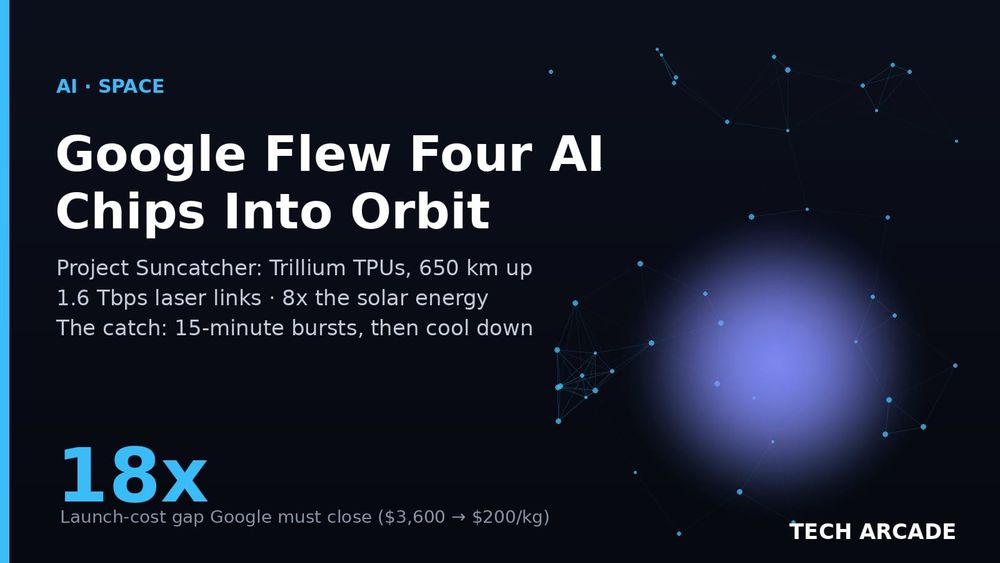

On October 1, a refrigerator-sized box rode a SpaceX Falcon 9 out of Vandenberg and into a dawn-dusk orbit about 650 kilometers up. Inside it: four of Google's Trillium AI chips, the first tensor processing units the company has ever flown. The mission is called Project Suncatcher, and the pitch is simple — put the data center where the sunlight never stops.
Here's the number that actually decides whether this works: $200 per kilogram. That's the launch cost Google says it needs to hit before running AI chips in space is cost-competitive with running them in Nevada. Today, a reusable Falcon 9 puts a kilogram into low Earth orbit for around $3,600. So the whole bet rides on an 18x drop in the price of getting to space (Futurum).
The chips are up there. The economics are not. That gap is the entire story.
🧠 Why This Matters
AI's real constraint isn't talent or algorithms anymore — it's power and cooling. Data centers are fighting cities for grid capacity, and every new cluster needs water and substations that take years to permit. Google's wager is that you can skip all of it by flying the compute into a dawn-dusk, sun-synchronous orbit, where a solar panel collects up to 8x the annual energy it would at mid-latitude on the ground (NPR). No night, no clouds, no NIMBY fight over a transformer.
If the math ever closes, the thing powering your next model response might be a swarm of satellites, not a warehouse in Ohio. That's why a four-chip prototype got this much attention — it's a proof of concept for moving the most contested resource in tech off the planet entirely.
📊 Deep Dive
The satellite Google and Planet Labs built is deliberately modest. Its four Trillium TPUs deliver roughly the power of a single Google Cloud TPU v6e-4 slice — about one standard data-center server's worth of compute, sipping around a kilowatt (Futurum). On board it runs Gemma, Google's open-weight model, answering simple queries. This is a test article, not a product.
The part that genuinely works is the plumbing. In the lab, Google clocked an optical link between satellites at 1.6 terabits per second, bidirectional, using off-the-shelf DWDM transceivers. The eventual design calls for 81 satellites flying inside a 1-kilometer cluster, close enough that neighbors sit just 100 to 200 meters apart, passing data by laser as if they were one machine (Tech Times).
How this prototype stacks up:
- Compute: 4 Trillium TPUs ≈ one terrestrial data-center server
- Power: ~1 kilowatt from solar, in an orbit that yields up to 8x ground-level energy
- Laser link: 1.6 Tbps bidirectional — in the lab, not yet in orbit
- Duty cycle: 15-minute compute bursts, then a cooling pause
- Radiation test: survived 15 krad total dose under a 67 MeV proton beam at UC Davis — well past the ~750 rad a shielded five-year mission expects
- Life: ~1 year of operations, up to six years in orbit before it comes down
Note what passed and what didn't. Radiation — the thing everyone assumed would kill the chips — turned out to be survivable. The TPUs took the proton beam and kept running, with one silent data-corruption event and bit flips that mostly cleared on restart.
⚠️ The Catch
The enemy is heat. In a vacuum there's no air to carry warmth away, so a chip can only shed heat by radiating it. That's why these TPUs run in 15-minute bursts and then stop to cool down — a server you can only use a quarter of the time is a hard sell. Temperatures swing more than 100°C between the sunlit and shadowed parts of each orbit, and Google has validated its radiators in a vacuum chamber but not yet through real orbital cycling.
Then there's the launch-cost wall. Google's own lead isn't selling a quick payoff.
"I don't see this being cheaper to do in the next five years. I think it will take longer." — Travis Beals, Senior Director, Paradigms of Intelligence, Google
To build the full vision, one analysis estimates you'd need roughly 1,800 Starship launches over a decade — about 180 a year, hauling 200 metric tons each. And not everyone buys the premise at all.
Astrophysicist Neil deGrasse Tyson called orbital data centers a "failed business model," arguing the renewable-energy advantage doesn't pencil out once you price in getting hardware up and keeping it alive.
Aerospace engineer Moriba Jah of UT Austin added a different worry: pack enough compute into low orbit and you raise the risk of Kessler syndrome, the cascade of collisions that can turn a useful altitude into a debris field (Tech Times).
🎯 What Happens Next
The current satellite has a one-year job: prove the chips keep working and the cooling holds. The real milestone comes in 2027, when Google and Planet Labs plan to fly two satellites and test whether that 1.6 Tbps laser link actually works between two objects moving at 28,000 km/h, not just across a lab bench.
Google frames Suncatcher as a decade-long research effort, with real cost parity penciled in for the mid-2030s — and only if launch prices collapse on schedule. Translation: you won't be served by a space TPU this year, or next. You're watching the first brick of something that may or may not get built.
🧩 Bigger Picture
Google isn't alone up there. Starcloud ran what it billed as the first AI training in orbit back in March, on an Nvidia H100, after a $170 million round at a $1.1 billion valuation. SpaceX is designing Starmind satellites that pack dozens of GPUs and draw over 100 kilowatts each, with prototype testing aimed at early 2027. Blue Origin has floated a roughly 5,400-satellite plan. And in January, China announced a 200,000-satellite constellation of its own. Orbit is getting crowded with compute before a single one of these projects has proven it pays (Tech Times).
Strip away the rocket romance and Suncatcher is a bet on one trend line: that the cost of reaching orbit keeps falling the way the cost of solar did. Google is placing that bet early, with four chips and a fridge, so that if the line bends its way, it already knows how to build the thing.
For now, Google owns a data center that sees the sun 24 hours a day — and can only use it 15 minutes at a time.
Sources