
A one-year-old startup that has never sold a product just convinced some of the sharpest investors in tech that gameplay footage from teenagers is the missing ingredient for robots and self-driving cars.
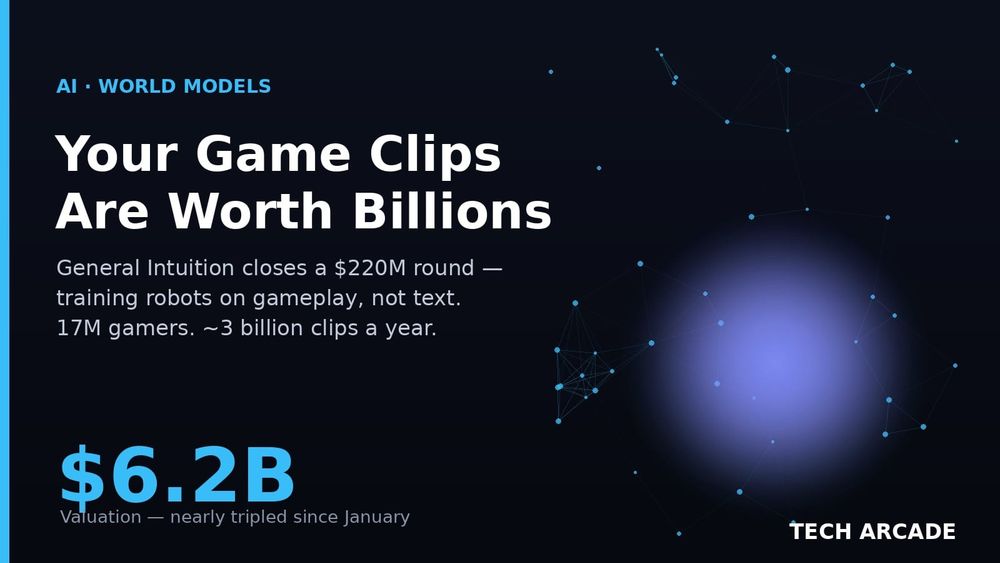
The number on the table: $220 million, at a $6.2 billion valuation (SiliconANGLE). That's the raise General Intuition closed this week, and it nearly triples the $2.3 billion the company was worth back in January (GamesBeat). Add it up and the company has pulled in north of $650 million in under 18 months (Tech Startups).
Here's the bet the money is making: the internet is drowning in text and photos, but almost none of it captures the thing a robot actually needs — what happens when you act. Video games do. Every dodge, crash, and reload is a labeled example of an action changing a world.
The thesis: if you want to teach a machine to move through space, start where humans already generate billions of moves a month — the game clip.
🧠 Why This Matters
Large language models learned to write by reading the web. The catch for anything with a body — a robot arm, a warehouse bot, a drone — is that reading doesn't teach you physics. You can memorize every sentence ever written about catching a ball and still whiff the catch.
General Intuition's pitch is that gameplay is the cheat code for this gap. It sits alongside Medal, a game-clip capture app with 17 million-plus monthly active users who upload roughly 195 million new clips every month — a library on track to hit 3 billion clips a year (Dutch Startup). Each clip is a person deciding, acting, and living with the result. That's exactly the data a machine needs and almost never gets.
"We don't build models that predict pixels or compete with game developers. We build models that predict actions." — Pim de Witte, CEO of General Intuition (GamesBeat)
📊 Deep Dive
The company's core tech is a class of AI called a world model — a system that learns the rules of an environment well enough to imagine what comes next. Its flagship, MIRA, generates playable video on the fly and, per SiliconANGLE, was built with help from Epic Games and the Kyutai research lab. The specs are unusually specific for a startup this young:
- 5.6 billion parameters, running on latent diffusion — modest next to a frontier chatbot, tuned instead for motion and space.
- 20 frames per second at 720×576 resolution, generated on a single Nvidia B200 GPU — cheap enough to actually deploy.
- It can "run infinitely without diverging," meaning the imagined world doesn't melt into nonsense after a few seconds — the failure mode that has plagued generated video.
The funding line-up tells you who's convinced. Valor Equity Partners and Atreides co-led, with Seven Seven Six, Point72, Khosla Ventures, and General Catalyst joining (MobileGamer.biz). Khosla and General Catalyst have now backed the company across rounds. The stated targets go well past gaming: robotics, autonomous driving, and search-and-rescue drones (TechCrunch).
⚠️ The Catch
A video game is not the world, and that's the whole argument against this. A racing sim doesn't model a blown tire, wet asphalt, or a kid chasing a ball into the street. Skills learned in a rendered environment have a long history of falling apart when they meet friction, lighting, and consequences that don't respawn.
There's a business risk baked in too. The moat is Medal's clip firehose — a consumer app, subject to the usual churn, competition, and questions about consent for training on what users upload. If that pipeline slows, the data advantage narrows fast. And $6.2 billion is a valuation for a company still pre-revenue on its core AI product, priced on a promise that gameplay generalizes to reality. That promise has not yet been proven at robot scale.
🎯 What Happens Next
Watch for the first real robotics or driving partnership, because that's the moment the thesis meets pavement. The cash is earmarked mostly for hiring AI researchers, so expect a talent land-grab against the world-model teams at Nvidia, Google DeepMind, and a wave of physical-AI startups chasing the same prize.
The tell to track is transfer: can a policy trained on clips actually run a physical arm or a car in a way that beats today's methods? If a demo lands in the next few quarters, $6.2 billion will look early. If it doesn't, this becomes the case study for how far vibes and a data story can carry a valuation.
🧩 Bigger Picture
Step back and the deal is a marker for where AI money is flowing in late 2026: away from another chatbot, toward machines that act. World models are the connective tissue of that shift, and everyone from Nvidia to DeepMind is racing to build them. General Intuition's angle is that the training data has been hiding in plain sight, generated for fun, at planetary scale, by people who thought they were just clipping a good play.
It's a genuinely clever reframe of a hard problem. It's also a reminder of how the current market works — a valuation can triple in nine months on the strength of a compelling story and a proprietary data pipe, well before a single robot proves the story true.
The web taught machines to talk. General Intuition is wagering $6.2 billion that your highlight reel teaches them to move — and we're about to find out whether a robot can tell the difference between a video game and the street.
Sources
- SiliconANGLE — World model startup General Intuition closes $220M investment
- MobileGamer.biz — General Intuition raises $220m at $6.2bn valuation
- Dutch Startup — General Intuition raises $220 million, nearly triples valuation to $6.2B
- GamesBeat — General Intuition raises $320M at $2.3B valuation (exclusive interview)
- TechCrunch — General Intuition in talks to raise $300M at around $2B valuation
- Tech Startups — Startup Funding News Today, September 30, 2026