🔥 A Welding Robot Startup Just Hit $2.45 Billion. The Shortage Behind It Is Real.
Path Robotics raised $300M at a $2.45B valuation on 10 Nov 2026 for Obsidian, an AI model that teaches robots to weld amid a deepening US welder shortage.
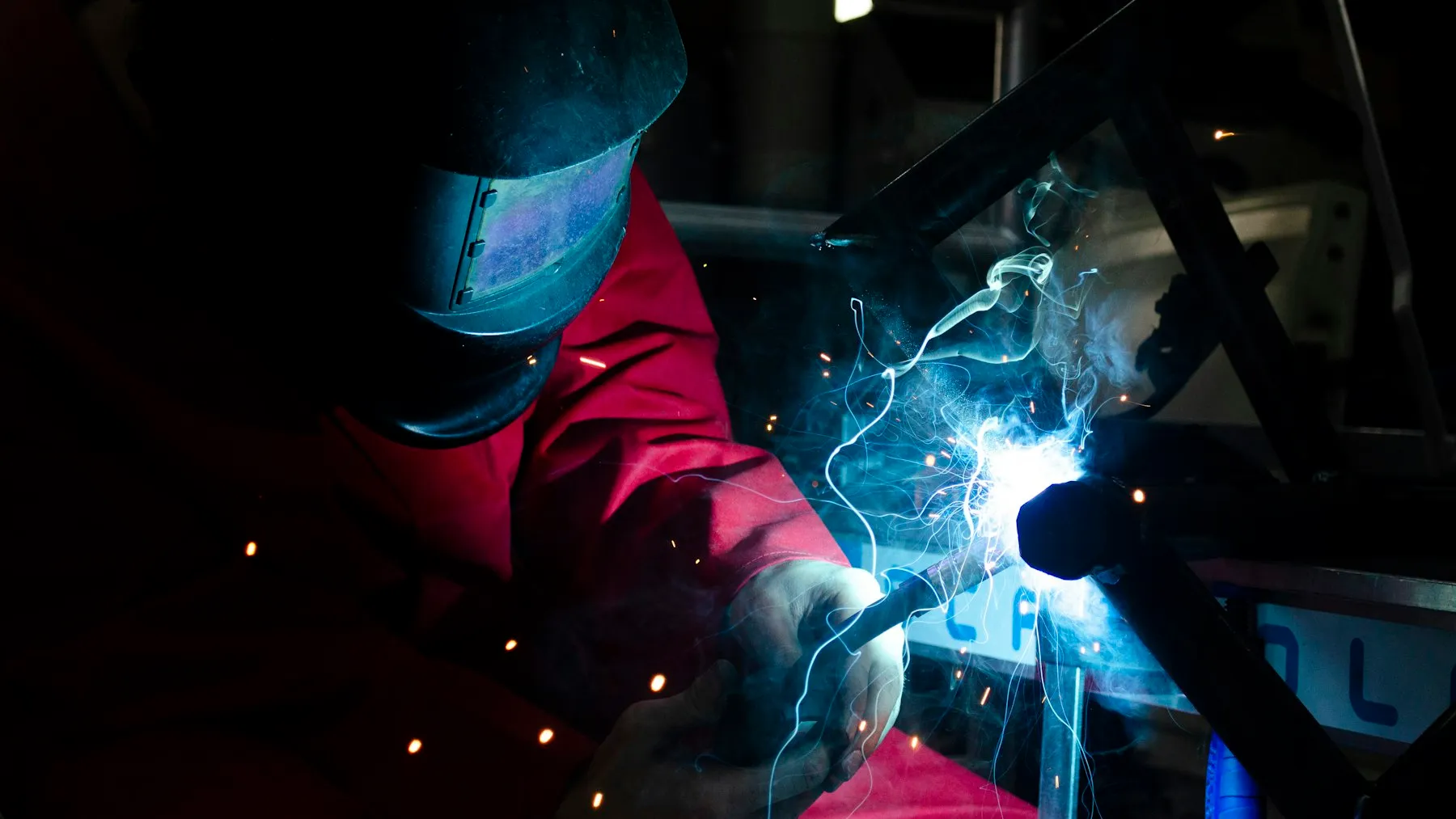
Welding is one of those jobs that holds the physical world together. The hull of a ship, the frame of a wind turbine, the utility pole outside your window: somewhere, a person in a mask dragged a molten bead of metal along a seam and made it one piece. And increasingly, nobody wants to do it.
Let’s get the number on the table first: $300 million. That’s what Columbus-based Path Robotics just raised in a Series E round, landing the company at a $2.45 billion post-money valuation (SiliconAngle). The round, announced on 10 November 2026, was led by growth-equity firm Georgian, with Tiger Global, Addition, Drive Capital, Yamaha Motor Ventures, D. E. Shaw Ventures and NAVER Ventures all in the mix (Robotics 24/7).
Path doesn’t sell robot arms. It sells the thing that makes a robot arm actually useful: an AI model that can look at a hunk of metal it has never seen and figure out how to weld it.
That distinction is the whole bet.
🧠 Why This Matters
Traditional industrial robots are brilliant and brittle. They repeat one motion a million times without complaint, but they need an engineer to program every weld in advance, and they fall apart the moment a part arrives slightly warped or a job runs in batches of five instead of five thousand. Most real manufacturing looks like the second case.
Path’s pitch is that the skilled welder shortage isn’t a hiring problem you can recruit your way out of. The American Welding Society projects the US will be short more than 300,000 welding professionals by 2029 (KY3). You cannot train that many people fast enough, and the ones you do train increasingly don’t want a career breathing fumes under a visor.
So Path is trying to bottle the welder’s judgment itself. Its model, Obsidian, uses four lasers and two cameras mounted on the torch to watch the weld pool in real time, then adjusts for metal distortion and part variation the way a human would (SiliconAngle). The robot isn’t following a script. It’s reacting.
“We started with welding because it is one of the hardest jobs on the factory floor to automate,” said co-founder and CEO Andy Lonsberry (Robotics 24/7).
📊 Deep Dive
The numbers under the headline are what convinced investors to roughly quadruple the valuation. Here’s the shape of the business:
- Revenue: Annual recurring revenue grew 17-fold over the past 18 months (Robotics 24/7).
- Headcount: The workforce grew 97% year-over-year, with a plan to hit 400 employees by the end of 2026.
- Anchor deal: In August 2026, Path signed a $600 million performance-based production agreement with shipbuilder HII for US Navy work.
- Customers: Big names like HII, Lockheed Martin and Saronic, alongside mid-sized shops such as EK Machine, Millerbernd and TYCROP.
- Hardware range: Beyond fixed cells, Path introduced Rove in 2026, a system that puts Obsidian on a four-legged robot so it can walk up to a ship hull instead of waiting for the hull to come to it.
Put those together and you get the thesis investors paid for: a software model that improves with every weld, strapped to hardware that can go anywhere. Each job becomes training data for the next one.
“Path’s proprietary models and growing base of real-world production data can create a powerful advantage,” said Georgian partner Emily Walsh, who is joining the board (Robotics 24/7).
⚠️ The Catch
A $2.45 billion valuation on 17x ARR growth is a bet on a curve continuing, not a destination reached. A few things could bend that curve.
First, welding is unforgiving in a way that demos hide. A bad weld on a utility pole is a warranty claim. A bad weld on a Navy hull is a different category of problem entirely, and defence customers audit accordingly. Path’s model has to be right not most of the time, but nearly all of the time, across metals and geometries it hasn’t seen.
Second, the defence concentration cuts both ways. A $600 million HII agreement is a spectacular reference, but leaning on Navy shipbuilding ties Path’s near-term fortunes to government procurement cycles and their famous habit of sliding to the right.
Third, Path is not alone. Physical AI for manufacturing is suddenly a crowded, well-funded race, and the moat is real-world data. Whoever welds the most, learns the most, and the lead can compound quickly in either direction.
🎯 What Happens Next
The new money goes toward three things: new robot form factors, new manufacturing tasks beyond welding, and more compute for training the model (Robotics 24/7).
That last phrase is the tell. Welding is the wedge, not the whole plan. The same recipe (watch the physical process, react in real time, learn from every repetition) could in principle apply to grinding, cutting, assembly or any other skilled task with a worsening labour shortage behind it. Expect Path to keep framing itself as a “physical AI” company rather than a welding company, because the second story supports a $2.45 billion valuation and the first one eventually caps out.
Watch two signals over the next year: whether Rove and other mobile form factors move from pilot to repeat orders, and whether Path can name a large commercial customer with the same confidence it names its defence ones.
🧩 Bigger Picture
The money flooding into robotics this month isn’t really about robots. It’s about the bet that the labour shortage in physical work is structural, not cyclical, and that software is finally good enough to do something about it. Path’s raise landed in the same week that Germany’s Agile Robots pulled in a reported $500 million at an $8.5 billion valuation, and London’s UFORCE raised $700 million for autonomous defence systems.
The common thread is a wager that the hardest problems left in automation are the ones your hands used to solve, and that whoever teaches a machine to improvise in the physical world owns an enormous market. Welders have spent a century being told a robot could never do their job. Path just raised $300 million arguing the opposite, one bead at a time.
Sources
- SiliconAngle: Industrial automation startup Path Robotics raises $300M in funding
- Robotics 24/7: Path Robotics announces $300M Series E financing at $2.45B valuation
- KY3: Welding workforce shortage — industry leaders warn of growing skills gap
❓ Quick answers
How much did Path Robotics raise and at what valuation?
Path Robotics raised $300 million in a Series E on 10 November 2026, reaching a $2.45 billion post-money valuation, in a round led by Georgian (SiliconAngle).
What does Path Robotics actually do?
It builds Obsidian, an AI welding model that uses four lasers and two cameras on the torch to autonomously plan and adjust welds on industrial robots, including a four-legged system called Rove.
Why is demand for welding robots rising?
The American Welding Society projects the US will be short more than 300,000 welding professionals by 2029, and traditional robots can't handle the varied, low-volume jobs most factories run (KY3).