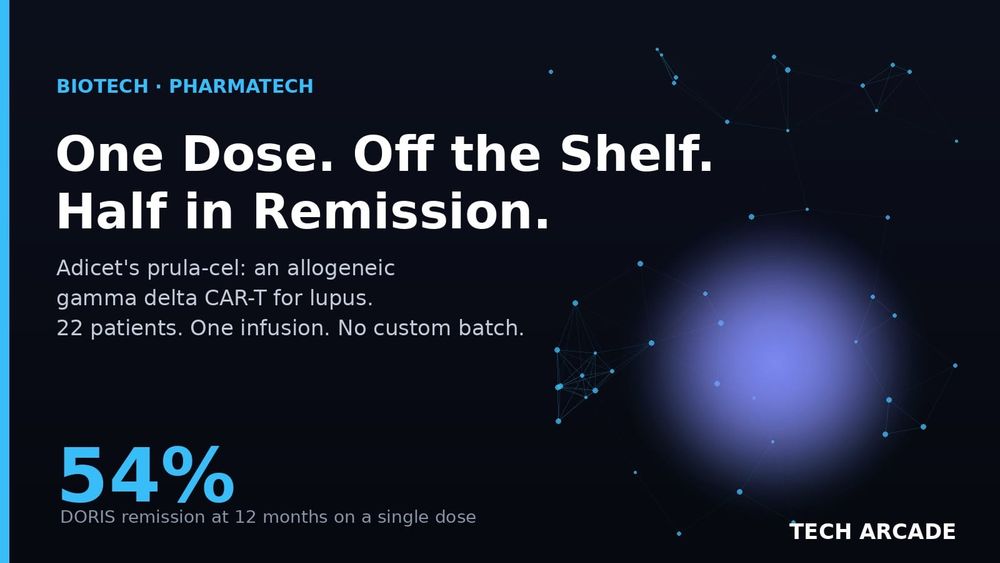

54%. That's the share of patients in a small lupus trial who reached full remission after a single infusion of a cell therapy that came off a shelf, not out of a bespoke manufacturing run built around their own blood.
The therapy is called prula-cel (prulacabtagene leucel, the drug formerly known as ADI-001), and its maker, Adicet Bio, reported the data on September 28. Among 22 efficacy-evaluable patients with systemic lupus, 54% hit DORIS remission at 12 months, half of the kidney-disease patients hit a complete renal response, and every single patient stopped taking immunosuppressants.
Then the stock fell about 22%.
Here's the tension worth sitting with: the science looks like a genuine step forward for autoimmune disease, and the market shrugged. Both reactions can be right at once.
🧠 Why This Matters
CAR-T therapy rewired cancer treatment by turning a patient's own T cells into guided missiles. The catch was always the plumbing. Standard CAR-T is autologous: doctors harvest your cells, ship them to a factory, engineer them, and ship them back. That round trip, the so-called vein-to-vein time, runs into weeks per person, and it costs a fortune to run one tiny batch at a time.
Prula-cel skips all of that. It's allogeneic — built from donor cells, in advance, ready to pull from inventory. One donor run can, in principle, treat many patients. Adicet also uses gamma delta T cells rather than the usual alpha beta ones, a design meant to lower the risk that donor cells attack the recipient.
Lupus is the target because it's common and brutal. A CDC-based estimate puts roughly 204,000 Americans living with the disease, and today's approved biologics — drugs like Benlysta and Saphnelo — manage it rather than reset it, taken indefinitely. A one-time infusion that lets patients walk away from their other lupus drugs is a different proposition entirely.
📊 Deep Dive
The trial covered 22 efficacy-evaluable patients (16 with lupus nephritis, 6 with lupus that had spared the kidneys), with 6 to 21 months of follow-up. The headline numbers, confirmed across the company release and independent coverage:
- DORIS remission: 54% of evaluable patients at 12 months.
- Complete renal response: 50% of lupus nephritis patients at 12 months.
- Off other drugs: 100% discontinued immunosuppressants; all but one patient tapered to 5 mg of prednisone-equivalent or less.
- Biology behind it: 100% of patients hit undetectable CD19+ B cells, and 91% of those who started with high anti-dsDNA antibodies saw those drop.
- Delivery: one dose, off-the-shelf, no per-patient manufacturing wait — versus weeks of bespoke production for autologous CAR-T.
- Versus the field: peer gamma delta therapies have posted complete-response rates around 40%, per BioPharma Dive, so 50-54% reads as competitive.
Safety, the usual worry with cell therapies, held up. Across 24 safety-evaluable patients there was no cytokine release syndrome worse than Grade 2, with mild-to-moderate CRS in about 25%, and zero cases of ICANS (the neurological toxicity that haunts CAR-T) and no graft-versus-host disease (StockTitan).
"We observed complete renal responses and DORIS remissions after a single dose... off immunosuppression." — Lloyd Klickstein, M.D., Ph.D., Interim Chief Medical Officer, Adicet Bio
⚠️ The Catch
Start with the sample size: 22 patients. That's an early-stage read, not a pivotal trial, and remission rates from small groups have a habit of drifting when the numbers get bigger. Twelve-month follow-up is encouraging, but lupus is a lifelong relapsing disease, and "durable" is a word you earn over years, not months.
The safety picture has an asterisk too: infections showed up in 54% of patients, with about 8% of those graded serious — the predictable price of wiping out B cells that also fight infection.
And the market's verdict is hard to ignore. Adicet's shares dropped roughly 22% on the news, landing it among the day's biggest decliners, and its market value sits near $84 million (StockTitan). When strong-looking data meets a falling stock, investors are usually pricing in the distance between a 22-patient signal and an approved product — the years of larger trials, the cash to fund them, and the crowd of rivals chasing the same idea.
🎯 What Happens Next
Adicet says it plans to begin pivotal study start-up activities in Q4 2026, and to look at expanding into lupus patients whose kidneys aren't involved. Pivotal is where the real test lives: bigger enrollment, longer follow-up, and the durability question answered in public.
Watch three things. Whether remissions hold past the two-year mark. Whether the off-the-shelf model actually delivers the cost and access advantages it promises once it's scaled. And whether a company valued at $84 million can afford to run a pivotal autoimmune program without a partner or fresh capital.
🧩 Bigger Picture
CAR-T is quietly migrating out of oncology. The same cell-engineering that clears tumors turns out to be good at resetting the misfiring immune systems behind autoimmune disease — and lupus is only the first stop, with scleroderma, myositis and multiple sclerosis all in researchers' sights.
The unlock everyone is racing toward isn't a better response rate. It's manufacturing. Autologous CAR-T, however powerful, is a hand-built product priced and paced like one. Off-the-shelf therapies like prula-cel are a bet that cell therapy can become something you stock in a freezer and dose on a Tuesday. If that bet pays off, the winners won't just be the labs with the best data — they'll be the ones who can make it by the thousand.
"The data suggests prula-cel has the potential to offer lupus patients a highly differentiated treatment option." — Chen Schor, President and CEO, Adicet Bio
Half of these patients got their lives back on a single dose from a shelf. Now Adicet has to prove it can do that for the other 204,000.
Sources
- Adicet Bio press release — prula-cel SLE safety and efficacy data (BioSpace, Sept 28, 2026)
- BioPharma Dive — An 'off-the-shelf' CAR-T therapy from Adicet shows promise against lupus
- StockTitan — Adicet Bio lupus study: 54% of evaluable patients remit (ACET)
- Lupus Research Alliance — CDC study estimates 204,295 Americans have lupus
- Hematology & Oncology — Autologous vs. allogeneic CAR-T and vein-to-vein time