
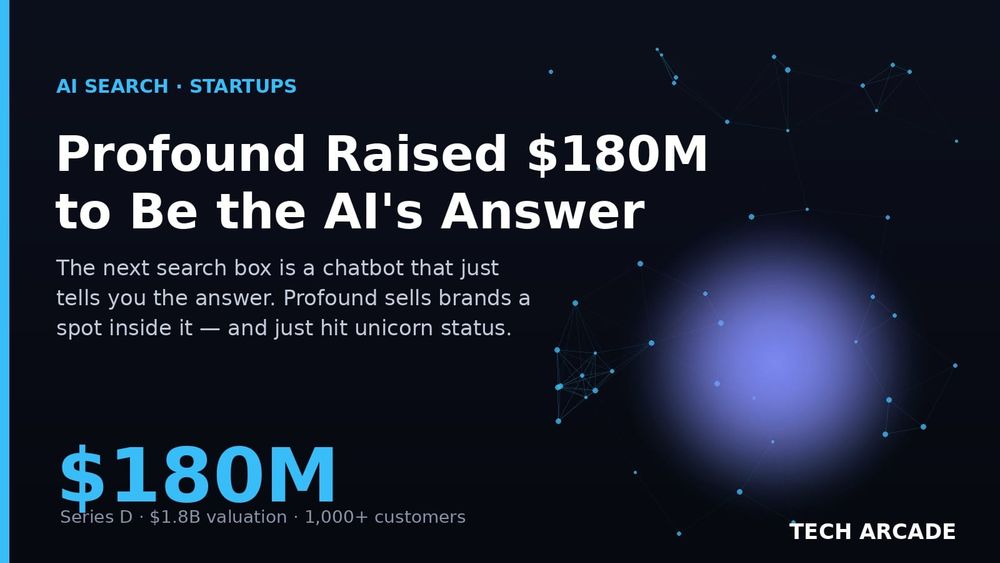

The search box you grew up with — type a few words, get ten blue links, click one — is quietly being swapped out for a chatbot that just tells you the answer. And if the chatbot doesn't say your brand's name, you might as well not exist.
Let's get the number on the table first: $180 million. That's what a roughly two-year-old New York startup called Profound just raised in a Series D round at a $1.8 billion valuation — its first turn as a unicorn — to solve exactly that problem: getting brands named, cited, and recommended inside the answers that ChatGPT, Gemini, and Google's AI Mode hand out ($180M raise (TechCrunch, The Next Web)).
The round was co-led by Sequoia Capital and Kleiner Perkins, with repeat backers Lightspeed Venture Partners and Khosla Ventures piling back in. It landed only about seven months after Profound's $96 million Series C, nearly doubling the check size in half a year (TechCrunch).
Here's the thesis: the business of being found online is being rewritten in real time, and Profound just became the most valuable company betting that tomorrow's winners are whoever the machine decides to mention.
🧠 Why This Matters
For twenty-five years, showing up online meant winning at Google. You optimized keywords, chased backlinks, prayed to the ranking gods, and if you did it right, you landed on page one and people clicked through to your site. An entire industry — search engine optimization — grew up around that single click.
The click is disappearing. When you ask ChatGPT which robot vacuum to buy, it doesn't show you ten links. It gives you a recommendation, in a sentence, often without you ever visiting a website. Analytics firm Similarweb found that AI referral visits to websites grew more than 3x between September 2024 and September 2025, and ChatGPT alone crossed 900 million weekly active users in 2026, up from about 400 million a year earlier (Brenton Way roundup).
So a new discipline has a name — answer engine optimization (AEO), sometimes called generative engine optimization (GEO) — and Profound is the best-funded company selling it. Brands don't want to be a link anymore. They want to be the answer.
📊 Deep Dive
Profound started life as an analytics dashboard: a way for a brand to see how often, and how favorably, it turned up when people queried the big AI models. It has since expanded into research and strategy — telling companies not just where they stand in the machine's answers, but how to move up (The AI Insider).
The traction is real. The company says it now serves more than 1,000 enterprise customers, including Comcast, The Estée Lauder Companies, and Walmart, and that its revenue has tripled over the past six months (TechCrunch). Founded around 2024 by CEO James Cadwallader and Dylan Babbs, it has now raised more than $335 million in total (The Next Web).
"[The forward-deployed marketing engineer] is becoming one of the most important roles in marketing, and this platform we built is for them." — James Cadwallader, CEO and co-founder (The Next Web)
The velocity is the story. Look at the last two rounds side by side:
- Series C (Feb 2026): $96 million raised
- Series D (Sep 2026): $180 million — nearly double, roughly seven months later
- Valuation now: $1.8 billion, a fresh unicorn
- Total raised since 2024: $335 million-plus
- Customers: 1,000+ enterprises, with revenue up 3x in six months
Investors are buying the premise that every large brand will soon need a permanent line item for "how the AI talks about us." A Conductor survey of 250-plus enterprise leaders found companies already devote an average of 12% of digital marketing budgets to AEO/GEO, and 94% planned to increase that spend in 2026 (Conductor).
⚠️ The Catch
Start with the valuation. Profound is worth $1.8 billion on paper, but it has not disclosed its revenue — only that the figure tripled off an unstated base (The Next Web). "Tripled" is thrilling when you start at $20 million and merely tidy when you start at $2 million. Nobody outside the cap table knows which.
Then there's the deeper problem: AEO is optimizing against a target that moves on someone else's whim. Google's ranking algorithm was gameable but stable enough to build a career around. AI models get retrained, reweighted, and rewired constantly, and the companies that run them — OpenAI, Google, Anthropic — can change how citations work, or wall off the data Profound depends on, whenever they like. Google spent two decades fighting SEO spam; the answer engines may decide they don't want to be optimized at all.
Trust is shaky on the consumer end too. Research cited by Gartner found 53% of U.S. consumers distrust the reliability of AI search results — which means the channel Profound sells into is one a majority of users already eye with suspicion (Brenton Way roundup).
🎯 What Happens Next
Expect a land grab. Profound is the best-funded pure play, but the incumbents are moving fast — Semrush, HubSpot, Conductor, and Writer have all bolted AI-visibility features onto their platforms, and every SEO agency on earth is rebranding as an "AEO agency" this quarter. Cheap money plus an obvious buyer means a crowded, noisy market within a year.
The wild card is agentic commerce. As AI assistants start not just recommending products but buying them on a user's behalf, the stakes of being the named brand jump from marketing to revenue. Adobe measured a roughly 693% year-over-year surge in U.S. retail traffic coming from generative-AI tools over the 2025 holidays (Brenton Way roundup). If the agent picks your competitor, you didn't just lose a click. You lost the sale before the shopper knew there was a choice.
🧩 Bigger Picture
SEO built a multibillion-dollar industry on a simple deal: the search engine sends you traffic, and you optimize to earn more of it. The answer engine breaks that deal. It keeps the user on its own page and dispenses a verdict — one brand, one recommendation, no scroll.
Profound's $180 million is a bet that the deal isn't dead, just transferred. Whoever teaches brands to win the machine's single spoken recommendation inherits the throne SEO is vacating. The metrics are opaque and the ground could shift the next time a model gets retrained — but the direction is hard to argue with: the interface between people and products is turning into a conversation, and Profound is selling front-row seats.
The old game was ranking first. The new game is being the only name the machine bothers to say — and there's no page two to fall back to.
Sources
- TechCrunch — AEO startup Profound hits unicorn valuation, raises $180M Series D
- The Next Web — Profound raised $180m at a $1.8bn valuation to sell brands visibility in AI answers
- The AI Insider — Profound Reaches $1.8B Valuation with $180M Series D
- Conductor — 2026 AEO/GEO Benchmarks Report
- Brenton Way — AEO Statistics 2026 (citing Similarweb, Adobe, Gartner)