🔥 Palantir Just Cleared $2 Billion in a Single Quarter for the First Time — and the Stock Fell Anyway
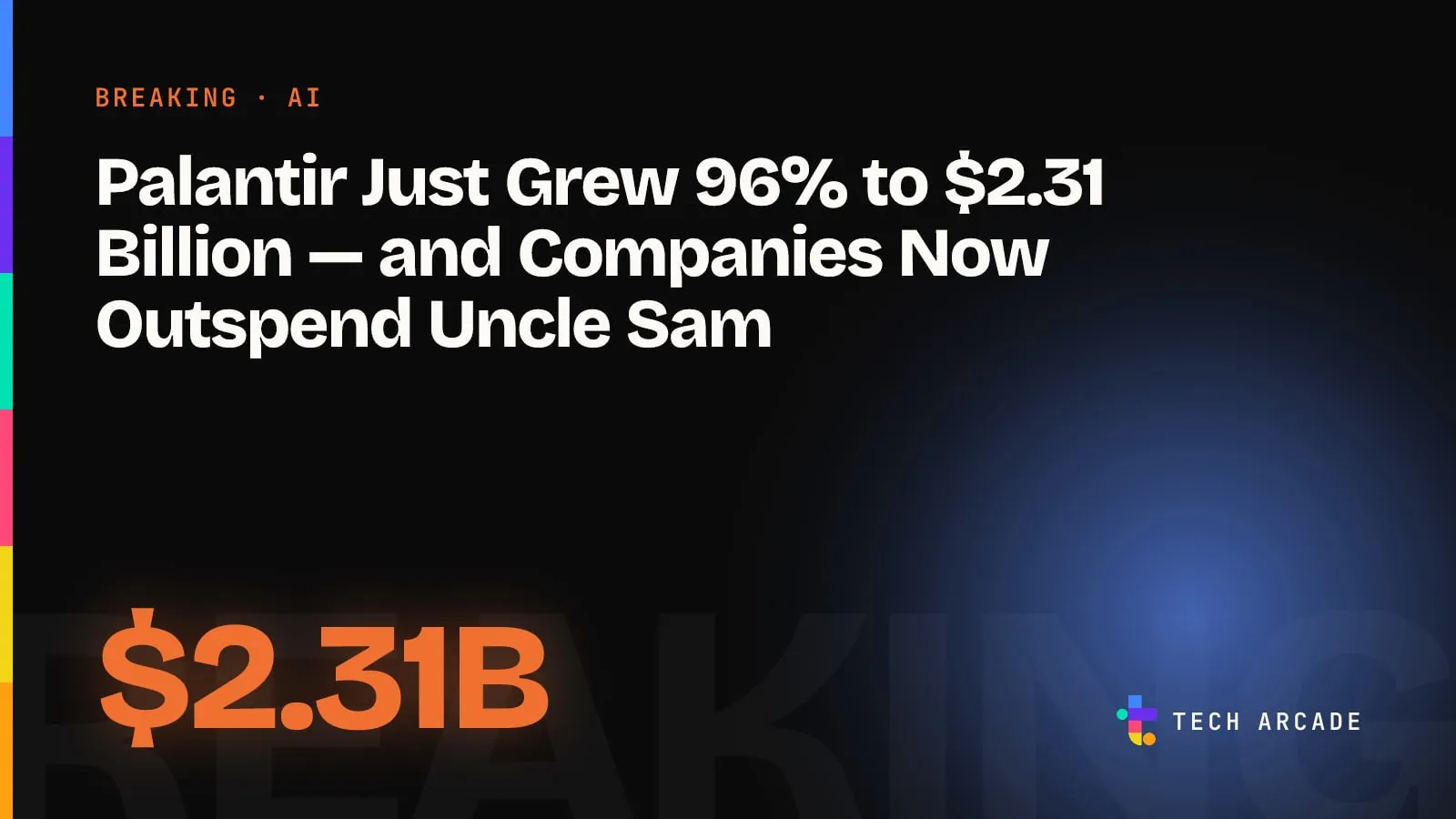
Palantir posted $2.31B in Q3 revenue, up 96%, with U.S. commercial topping government for the first time — and the stock still fell on valuation.

Palantir just did something it had never done before: it booked $2.313 billion in revenue in a single quarter, up 96% from a year ago (Grafa). That is the first time the company has ever cleared $2 billion in three months, and it blew past the $2.18 billion Wall Street expected (TechCrunch).
Then the stock dropped.
Shares slid almost 4% right after the print and were down roughly 6% by the next session, even though Palantir beat on revenue, beat on earnings, and raised its guidance for the rest of the year (247 Wall St.). When a company grows 96% and investors still head for the exits, something more interesting than the headline is going on.
Here’s the thesis: Palantir’s business is firing on every cylinder — and that may be exactly the problem.
🧠 Why This Matters
For years the knock on Palantir was that it was a government contractor wearing an AI costume. That argument just collapsed. U.S. commercial revenue hit $984 million, up 148%, and for the first time ever it outgrew the government business, which brought in $953 million (Grafa). The spy-agency vendor is now, by its biggest-growing segment, an enterprise software company that happens to also sell to spy agencies.
And it is wildly profitable while doing it. Palantir posted $1.128 billion in GAAP net income — a 49% margin — plus $1.216 billion in adjusted free cash flow (Grafa). Software companies growing this fast usually bleed cash to do it. Palantir is printing it.
So why the sell-off? Because the stock had already priced in a quarter this good — and then some. The bar wasn’t “beat expectations.” The bar was “beat the expectations about the expectations.” That’s the trap a stock falls into when it becomes the market’s favorite story.
📊 Deep Dive
The numbers themselves are hard to argue with. CEO Alex Karp opened the call with a line that tells you exactly how the company sees itself:
“Our somewhat crazy aspiration to take the whole market doesn’t look that crazy right now.”
Here’s how the quarter broke down:
- Total revenue: $2.313 billion, up 96% year over year and 20% from the prior quarter (TechCrunch).
- U.S. commercial: $984 million, up 148% — the fastest-growing part of the company and now bigger than government.
- U.S. government: $953 million, up 96% — the “slow” legacy business still nearly doubled.
- Adjusted EPS: $0.44 versus the $0.41 analysts modeled, an 8% beat (Investing.com).
- Full-year guidance: about $8.53 billion, roughly 91% growth, raised again.
- Q4 guidance: $2.65 billion at the midpoint, above the $2.46 billion Street consensus (Yahoo Finance).
Read that list twice. There isn’t a weak line in it. The company guided next quarter above what analysts wanted and still lifted the full-year number. Karp was even blunter about customer stickiness:
“Conversely, once you go Palantir, you do not go back.”
That’s the pitch, and the margins suggest customers are buying it.
⚠️ The Catch
Now the part that made traders nervous. Buried under the record print was a quieter number: total contract value from enterprise deals came in at $1.46 billion — down from a record $2.13 billion the quarter before (TechCrunch).
Why would new-deal value shrink while revenue explodes? Palantir’s answer is that AI buyers now move differently. They sign shorter trials, get hooked, and expand later. Karp described the shift as a “shorter duration of the contract but then an ability to expand that contract dramatically” (TechCrunch).
That’s a plausible, even bullish, reading. But a shorter contract is also an easier contract to walk away from. Faster to sign, faster to cancel. When a stock is valued for flawless compounding years into the future, “customers can leave more easily now” is the kind of footnote that turns a blowout into a sell-off.
The valuation is the real tell. Palantir trades at one of the steepest revenue multiples in all of software, which means every quarter has to be not just great but better than the last fear-of-missing-out spiral priced in. Beat-and-raise used to be enough. Here it wasn’t.
🎯 What Happens Next
Watch two things. First, does enterprise TCV rebound next quarter? If the short-contract theory is right, expansions should start flowing through as expiring trials convert into bigger deals. If TCV keeps sliding, the “easy to cancel” worry gets louder.
Second, watch whether the commercial-over-government crossover holds. This was the quarter U.S. commercial passed government for the first time. One quarter is a milestone; three in a row is a trend — and a trend is what justifies the multiple. Q4 guidance of $2.65 billion gives the company room to prove it.
The broader read-through for you: this is now the dominant pattern of the AI trade. Companies are posting genuinely spectacular numbers, and the stocks are still getting sold because expectations ran ahead of even the good news. Oracle, Super Micro, and others have had versions of the same week.
🧩 Bigger Picture
Strip away the stock move and Palantir’s quarter is a data point about where enterprise AI actually is. A 49% net margin on 96% growth says that at least one company has figured out how to sell AI software at scale without lighting money on fire (Grafa). That’s rare, and it’s real.
But the sell-off is its own data point — about the market, not the company. When beat-and-raise gets punished, it means investors have stopped grading on results and started grading on surprise. The number that matters is no longer revenue. It’s the gap between the number and the dream.
Palantir delivered the number. The dream just wanted more.
Sources
- TechCrunch — Hiding inside Palantir’s skyrocketing quarter is a foreboding signal
- Grafa — Palantir Q3 2026 revenue surges 96% to $2.31bn
- Investing.com — Palantir Q3 2026 earnings call transcript
- 247 Wall St. — Palantir Falls 6% Despite Earnings Beat and Raised Outlook
- Yahoo Finance — Palantir reports bullish Q3 2026, full-year guidance optimistic
❓ Quick answers
How much revenue did Palantir make in Q3 2026?
$2.313 billion, up 96% year over year, reported November 2, 2026 — its first quarter ever above $2 billion (TechCrunch, Grafa).
Why did Palantir stock fall despite beating earnings?
Shares fell about 6% because the stock already traded at one of software's richest valuations, so a beat-and-raise wasn't enough; enterprise contract value also slipped to $1.46B from a record $2.13B the prior quarter (TechCrunch, 247 Wall St.).
Did Palantir's commercial business pass its government business?
Yes — U.S. commercial revenue was $984 million (up 148%) versus $953 million for U.S. government in Q3 2026, the first time commercial led (Grafa).