
For eight years, the private orbital club had exactly two members: the United States, courtesy of SpaceX, and China, courtesy of a scrum of state-adjacent startups. On Saturday, a company from Hyderabad kicked the door open and walked in.
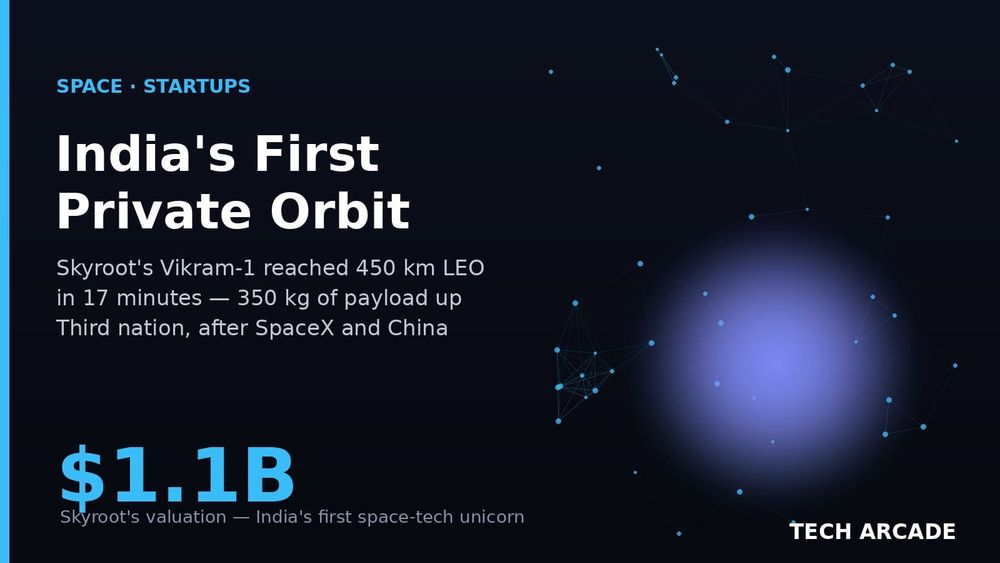
At 12:05 p.m. IST on July 18, 2026, a four-stage rocket named Vikram-1 lifted off from the Satish Dhawan Space Centre in Sriharikota and, roughly 17 minutes later, dropped four satellites into a 450-kilometer low Earth orbit (Space.com). With that, Skyroot Aerospace became the first Indian company — not the government's ISRO, a private company — to reach orbit, making India just the third nation on Earth where a business, not a state agency, can put payloads in space.
The number that frames the whole thing: Skyroot is now worth $1.1 billion, India's first space-tech unicorn (TechCrunch). And it got to orbit for a fraction of what the incumbents spent.
The thesis: the barrier to orbit just moved from national treasuries to Series-B checkbooks — and the next SpaceX might not be American.
🧠 Why This Matters
Reaching orbit is the hardest binary in engineering. You either hit roughly 28,000 km/h of orbital velocity or you become a very expensive firework. There is no partial credit. For six decades, that line was crossed almost exclusively by governments — NASA, Roscosmos, ISRO, CNSA — because the physics demanded budgets only a treasury could sign.
SpaceX broke that assumption for America in 2008. It took until 2026 for a second country's private sector to do it at commercial scale, and it wasn't a Silicon Valley darling — it was two former ISRO engineers, Pawan Kumar Chandana and Naga Bharath Daka, who quit their government jobs in 2018 to build rockets in a rented Hyderabad workshop (TechCrunch). That's the story here. The knowledge that used to live only inside national space agencies is now walking out the door and starting companies.
"The Vikram-1 Aagaman mission is a grand success." — Mission Control Director, Skyroot Aerospace (Space.com)
📊 Deep Dive
Vikram-1 is a seven-story-tall, four-stage expendable rocket built around carbon-composite airframes and 3D-printed engines — the same manufacturing playbook that lets SpaceX and Rocket Lab iterate fast and cheap. It can loft 350 kilograms (about 770 pounds) to low Earth orbit, which puts it squarely in the small-satellite launch market that's exploding as constellations multiply.
The debut wasn't a dummy payload, either. Vikram-1 carried four real customer satellites to orbit:
- SCOPE — Skyroot's own performance-data satellite, gathering telemetry on the vehicle
- SOLARAS S3 — a nanosatellite from Indian startup Grahaa Space
- EMBRACE — a robotic debris-capture arm from India's Cosmoserve Space
- DCUBED demo — a technology demonstrator from Germany
Here's how the private-orbit ledger now reads:
- United States (2008): SpaceX, Falcon 1 — the original private-to-orbit milestone
- China (early 2020s): a cluster of commercial launchers reaching orbit
- India (2026): Skyroot, Vikram-1 — 350 kg to LEO, backed by a $1.1B valuation
The money tells the same acceleration story. Skyroot closed a $60 million round in May 2026 — $50 million in equity plus $10 million in structured debt — co-led by Sherpalo Ventures and Singapore's sovereign fund GIC, with debt from BlackRock-affiliated funds (Via Satellite). That round more than doubled the company's valuation from $500 million in 2023 to $1.1 billion. Even Ram Shriram — Sherpalo founder and a longtime Alphabet board member — is taking a board seat.
⚠️ The Catch
One successful launch is a milestone, not a business. SpaceX flew Falcon 1 to orbit in 2008 and still nearly went bankrupt before it turned launch into a cash machine. Skyroot's plan is to reach a cadence of one rocket per month — but there's a canyon between a triumphant debut and a reliable, repeatable production line, and it's littered with companies that cleared the first and never crossed the second.
Vikram-1 is also expendable — every rocket is thrown away after a single flight. SpaceX's cost advantage comes almost entirely from reusability, and Skyroot doesn't have it yet. Until it does, its economics look more like a very efficient traditional launcher than a genuine SpaceX-style disruptor. And the small-sat launch market it's targeting is getting crowded fast, with Rocket Lab, dozens of Chinese firms, and SpaceX's rideshare program all fighting for the same payloads.
🎯 What Happens Next
Watch the second launch. In this business, flight two matters more than flight one — it's the difference between a stunt and a service. If Skyroot can turn Vikram-1 around on anything close to a monthly cadence, the customer manifest will fill quickly, because India's launch prices undercut nearly everyone.
Watch the capital, too. Having GIC, Sherpalo, and BlackRock money on the cap table means the next round could be enormous, and it would likely fund the reusable vehicle that actually threatens incumbents. The unicorn tag was earned before the rocket flew; now that it has, expect the valuation conversation to reopen.
🧩 Bigger Picture
India's space economy is estimated at $8.4 billion today and is projected to reach $44 billion by the early 2030s, with roughly 400 space-tech startups already operating (TechCrunch). Saturday's launch is the proof-of-concept that the whole ecosystem was waiting for — evidence that Indian engineers can build orbital hardware without a government agency's balance sheet behind them.
Zoom out further and the pattern is unmistakable. Space is de-nationalizing. The capability that once defined superpower status — the ability to reach orbit — is diffusing into the private sector, country by country, and the price of admission keeps falling. A decade ago, "the next SpaceX" was a Silicon Valley thought experiment. On Saturday, it filed its debut flight from Sriharikota.
The club of nations that can reach orbit has always been small. The club of companies that can is now growing faster — and it just added a member most people couldn't have named a year ago.
Sources
- Space.com — Vikram-1, India's 1st private orbital rocket, aces debut launch
- TechCrunch — India's first space tech unicorn emerges as Skyroot gears up for orbital launch
- Via Satellite — Skyroot Secures $60M, Becoming India's First Space 'Unicorn'
- Bloomberg — Skyroot Rockets to Unicorn Status Backed by GIC, BlackRock Funds
- Tech Times — Skyroot Clears Orbit on Debut, Making India Third Private Space Nation