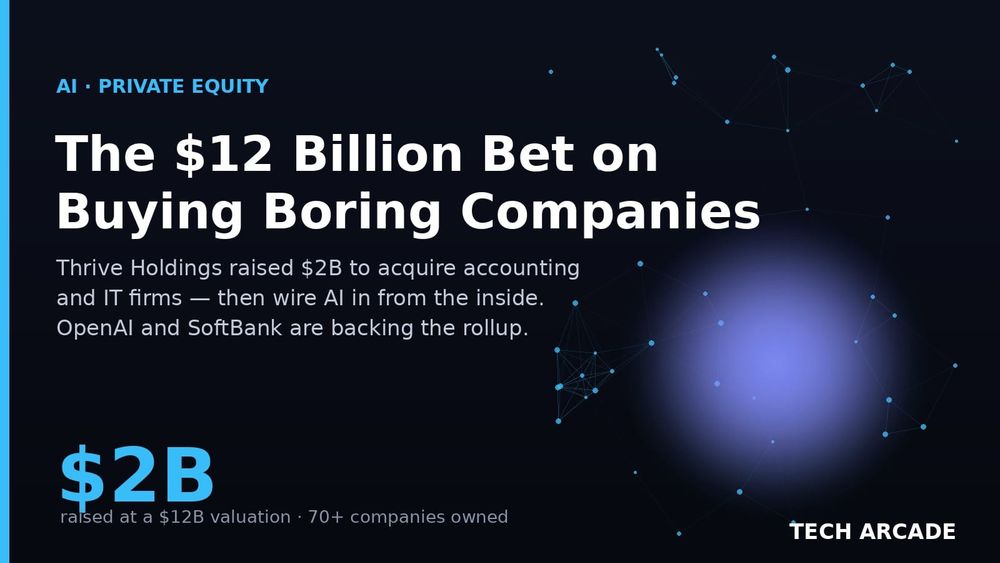

Most AI startups sell you software and hope you plug it in. Thrive Holdings has a different idea: buy the whole company first, then wire the AI in from the inside.
Let's get the number on the table first: $2 billion, raised at a $12 billion valuation, for a firm that owns accounting practices and IT shops — not a chatbot, not a model, not a coding tool (TechCrunch).
The round was led by SoftBank, D1 Capital Partners, and Altimeter Capital, and it comes with a name attached that tells you where the technology is coming from: OpenAI, which has held a stake in the company since December 2025 (TechFundingNews).
Here's the thesis in one line: the hottest bet in AI right now isn't a smarter model — it's owning the unglamorous businesses that model can quietly make cheaper to run.
🧠 Why This Matters
For three years, the AI money went to the model makers and the app layer on top — the Cognitions and Lovables of the world, priced in the tens of billions on the promise that they'll sell AI to everyone else. Thrive Holdings, a spinout of Josh Kushner's venture firm Thrive Capital, is running the play from the other end.
Instead of selling software to an accounting firm, it buys the accounting firm. Then it drops in AI agents to do the repetitive work, keeps the humans for the judgment calls, and pockets the margin difference. Wall Street has a nickname for this now: the "AI rollup."
It matters because it's a real-economy test. Everyone keeps asking whether AI actually shows up in productivity numbers. Thrive owns the balance sheets where you'd see the answer.
📊 Deep Dive
Thrive Holdings already sits on top of more than 70 businesses, organized into two platforms (Yahoo Finance / TechCrunch):
- Current — the accounting arm: 50-plus firms and 2,000-plus professionals doing tax and bookkeeping.
- Shield — the IT services arm: roughly 20 companies running help desks and managed tech.
- The raise itself: $2B new capital on top of about $1 billion already committed from Thrive Capital's institutional base — a $12B valuation for a company most people have never heard of.
- The OpenAI wrinkle: the December 2025 deal reportedly puts OpenAI staff working directly inside Thrive's portfolio companies to speed up AI adoption.
The early numbers are the whole pitch. Thrive says its TaxAI system has processed more than 7,000 tax returns at 98% accuracy, cutting preparation time by over 30%. On the IT side, Shield's tools have reportedly pushed help-desk resolution times 36 times faster, and the number of custom AI agents deployed roughly doubled in a single month (Crypto Briefing).
Next up is a third platform, aimed at regulatory and compliance services for physical infrastructure — data centers, manufacturing, power, healthcare, transportation — the paperwork-heavy corners of the economy that AI hasn't touched yet.
"AI partnered with a lot of the experts and practitioners at these businesses can really help compress regulatory bottlenecks, keep the safety standards high, but also be able to do it with less of a burden." — Kareem Zaki, founding member, Thrive Holdings
⚠️ The Catch
Strip away the AI label and you're looking at a private-equity roll-up — buy up fragmented mom-and-pop firms, squeeze costs, sell the bundle later. That playbook is decades old, and its usual cost-cutting lever is people. Thrive insists the humans stay; its own leadership says AI "won't replace field work, local judgment, or professional sign-off." The margins only work if that promise and the productivity gains both hold.
Then there's the froth. One recent tally found 87.5% of U.S. venture dollars flowed into AI deals this year (Fortune). A $12 billion valuation on a portfolio of accounting and IT shops leans hard on the assumption that the AI part keeps compounding — and that cheap capital keeps flowing.
And the dependency runs deep: the technology edge is largely OpenAI's, right down to OpenAI's own people embedded in the portfolio. If that relationship shifts, so does the moat.
🎯 What Happens Next
Expect Thrive to spend fast. The new capital is earmarked for more acquisitions and the launch of that third, compliance-focused platform. The tell to watch isn't the deal count — it's the margins. If Current and Shield can lift profitability at the firms they already own, the roll-up thesis is real. If AI just becomes another line item that never quite pays for itself, this becomes an expensive lesson in old-fashioned PE dressed up in new clothes.
Watch, too, whether other investors copy the structure. When SoftBank and Altimeter write nine-figure checks into a model, imitators tend to follow within a quarter.
🧩 Bigger Picture
The first wave of the AI boom asked companies to adopt the technology. This is a bet that the faster route is to own the company and adopt it for them. It's software-eats-the-world, except instead of selling the software, you buy the business and eat the labor cost from the inside.
If it works, expect a stampede of AI-native private-equity firms hunting for boring, people-heavy, high-margin services — the exact industries that spent the last decade assuming they were too messy to automate. If it doesn't, Thrive will have proven something almost as useful: that owning the workflow is not the same as fixing it.
Either way, the experiment is now funded to the tune of $2 billion, and the results will show up somewhere no slide deck can hide — on the books of 70 real companies.
The AI hype cycle finally bought a building. Now we get to see if anyone inside it actually works faster.
Sources
- TechCrunch — OpenAI-backed Thrive Holdings raises $2B to bring AI to the enterprise
- TechFundingNews — Josh Kushner's Thrive Holdings raises $2B at a $12B valuation
- Crypto Briefing — Thrive Holdings raises $2B at $12B valuation
- Yahoo Finance — OpenAI-backed Thrive Holdings raises $2B
- Fortune — 87.5% of venture dollars went to AI