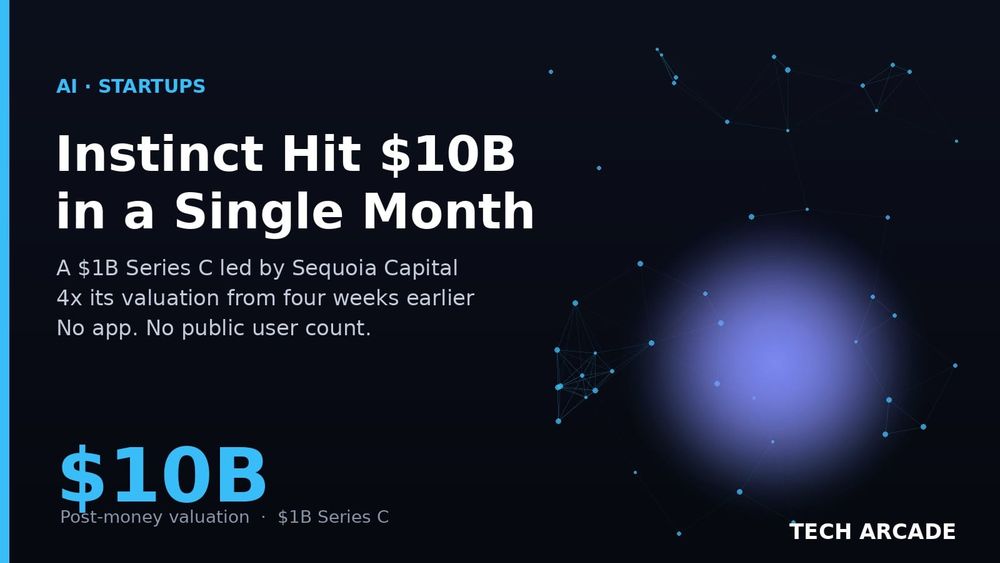

Here is a number to sit with: $10 billion. That is what investors now say a personal AI assistant called Instinct is worth, after it raised a $1 billion Series C led by Sequoia Capital, with Benchmark and Coatue along for the ride (Pulse 2.0).
The round closed around September 28. The striking part is the speed. Roughly one month earlier, Instinct had raised a $250 million Series B at a $2.5 billion valuation, co-led by Index Ventures and Benchmark (Layer3 Labs). So the price tag quadrupled in about four weeks (TechJack Solutions).
What makes that leap unusual: Instinct still runs invite-only, has not shipped a mobile app, and has disclosed zero user numbers and zero revenue (Phemex).
The thesis: the market is now paying ten figures for the promise of an agent that does your errands — before anyone outside the invite list can tell you whether it works.
🧠 Why This Matters
Most of the AI money so far has gone into models that tell you things — answer a question, draft an email, summarize a PDF. Instinct is selling something narrower and harder: an agent that finishes the task. It texts and calls on your behalf to plan trips, order groceries, book tickets, cancel subscriptions, and argue with a service provider until the problem is fixed (Dealroom).
If that category works, it is worth a fortune, because it eats the part of your week nobody enjoys. If it doesn't, you have handed your calendar and your credit card to a bot that occasionally makes things up. Sequoia is betting a billion dollars that the first scenario wins.
"We're building Instinct to be the best personal agent that can handle the deeply personal nuances of everyday life. This funding helps us bring Instinct to more people and continue building the future of personal AI." — Noah Shinn, founder of Instinct
📊 Deep Dive
The founder is a large part of the story. Noah Shinn is 23. He studied at Northeastern and MIT, dropped out in 2023, and became one of the earliest employees at Sierra, the agent company (Layer3 Labs). Before any of that, at 20, he was first author on Reflexion, a widely cited paper on agents that learn from their own mistakes through self-critique rather than retraining. In its benchmark, Reflexion hit 91% pass@1 on HumanEval, against GPT-4's then-best 80% (arXiv).
That pedigree matters because it explains the valuation more than any shipped metric does. Investors are paying for the view that Shinn understands how to make agents self-correct — the exact failure mode that sinks most "do it for me" products.
Instinct's feature set leans into the hard, human stuff: an Instinct Concierge for white-glove tasks like phone calls and hard-to-book reservations, a Trusted Person Network that lets your agent coordinate with other people's agents, location-aware iMessage suggestions, and privacy plumbing like isolated sandboxes and hallucination detection (Dealroom).
For scale, here is how Instinct's raise sits against the other big AI rounds from the same week (September 26 – October 2), per Crunchbase:
- Instinct — $1B Series C at a $10B valuation (personal AI agent)
- EliseAI — $350M at a $4B valuation (AI for rental housing)
- Armadin — $255.5M Series B at $2.5B+ (AI-native cybersecurity)
- GMI Cloud — $223M equity plus $445M debt (GPU cloud for AI)
- General Intuition — $220M at a $6.2B valuation (world models from video)
Instinct raised more than the next two rounds combined — for a product with the least public evidence of traction on the list.
⚠️ The Catch
Start with the obvious: no disclosed users, no revenue, no app, invite-only. A $10 billion valuation on an undisclosed user base is a bet on a person and a category, not on a business you can measure yet.
Then the category risk. An agent that books, buys, and cancels on your behalf has to be right nearly every time, because a wrong hotel or a missed cancellation costs you real money. Instinct's own pitch — building in hallucination detection and sandboxes — is a tacit admission that the failure modes are serious.
And the competition is not a startup. Meta is building a rival consumer agent, Muse, under an internal effort reportedly overseen by Mark Zuckerberg; Meta's team has publicly needled Instinct, at one point mocking the name as "Insect" and touting Muse's speed (Fortune). A 23-year-old with a billion dollars is well funded. Meta has data centers, a few billion users, and patience.
🎯 What Happens Next
Watch for three things. First, a public launch and a user number — the moment Instinct opens the gates and says how many people actually use it, the $10 billion gets a reality check in either direction. Second, a mobile app, since a personal agent that lives only in text and phone calls has a ceiling. Third, reliability data: not demos, but how often the agent completes a booking correctly without a human bailing it out.
The $1 billion gives Shinn a long runway to answer those questions. It also raises the bar: at this price, "promising" is no longer enough.
🧩 Bigger Picture
Instinct is the clearest sign yet that the AI market has moved its bets from chatbots to agents that act — and that it will pay enormous premiums for the teams it thinks will get the reliability right. Nine of the ten biggest venture rounds that week were AI, and the single largest went to the one selling autonomy rather than answers.
That is either the start of the most useful software category in years, or the point where valuations fully detached from shipped products. For now, a 23-year-old who literally wrote the paper on self-correcting agents gets to decide which.
Ten billion dollars, no app, no user count — and the whole thing riding on whether a bot can cancel your gym membership without canceling your flight.
Sources
- Pulse 2.0 — Instinct Raises $1 Billion Series C at $10 Billion Valuation
- Dealroom — AI startup Instinct raises $1B Series C at $10B valuation
- TechJack Solutions — Instinct's $10B Valuation, Four Times Its Prior
- Phemex — No app, no disclosed user metrics
- Layer3 Labs — Who Is Noah Shinn? Instinct Founder and Reflexion Author
- Reflexion: Language Agents with Verbal Reinforcement Learning (arXiv)
- Fortune — Noah Shinn, Instinct, and the Meta Muse rivalry
- Crunchbase — The Week's 10 Biggest Funding Rounds