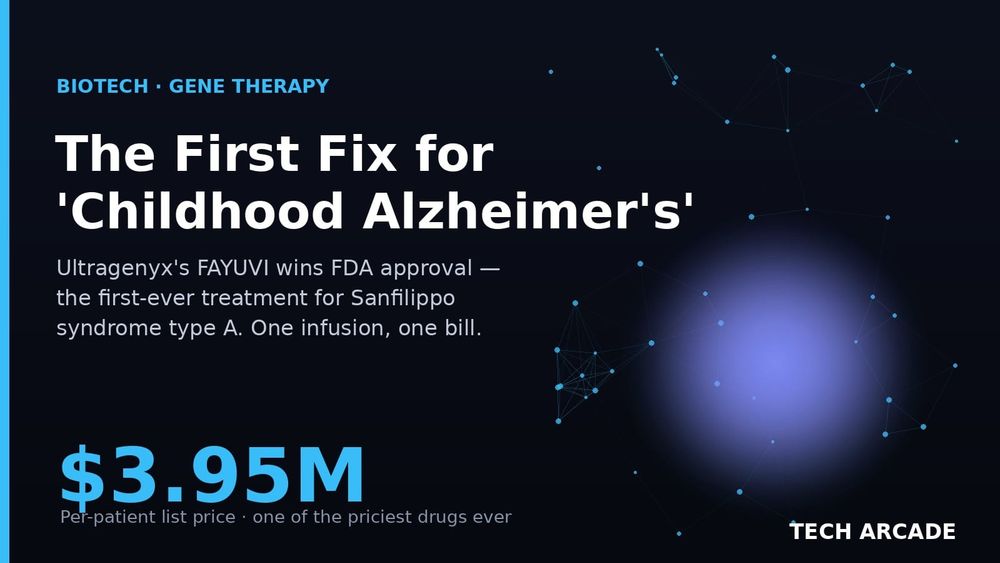

For twenty years, a diagnosis of Sanfilippo syndrome type A came with a script that never changed: your child will slowly lose speech, then memory, then movement, and there is nothing to prescribe. On September 17, 2026, that changed. The FDA approved FAYUVI (rebisufligene etisparvovec-hopf), the first-ever treatment for the disease, made by Ultragenyx (FDA).
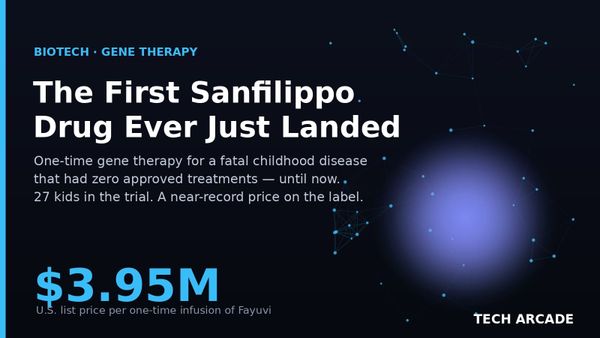
Let's get the number on the table first: $3.95 million. That's the U.S. list price for a single infusion, making FAYUVI one of the most expensive drugs ever sold (BioSpace).
Sanfilippo type A is a rare, inherited disorder that strips children of the abilities they've already learned — which is why doctors call it "childhood Alzheimer's." Most kids don't reach their mid-teens. Median life expectancy is about 15 years (Pharmaceutical Technology).
The thesis: FAYUVI is a genuine medical first that will save a small number of children, and a pricing event that forces everyone to ask what a one-shot cure is actually worth.
🧠 Why This Matters
Sanfilippo type A comes from mutations in a gene called SGSH. Without it, cells can't make an enzyme called sulfamidase, so a sugar molecule named heparan sulfate builds up — including in the brain. The accumulation is what quietly dismantles a child's nervous system.
FAYUVI is a single-dose intravenous gene therapy. It uses a modified, non-infectious virus (an AAV9 vector) to carry a working copy of SGSH into the body's cells, so they can start producing sulfamidase on their own and clear the backlog (FDA). One infusion, done in a hospital equipped to handle reactions, with a course of corticosteroids starting the day before and running at least eight weeks after.
The reason this lands as a milestone rather than a footnote is simple: there was nothing before it. Every prior option for these families was supportive care — managing symptoms while the disease ran its course.
"This would just finally mean when patients receive this diagnosis, they would be given hope and an action plan." — Cara O'Neill, chief science officer, Cure Sanfilippo Foundation (STAT)
📊 Deep Dive
The approval rests on Ultragenyx's Transpher A study, a single-arm trial that compared treated children against an external group of untreated patients tracked over time. In the primary analysis, 17 FAYUVI-treated children were measured against a natural-history cohort of 27 untreated patients (Ultragenyx).
The headline result: treated children scored 23.5 points higher on a cognitive assessment than the untreated group over the study period, a gap the company reported at p<0.0001 — statistically about as clean as trials get. The therapy also lowered heparan sulfate in the cerebrospinal fluid, the biomarker that tracks the disease's damage (Ultragenyx).
Now put the economics side by side:
- Price per patient: $3.95 million, paid once (CNBC).
- Cost of doing nothing: lifetime care for an untreated child can exceed $8 million (Pharmaceutical Technology).
- Addressable patients: roughly 3,000 to 5,000 across commercially accessible markets (BioSpace).
- Projected peak sales: about $250 million a year, per a Jefferies estimate (BioSpace).
- Bonus prize: approval came with a rare pediatric disease Priority Review Voucher, tradeable and currently worth roughly $150–200 million (Pharmaceutical Technology).
FAYUVI carried Orphan Drug, Fast Track, and Breakthrough Therapy designations on its way through review — the regulatory fast lanes reserved for serious conditions with no alternatives (FDA).
⚠️ The Catch
Three of them, actually.
First, the trial is small and single-arm. Seventeen treated children against a historical comparison group is enough for the FDA to act on a devastating disease with no treatment, but it isn't the large randomized study you'd want for a common condition. The long-term durability of a one-time gene fix — does sulfamidase keep flowing a decade later? — is a question the data can't yet answer.
Second, the road here was not smooth. Ultragenyx was rejected in July 2025 over manufacturing issues, not efficacy, and had to fix its production process before coming back (BioSpace). Gene therapy is as much a factory problem as a science problem.
Third, and loudest: the price. At $3.95 million, a single insurer or state Medicaid program covering a handful of kids absorbs a real budget hit up front, even if the lifetime math favors treatment. And earlier diagnosis matters enormously — the therapy works best in young children, before too much damage is done, yet Sanfilippo is often caught late because its early signs look like ordinary developmental delay.
🎯 What Happens Next
Ultragenyx's stated priority is getting the therapy to families quickly and lining up insurance coverage in the U.S.
"We recognise the profound urgency of making this therapy available to families, and our focus now is on supporting timely access in the US." — Emil Kakkis, CEO, Ultragenyx (Pharmaceutical Technology)
Watch three things. Whether payers agree to outcomes-based deals, where the $3.95 million is paid out over time and tied to the child actually benefiting. Whether newborn screening programs add Sanfilippo type A, since a treatment that only works early is only as good as the diagnosis that precedes it. And whether Ultragenyx sells or banks that Priority Review Voucher to help fund the next program.
🧩 Bigger Picture
FAYUVI is the latest data point in a shift that's been building for years: medicine moving from lifelong management to one-and-done genetic repair. When it works, a single infusion replaces decades of care. The trade-off is that the entire value of a lifetime of treatment gets compressed into one invoice — and the healthcare system, built to pay in monthly installments, keeps flinching at the lump sum.
For roughly a few thousand families worldwide, that debate is abstract. What's concrete is that a diagnosis which used to end one way now comes with an action plan. The pricing fight over how to pay for cures is real and unresolved. For the kids getting the infusion, it's also beside the point.
A cure you can't afford is a cruel kind of progress — but a cure that didn't exist a month ago is still a cure.
Sources
- FDA — FDA Approves First Gene Therapy for Pediatric Patients with Sanfilippo Syndrome Type A
- Ultragenyx — Announces Approval of FAYUVI Gene Therapy (Transpher A trial data)
- BioSpace — Ultragenyx Wins FDA Greenlight for First Sanfilippo Therapy, Priced at Nearly $4M
- CNBC — Ultragenyx Sets $3.95 Million Price for Rare Disease Gene Therapy
- Pharmaceutical Technology — FDA Approves First Gene Therapy for Sanfilippo Syndrome Type A
- STAT — FDA Approves a New Gene Therapy for Sanfilippo Syndrome