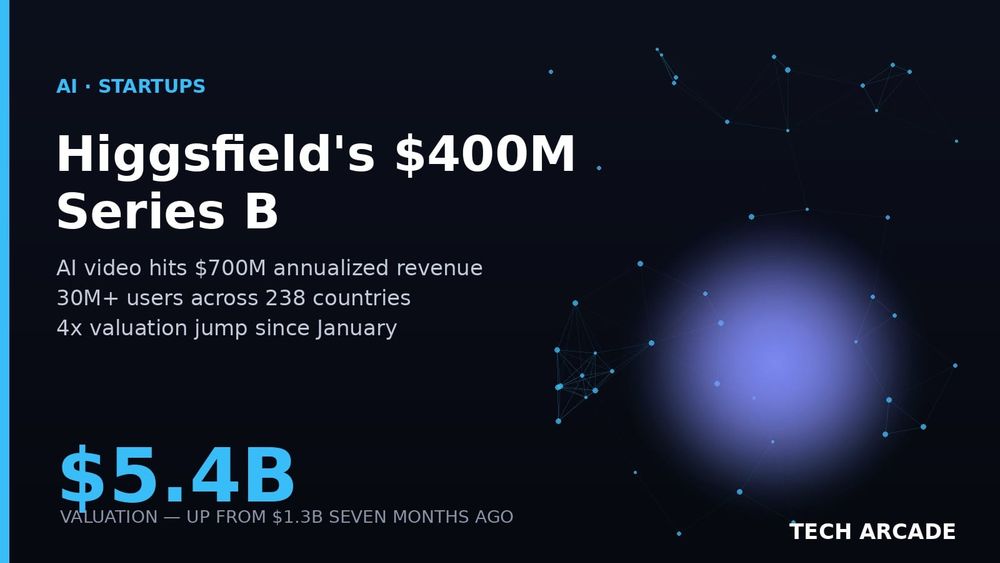

Fifteen months ago, Higgsfield was a curiosity — a scrappy AI video tool with a viral camera-move gimmick and a founder most people outside Silicon Valley had never heard of. On August 17, 2026, it closed a $400 million Series B at a $5.4 billion valuation (PR Newswire).
Here's the number that actually matters: $700 million. That's Higgsfield's annualized revenue as of this month — the run rate a company barely three years old is now printing (Pulse 2.0). In January, the same company raised money at a $1.3 billion valuation. Seven months later it's worth more than four times that.
The thesis in one line: AI video stopped being a demo and turned into a real business — and Higgsfield is the fastest-growing proof.
🧠 Why This Matters
For two years, generative video was the flashy sibling that couldn't hold a job. Gorgeous clips, wobbly hands, no revenue. The knock was always the same: fun to watch, impossible to monetize.
Higgsfield is the counterargument with a P&L attached. 390 of the Fortune 500 are now customers — advertising, media, retail, fashion, even pharma (PR Newswire). The platform serves 30 million-plus users across 238 countries and pumps out more than 20 million content generations a month. When your marketing team needs forty ad variants by Friday, you're the reason a $700 million run rate exists.
Investors noticed. The round was led by Yuri Milner's DST Global, with growth equity from Goldman Sachs Alternatives, plus Intel Capital, Tribe Capital, Fifth Wall, Smash Capital, and Mirae Asset (TechFundingNews). This is not a crypto-style crowd chasing vibes. It's the balance-sheet money.
"Every business needs visual content, but creating it at the quality, speed and scale companies demand remains complex." — Alex Mashrabov, Co-Founder & CEO, Higgsfield
📊 Deep Dive
Higgsfield's trick isn't a single frontier model. It's a workflow layer that stitches together the best video and image engines, wraps them in templates marketers actually understand, and charges a subscription. Founder Alex Mashrabov ran generative AI at Snap and sold his earlier startup, AI Factory, to Snap for $166 million in 2020 (TechFundingNews). He knows how to ship consumer AI that sticks.
The inflection came in May 2026, when Higgsfield launched a product it calls "Supercomputer." Since then, users of its agentic tools have grown 42-fold in three months (PR Newswire). Here's how the money is stacking up against the rest of the AI-video field:
- Higgsfield: $400M raise, $5.4B valuation, ~$700M annualized revenue (Aug 2026)
- Runway: $315M raise, $5.3B valuation, led by General Atlantic (Feb 2026) — now leaning into "world models" and robotics (TechCrunch)
- Higgsfield's own trajectory: $1.3B valuation in January → $5.4B in August, a 4x-plus jump in seven months
- Valuation-to-revenue: roughly 7.7x annualized revenue — rich, but a fraction of the 30x-plus multiples paid at the 2024 peak of AI hype
Two comparably valued companies, two different bets. Runway is retreating toward the lab, chasing simulation and robotics. Higgsfield is running straight at the enterprise marketing budget. So far, the marketing budget is paying better.
⚠️ The Catch
Fast growth left fingerprints. In February 2026, Forbes documented racist videos generated on the platform and a string of payment complaints — "the dark side" of Higgsfield's super-fast growth (Forbes). Around the same stretch, the company's account on X was suspended amid backlash over aggressive growth tactics (No Film School).
Then there's the math. A $5.4 billion price on $700 million of revenue only works if that revenue keeps compounding. AI video is brutally compute-hungry, the underlying models are largely rented from other labs, and the switching cost for a marketer is one cancelled subscription. If growth cools even a little, that 7.7x multiple stops looking cheap and starts looking like a bet on a curve that never bends.
"We are looking forward to supporting Alex, Yerzat, and the team as they build the next generation of AI tools." — Yuri Milner, Founder, DST Global
🎯 What Happens Next
The money is earmarked for R&D, global infrastructure, and AI-talent hiring (PR Newswire). Translation: Higgsfield wants to own more of its own model stack so it isn't renting the engine that drives its margins. Expect a harder push into enterprise contracts — the kind with legal review, brand-safety clauses, and the boring guardrails that keep Fortune 500 CMOs from getting fired. The trust problems of early 2026 are now a business problem, not just a PR one.
🧩 Bigger Picture
Zoom out and a pattern appears: the AI companies quietly winning aren't the ones building the biggest foundation model — they're the ones wrapping models in a workflow someone will pay for every month. Higgsfield doesn't need to beat the labs at raw video quality. It needs to be the tool a marketing manager opens on Monday. That's a much smaller, much more winnable game, and $700 million says the strategy is landing.
The AI-video field is now a two-horse sprint at the top — one horse (Runway) drifting toward the research frontier, the other (Higgsfield) parked on the ad budget. Elsewhere, well-funded rivals including China's Kling, backed by Alibaba, Tencent, and Baidu, are pushing their own video models into the market. The category that couldn't make a dollar in 2024 now has multiple players clearing hundreds of millions.
The demo era is over. Higgsfield just proved the invoice era pays better — the only question left is whether the invoices keep coming.
Sources
- Higgsfield Series B announcement — PR Newswire
- Higgsfield Raises $400M at $5.4B — Pulse 2.0
- Higgsfield raises $400M from Goldman Sachs, DST Global — TechFundingNews
- Runway raises $315M at $5.3B — TechCrunch
- The Dark Side of Higgsfield's Super-Fast Growth — Forbes
- Higgsfield AI's X Account Suspended — No Film School