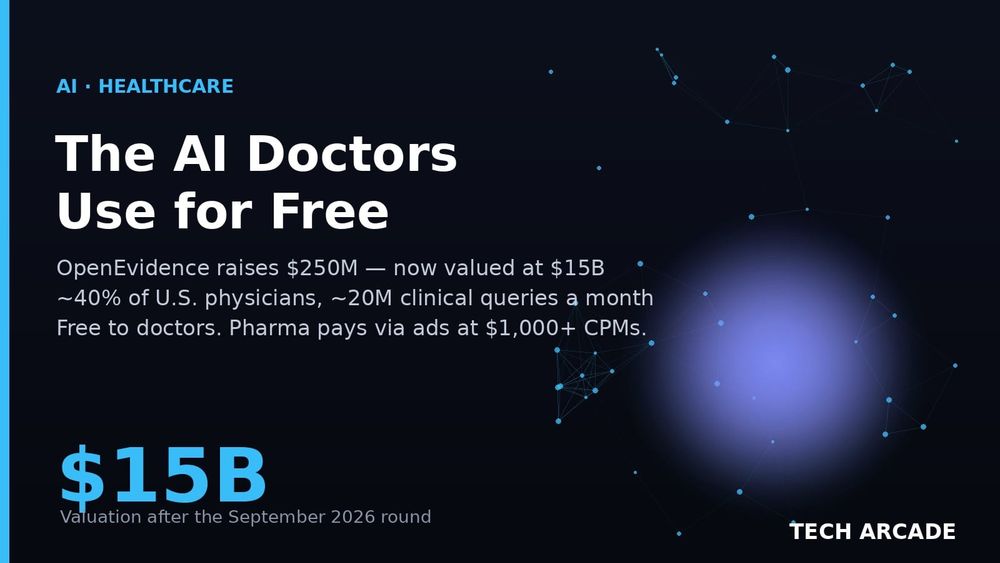

Here's a number that should stop you: $15 billion. That's what investors just decided OpenEvidence is worth, after the medical-AI company raised a fresh $250 million round led by Andreessen Horowitz, with hospital systems joining in (Axios, Refresh Miami).
Now here's the number that makes it strange: $0. That's what the roughly 40% of U.S. physicians who use OpenEvidence pay to use it (AI Weekly). The product is free. The doctors are the audience, not the customers.
So who pays? Pharma. Medical-device makers. The people who very much want to reach a physician in the three seconds before a prescribing decision. OpenEvidence is a $15 billion advertising business wearing a lab coat — and that's exactly why it's growing this fast.
🧠 Why This Matters
OpenEvidence calls itself an AI clinical-search engine. In plain terms: a doctor types a messy real-world question — drug interactions, an odd lab result, a treatment path for a specific cancer stage — and gets back a synthesized answer grounded in peer-reviewed literature, with citations to sources like the New England Journal of Medicine and JAMA (Wikipedia).
The traction is the story. More than 750,000 verified physicians have registered, and the platform fields around 20 million clinical queries a month (valueaddvc). CEO Daniel Nadler says more than 40% of U.S. physicians now use it daily, and that doctors using the tool treated roughly 100 million Americans last year (Fierce Healthcare). When a piece of software quietly slips into the exam room for a big share of a whole profession, the valuation stops looking like hype and starts looking like math.
📊 Deep Dive
The valuation didn't creep. It climbed a ladder, two rungs at a time. Miami-based OpenEvidence was founded in 2022 by Nadler — who previously built the financial-analytics company Kensho — and machine-learning researcher Zachary Ziegler (Refresh Miami). Here's the climb:
- Feb 2025 — $1B: $75M Series A, led by Sequoia.
- Jul 2025 — $3.5B: $210M, with Google Ventures and Kleiner Perkins.
- Oct 2025 — $6B: $200M Series C.
- Jan 2026 — $12B: $250M Series D.
- Sep 2026 — $15B: $250M, a 25% step up in eight months.
That's a roughly 15x valuation jump in about 19 months, and more than $1 billion raised in the past year alone from a backer list that includes Nvidia, Thrive Capital, DST, Blackstone, and Mayo Clinic (Wikipedia).
The engine underneath is the ad model. Verified U.S. clinicians get in free, which skips the brutal hospital-procurement cycle entirely. Revenue comes from pharmaceutical and device ads shown while the AI answer generates — and those slots are expensive, with CPMs reaching $1,000 and above (Sacra). Sacra estimates OpenEvidence hit roughly $300 million in annualized revenue by mid-2026, up from about $150 million exiting 2025, at gross margins near 90%. It reportedly sells only about 5% of its ad inventory so far, which is either a rounding error or a very large runway, depending on how you squint.
"Healthcare can't be a side hustle. We have one division. We wake up every morning thinking about healthcare." — Daniel Nadler, CEO, OpenEvidence (Fierce Healthcare)
⚠️ The Catch
Read that revenue model again slowly. A drug company can pay to appear at the precise moment a physician is deciding what to prescribe, inside a tool the physician trusts to be neutral and evidence-based. That's a powerful place to stand, and it raises the obvious question: can an answer be truly impartial when the space around it is auctioned to the makers of the products in that answer? OpenEvidence says ads sit beside the clinical response rather than inside it, but the tension is baked into the business.
Then there's the accuracy problem every clinical AI carries. A confident, well-cited, wrong answer in medicine isn't an embarrassing screenshot — it's a patient. And at $15 billion on roughly $300 million of revenue, you're looking at about a 50x revenue multiple, which prices in years of flawless execution.
🎯 What Happens Next
Two moves to watch. First, the exit: the founders are reportedly fielding acquisition interest and could sell rather than push toward an IPO (AI Weekly). A tool used daily by nearly half of U.S. doctors is the kind of distribution a much larger health or tech company would pay dearly to own.
Second, the pivot beyond search. OpenEvidence says it plans to build its own drug pipeline, with first clinical trials targeted before the end of 2026 (Refresh Miami). Its chief medical officer framed the logic like this:
"Precision oncology has produced an extraordinary amount of knowledge, but that knowledge only helps a patient if the right interpretation reaches the physician at the moment a decision is being made." — Travis Zack, Chief Medical Officer, OpenEvidence (Refresh Miami)
🧩 Bigger Picture
OpenEvidence is a clean example of a pattern reshaping AI: give the expensive-to-reach professional a genuinely useful tool for free, become the default, then monetize the attention you've captured. Google did it to the open web. OpenEvidence is doing it to the exam room — and the exam room has far higher stakes and far deeper-pocketed advertisers.
The upside is real: a solo physician in a rural clinic now gets the same synthesized, cited medical reasoning as a specialist at a top hospital. The catch is equally real: the neutrality of that reasoning is now a paid surface. Both things are true, and the next few years of health AI will be spent arguing over which one matters more.
For now, the market has made its call: the most valuable seat in American medicine isn't the doctor's — it's the ad slot next to the answer.
Sources
- Axios — OpenEvidence raises $250M at $15B valuation
- Refresh Miami — OpenEvidence hits $15B valuation
- AI Weekly — $15B, 25% above January's $12B, and weighing a sale
- Sacra — OpenEvidence revenue, valuation & the ad model
- Fierce Healthcare — reach among doctors and Nadler quotes
- valueaddvc — 40% of U.S. doctors, registered physicians, queries
- Wikipedia — OpenEvidence company overview and funding history