
Akamai spent 27 years making the internet load faster. This week it signed the biggest deal in its history to do something it's barely known for: run other companies' artificial intelligence.
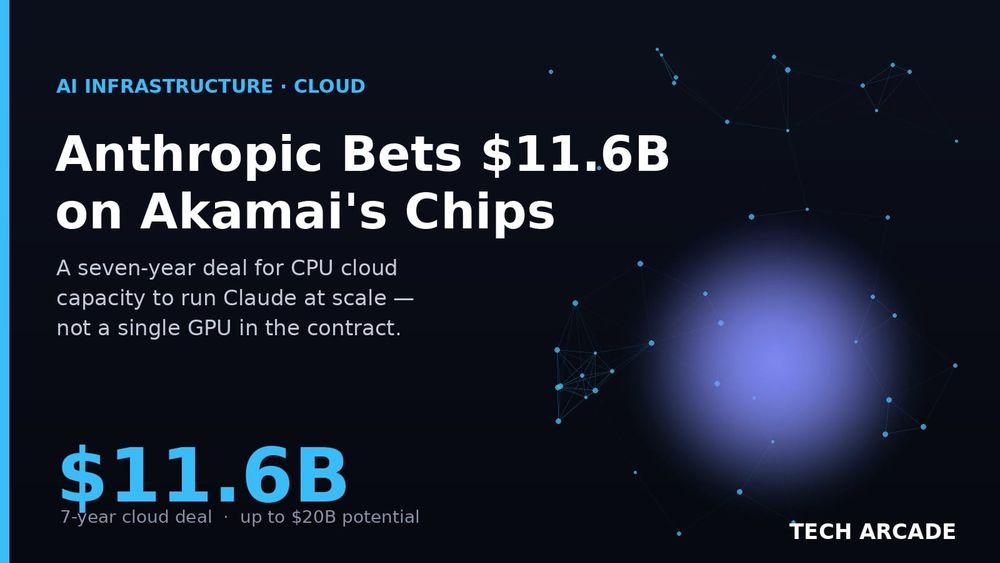
Let's get the number on the table first: $11.6 billion. That's what Anthropic — the company behind the Claude chatbot — has agreed to pay Akamai over seven years for cloud computing, in a deal announced Thursday after the closing bell (TechCrunch). If Anthropic exercises the full option built into the contract, the total climbs to roughly $20 billion.
For a company whose market value sat in the low teens of billions going in, that's not a contract. That's a second business bolted on overnight — and investors noticed, sending Akamai shares up as much as 17% in after-hours trading (Yahoo Finance).
The thesis: the AI boom has quietly created a land grab for the unglamorous compute nobody puts on a keynote slide — and Akamai just grabbed a very large piece of it.
🧠 Why This Matters
Almost every AI headline you read is about GPUs — the Nvidia chips that cost a fortune and train the models. This deal is about the other silicon. Anthropic is buying CPU capacity: the general-purpose processors that handle the enormous amount of ordinary computing that wraps around a large language model — data prep, orchestration, serving, the plumbing that keeps a chatbot answering millions of people at once (Forbes).
That plays directly to what Akamai already is. Its whole reason for existing is a network of servers scattered across the planet, sitting close to users so web pages and video load without lag. Repoint that distributed muscle at AI workloads and you have inference capacity in hundreds of locations, ready to rent.
"Anthropic is advancing the AI revolution and we are thrilled they chose Akamai's capabilities for building and operating AI infrastructure at scale."
— Dr. Tom Leighton, co-founder and CEO, Akamai (Akamai)
There's a second, sharper detail. Anthropic isn't just a customer here — it's becoming a shareholder. Akamai issued Anthropic a warrant for nonvoting preferred stock convertible into 7.7 million common shares, up to about 5% of the company, at an exercise price of $111.33 a share. Roughly 2% vests on the first payment, with the rest tied to how much Anthropic actually spends (TechCrunch). The customer's incentives and the vendor's stock price are now stapled together.
📊 Deep Dive
Peel back the headline number and this is really a bet on the back half of the decade. Akamai says the deal starts generating revenue in the second half of 2027, contributing $150–300 million that year, then accelerating to an annual pace of about $1.7 billion by the end of 2028 (Akamai).
To get there, Akamai has to build. The company plans to spend around $5.5 billion in capital expenditure to stand up the capacity, including an extra $1.7 billion in 2026 just to buy components ahead of demand.
Here's how the pieces stack up:
- Base contract: $11.6 billion over seven years
- Full potential: ~$20 billion, if Anthropic commits an additional $9 billion
- Compute type: CPUs, not GPUs — Akamai Cloud's distributed infrastructure
- Equity kicker: a warrant for up to ~5% of Akamai, at $111.33/share
- Warrant mechanics: ~2% vests now; ~1% more unlocks for roughly every additional $3 billion Anthropic commits
- Build cost: ~$5.5 billion in capex, plus $1.7 billion of 2026 component buying
- Revenue ramp: $150–300M in 2027 → ~$1.7B annual run rate by end of 2028
⚠️ The Catch
Read the timeline again and the risk jumps out. Akamai spends $5.5 billion up front and collects, at most, $300 million in 2027. The money going out and the money coming in are separated by years, and the whole thing rests on demand for AI holding up through 2028 and beyond.
Then there's concentration. One customer now underpins an entire growth story, and that customer is spreading its own bets widely — Anthropic has committed to spending across Amazon, Google, Microsoft, and AMD too (TechCrunch). Akamai is one supplier in a very crowded shopping cart.
And the warrant cuts both ways. Handing a customer up to 5% of your equity to win their business is the kind of circular arrangement — you pay me, I give you a stake in my rising stock — that has started to make some investors uneasy across the AI supply chain. It aligns interests. It also means the deal only looks cheap if the stock keeps climbing.
🎯 What Happens Next
Watch three things. First, whether Anthropic actually commits the extra $9 billion — that decision unlocks the bulk of the warrant and tells you how serious the "up to $20 billion" figure really is. Second, Akamai's capex discipline over the next 18 months, because the building starts now and the revenue doesn't. Third, that 2028 run-rate target: hitting $1.7 billion a year from a standing start would roughly reshape Akamai's cloud business.
If the ramp lands, Akamai stops being the CDN company your IT department half-remembers and becomes a genuine AI infrastructure player. If it slips, it's a very expensive lesson in building ahead of demand.
🧩 Bigger Picture
The interesting shift here is where the AI money is flowing. The market has spent two years obsessing over training and the GPUs that power it. The Akamai deal is a large, concrete signal that inference — the cost of actually running these models for real users, every second of every day — is becoming its own enormous market, and that it doesn't all run on the priciest chips.
It's also a second act for legacy infrastructure. Companies that spent decades quietly wiring the internet — content networks, edge providers, colocation operators — are discovering that the same distributed footprint is exactly what AI serving needs. The picks-and-shovels layer of the AI economy is getting deep, and it reaches well past Nvidia.
For Anthropic, the message is simpler: running Claude at global scale is going to cost tens of billions of dollars, and the company is locking in capacity wherever it can find it.
Akamai made its name shaving milliseconds off web pages. Now it's betting $5.5 billion that the next fortune is in the boring chips — and Anthropic just wrote it a $11.6 billion IOU to prove the point.
Sources
- TechCrunch — Anthropic to pay Akamai $11.6 billion over seven years in cloud deal
- Akamai — Akamai Announces $11.6 Billion Multi-year Agreement with Anthropic
- Forbes — Anthropic Signs $11.6 Billion, Seven-Year CPU Deal With Akamai
- Yahoo Finance — Akamai Lands Record $11.6B Anthropic AI Cloud Deal, Eyes $20B Potential