
For most of the AI boom, AMD played the other guy. The chipmaker that was doing fine while Nvidia printed money. On Monday, September 21, that framing quietly stopped working.
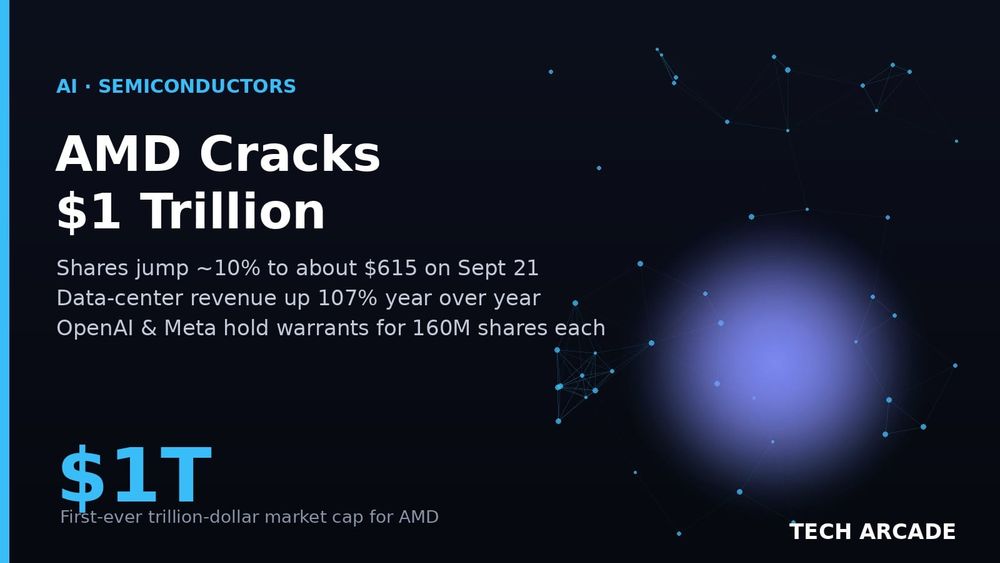
AMD shares jumped almost 10% in a single session — up roughly $56, to about $615 — and for the first time ever the company's market value pushed past $1 trillion (CNBC). That is the headline number. Sit with it for a second, because eighteen months ago the idea that AMD would be a trillion-dollar company was a bull-case fantasy, not a Monday.
The stock has now climbed roughly 185% in 2026 — nearly tripling on the year (CoinCentral). The thesis here is simple: the market has decided there are going to be at least two winners in AI silicon, and it just repriced the second one accordingly.
🧠 Why This Matters
A trillion-dollar market cap is a round number, and round numbers get headlines. But the reason AMD got here is more concrete than sentiment.
In its most recent quarter, AMD posted revenue of about $11.5 billion, up roughly 50% from a year earlier (Yahoo Finance). The part investors actually care about — the data center business that sells AI accelerators — brought in about $6.7 billion, up 107% year over year (XenoSpectrum). When a segment doubles in a year, the stock stops trading on what the company is and starts trading on what it's about to be.
And what it's about to be, if the customer list is any guide, is very large.
📊 Deep Dive
The trillion-dollar move isn't really about this quarter's numbers. It's about a set of deals that turned AMD's biggest customers into something closer to co-investors. Here's the shape of it:
- OpenAI: committed to deploying up to 6 gigawatts of AMD Instinct GPUs, and holds warrants for up to 160 million AMD shares at a nominal $0.01 each — roughly a 10% stake in the company if fully vested (CNBC).
- Meta: a near-identical arrangement — up to 6 gigawatts of Instinct GPUs and its own warrant for up to 160 million shares, with vesting tied to deployment milestones and stock-price targets running up to $600 (XenoSpectrum).
- Anthropic: up to 2 gigawatts of AMD's MI450-series chips (Yahoo Finance).
- The hardware: AMD's "Helios" rack-scale system packs 72 Instinct accelerators and 18 EPYC CPUs, with early deployments across Meta, Microsoft, Oracle, OpenAI and Anthropic (XenoSpectrum).
- The pricing power: AMD is raising prices about 10% across AI accelerators, consumer GPUs and chipsets (Yahoo Finance). Companies short on demand don't hike prices.
Put those warrants next to Monday's price and the math is almost funny. Those 160 million OpenAI shares — bought for a penny apiece — are worth on the order of $90 billion-plus at $600 a share. AMD's customers are being paid, in AMD stock, to buy AMD chips. The more they build, the more the stock is worth, and the more their own warrants are worth. It's a flywheel with everyone's name on it.
AMD CEO Lisa Su has forecast the AI data-center accelerator market will reach $500 billion by 2028 — "roughly equivalent to annual sales for the entire semiconductor industry in 2023."
— Lisa Su, AMD CEO (PC Gamer)
⚠️ The Catch
Here's where you slow down. That same flywheel that got AMD to $1 trillion is also its biggest risk.
The warrant structure means AMD's revenue and its share price are now wired to the same handful of customers. If OpenAI, Meta and Anthropic keep spending, the numbers keep going up and the warrants keep vesting. If AI capex cools — if even one of those multi-gigawatt build-outs slips — the story runs in reverse, and you find out how much of that trillion was earnings and how much was expectation.
There's also dilution to reckon with. Handing warrants for 160 million shares to each of two customers is not free; it's a slice of every existing shareholder's ownership, granted to lock in demand. AMD is betting that the volume those customers bring is worth far more than the stock it's giving away. Probably right. Not certainly right.
And the whole edifice sits on a debate nobody has settled: whether AI infrastructure spending at this scale is a durable buildout or a bubble inflating in real time. California alone is bracing for hyperscaler debt issuance projected around $420 billion in 2027 (Tech Startups). That's a lot of borrowed money riding on the same bet.
🎯 What Happens Next
The near-term test is deployment. The first big OpenAI tranche calls for a 1-gigawatt cluster of MI450 chips shipping in the second half of 2026 (XenoSpectrum). Watch whether that ships on time and at the volumes promised — that's the milestone that turns paper commitments into recognized revenue.
Su has told investors she expects the OpenAI partnership alone to generate more than $100 billion in revenue over its life (Benzinga). Numbers like that are why the stock moved. Delivering against them is the entire job for the next two years.
🧩 Bigger Picture
Step back and the trillion-dollar tag is almost a footnote to the real shift: the AI chip market is no longer a monopoly with an audience. For two years the trade was "buy the one company that makes the chips everyone needs." AMD just demonstrated that the customers themselves would rather not be that dependent — dependent enough to write warrants, commit gigawatts, and underwrite a genuine second supplier into existence.
AMD is still a fraction of Nvidia's size; the leader remains several times more valuable. But a second trillion-dollar AI-chip company changes the board. It gives hyperscalers leverage, gives the market a hedge, and gives the buildout a backup plan. That's worth more to the industry than any single quarter's revenue.
The other guy just became a trillion-dollar guy. In this cycle, that's the plot twist — and the whole point.
Sources
- CNBC — AMD hits $1 trillion market cap for the first time
- Yahoo Finance — AMD becomes a trillion-dollar stock as it hikes chip prices 10%
- XenoSpectrum — AMD's market cap tops $1 trillion, unlocking OpenAI and Meta warrants
- CNBC — OpenAI looks to take 10% stake in AMD through AI chip deal
- CoinCentral — AMD stock has nearly tripled in 2026
- PC Gamer — Lisa Su predicts a $500 billion AI GPU market by 2028
- Benzinga — Su expects OpenAI partnership to generate over $100 billion
- Tech Startups — Top tech news, September 22, 2026