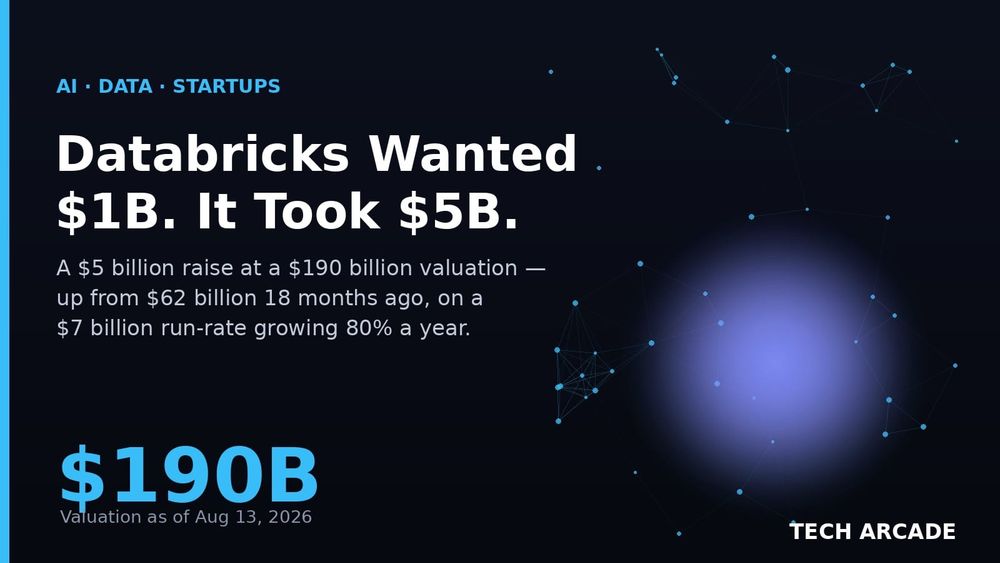

Databricks went into this round trying to raise a modest $1 billion. It came out the other side having sold $5 billion in stock — and could have sold three times that.
Let's get the number on the table first: $190 billion. That's the valuation Databricks locked in on August 13, up from $62 billion in January 2025. In roughly 18 months, the data-and-AI company added more paper value than most of the S&P 500 is worth in total. And it did it while still private, with no IPO in sight.
The reason the round ballooned is almost comic. CEO Ali Ghodsi says the plan was small until word leaked.
"We wanted to raise $1 billion, but then The Information printed this article saying that Databricks is doing a big fundraise." — Ali Ghodsi, CEO, Databricks (TechCrunch)
Once the article ran, the phones didn't stop. Investors reportedly offered $15 billion in total interest. Databricks took a third of it and called it a day. The thesis: whoever owns the enterprise data owns the AI agents that run on top of it — and Databricks is betting $190 billion says that's them.
🧠 Why This Matters
A $190 billion valuation would make Databricks one of the most valuable private companies on Earth, ahead of most public software firms. But the number that should get your attention isn't the valuation — it's the revenue run-rate of $7 billion, growing more than 80% year over year in the most recent quarter (Databricks).
Most companies that get slapped with a $190B tag are running on vision and vibes. Databricks is running on invoices. It's the rare AI-era story where the money coming in the door is scaling alongside the money investors are pouring in — and where the company says it's been free-cash-flow positive on an adjusted basis over the trailing 12 months.
📊 Deep Dive
The core business is the "lakehouse" — a system that lets companies store all their messy data in one place and run analytics and AI on it without shuffling it between a dozen tools. It's boring plumbing, and it prints money. That product alone is now at a $1.5 billion run-rate, growing over 100% year over year. A newer piece, Lakebase (a database built for AI agents), already clears a $100 million run-rate barely a year after launch.
Here's how the valuation climbed, round by round:
- January 2025: $62 billion (Series J, $15.3B raised — TechCrunch)
- December 2025: $134 billion (CNBC)
- July 2026: $188 billion (employee tender — TechCrunch)
- August 2026: $190 billion ($5B raised — CNBC)
The customer base backs it up: more than 1,000 customers spending over $1 million a year, and more than 100 spending over $10 million. Coatue led the round, with a who's-who behind it — Blackstone, MGX, T. Rowe Price, Sixth Street, Point72, TPG, Andreessen Horowitz, Thrive Capital, Temasek and roughly two dozen more.
Where does $5 billion go when you're already cash-flow positive? Ghodsi's pitch is that the AI agent wave needs infrastructure, and infrastructure needs cash up front.
"Enterprises don't just want AI that talks. They want agents working across their business that remember context, deliver accurate answers, and execute work without blowing through their budgets." — Ali Ghodsi (Databricks)
Translation: multibillion-dollar cloud commitments with the hyperscalers, a 100-person AI research team, and a war chest for acquisitions.
⚠️ The Catch
A $190 billion valuation against a $7 billion run-rate is about 27 times revenue. That's a rich multiple even by software standards, and it assumes the 80% growth holds for years, not quarters. Public software companies growing at half that rate trade at a fraction of the multiple.
Then there's the liquidity problem. All of this value is private paper. Employees and early investors can't cash out on a public market — they rely on tender offers like the $188 billion one in July to sell shares. The longer Databricks stays private, the more pressure builds to eventually IPO into whatever market exists when it finally does. And $20 billion raised over the past 20 months is a lot of dilution to justify with a debut that keeps not happening.
🎯 What Happens Next
Watch for two things. First, whether the AI-agent bet actually converts: Lakebase and the agent tooling are early, and $190 billion prices in a lot of future adoption that hasn't landed yet. Second, the IPO clock. Every mega-round makes the eventual public offering both more likely and more fraught — the bigger the private mark, the harder it is to clear it on the public market without a disappointing first day.
Expect the acquisition spree to start soon, too. With $5 billion to spend and rivals like Snowflake and the cloud giants circling the same customers, Databricks has both the motive and the means to buy its way into new corners of the AI stack.
🧩 Bigger Picture
Databricks is the clearest example yet of a market where the best companies simply refuse to go public. Why deal with quarterly earnings calls when investors will hand you $15 billion in offers off a single leaked article? The private markets have gotten deep enough to fund companies to $190 billion and beyond without ever ringing the opening bell.
That's great for founders and early backers, and quietly frustrating for everyone else — the biggest value creation of the AI era is happening in rounds most people can never buy into. Databricks turned a $1 billion ask into a $5 billion haul because it could. The real test is whether $7 billion in revenue can grow into the $190 billion story fast enough to make the paper real.
Databricks asked for a billion, got offered fifteen, and took five. The only number that still needs proving is the one with twelve zeros.
Sources
- TechCrunch — Databricks wanted to raise $1B, investors wanted $15B. It settled on $5B at a $190B valuation
- CNBC — Databricks wraps $5 billion funding round at $190 billion valuation
- Databricks — Databricks grows >80% YoY, surpasses $7B revenue run-rate
- Bloomberg — Databricks Raises $5 Billion at a $190 Billion Valuation
- CNBC — Databricks raises capital at $134 billion valuation
- TechCrunch — Databricks closes $15.3B financing at $62B valuation