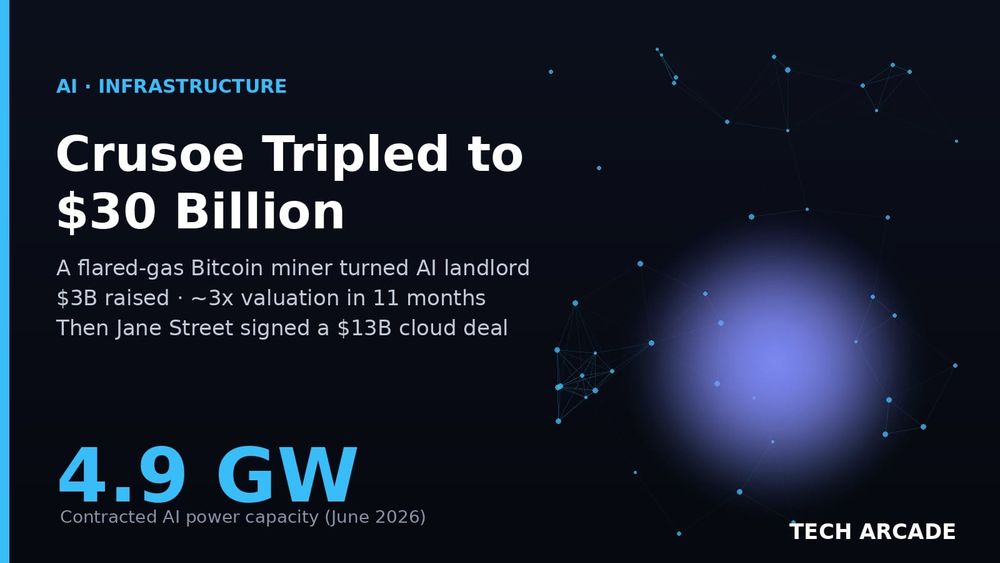

Start with the number that matters: $30 billion. That's what a Denver company called Crusoe is now worth after raising roughly $3 billion this week, according to reporting from TechCrunch and Bloomberg. The round is led by Atreides Management and Valor Equity Partners, with Mubadala Capital along for the ride.
Here's why that figure lands harder than it looks. Back in October 2025, Crusoe raised $1.38 billion at a $10 billion valuation (Axios). Do the math and the company has roughly tripled in about eleven months. Not over a decade. Not over a five-year grind. Eleven months.
And the customer signing the biggest new check isn't an AI lab. It's a stock-trading firm. This week Crusoe also inked a $13 billion, five-year AI cloud deal with Jane Street, the secretive quantitative trading giant (Bloomberg).
The thesis: the picks-and-shovels of the AI boom are now worth more, faster, than most of the companies actually building the models — and the buyers are coming from places nobody was watching.
🧠 Why This Matters
You've heard the phrase "AI infrastructure" so many times it's gone numb. Crusoe makes it concrete. The company builds and operates the physical buildings — the power, the cooling, the racks of Nvidia chips — that everyone else rents to run their models. As of June 2026 it had 4.9 gigawatts of contracted AI capacity, nearly five nuclear reactors' worth of power (Crusoe).
The tripling matters because it tells you where the money believes the bottleneck is. Not chips. Not talent. Power and buildings. Everyone can order GPUs; almost nobody can pour a billion dollars of concrete, wire up a gigawatt of electricity, and have it humming in eighteen months. That scarcity is what a $30 billion sticker is really pricing.
"The demand from the world's leading technology companies for AI infrastructure — quickly and at scale — has never been greater, and Crusoe is uniquely positioned to meet it." — Chase Lochmiller, co-founder and CEO of Crusoe
📊 Deep Dive
Crusoe's origin story is genuinely odd. It launched in 2018 mining Bitcoin off flared natural gas — the excess methane oil wells burn off into the sky. It captured that wasted gas, ran generators, and mined crypto in shipping containers in the oil fields. Then the AI wave hit, and Crusoe pivoted its whole "cheap power in weird places" playbook toward data centers.
Its flagship is in Abilene, Texas — the anchor site for the Stargate project. The first two buildings went live in late 2025 with 200+ megawatts across 980,000 square feet, filled with Nvidia GB200 racks and leased to Oracle to serve OpenAI. The full campus is designed for 1.2 gigawatts across eight buildings and roughly 4 million square feet (DataCenter Dynamics).
Here's how the two funding rounds and this week's mega-deal stack up:
- Valuation: ~$10B (Oct 2025) → ~$30B (Sept 2026) — a 3x step-up.
- Raise size: $1.38B (Series E) → ~$3B this round.
- Biggest new customer: a five-year, $13B cloud commitment from Jane Street — bigger than every dollar Crusoe has ever raised, combined.
- Contracted power: approaching 5 gigawatts, anchored by the 1.2 GW Abilene campus.
- Marquee tenants: Meta, Microsoft, OpenAI, and Oracle.
⚠️ The Catch
Now the part the headline number won't tell you. A $13 billion customer contract is spectacular right up until you notice how concentrated this whole business is. A handful of tenants — the same names propping up every neocloud — account for enormous slices of contracted revenue. If one of them trims an order, the ripple is not small.
Then there's the money math. Building gigawatts of data centers is brutally capital-hungry, and Crusoe, like its rivals, leans heavily on debt secured against the chips and the buildings. That works beautifully while demand runs hot. It works much less beautifully if GPU rental rates soften or Nvidia's next generation makes today's racks look old — the exact hardware the loans are borrowed against.
And the Jane Street twist cuts both ways. A quant firm renting $13 billion of AI compute is a stunning vote of confidence — and a reminder that the buyers now include players whose needs can change with the market's mood far faster than a research lab's roadmap.
🎯 What Happens Next
Two things to watch. First, an IPO. Crusoe has reportedly met with bankers from Goldman Sachs, Morgan Stanley, Bank of America, and JPMorgan about going public (TechCrunch). A $30 billion private round is often the last stop before the ticker.
Second, the Abilene build-out. Six more buildings are slated to bring the campus to 1.2 GW. Hitting that on schedule is the proof point behind the valuation; slipping on it is the first crack anyone will point to.
🧩 Bigger Picture
Crusoe sits in a category investors have started calling "neoclouds" — CoreWeave, Nebius, Lambda, and Crusoe among them — specialists that rent out GPUs at scale while the hyperscalers scramble to keep up. The category barely existed three years ago. Now the money is moving toward the companies that own the concrete and the power lines, not just the algorithms.
The uncomfortable question underneath the $30 billion: is this the pricing of a genuine, durable shortage of computing power — or the sound of an AI-infrastructure boom borrowing against tomorrow to build faster today? The honest answer is that both can be true at once, and only the electricity bill knows for sure.
A company that started by burning oil-field methane to mine Bitcoin is now the landlord for the smartest machines humanity has built. The AI gold rush finally found its Levi Strauss — and it's charging by the gigawatt.
Sources
- TechCrunch — Crusoe reportedly raises $3B at a $30B valuation
- Bloomberg — Crusoe Raises Over $3 Billion at $30 Billion Valuation
- Bloomberg — Jane Street Secures Crusoe's AI Cloud in $13 Billion Deal
- The Next Web — Jane Street signs $13bn five-year AI cloud deal with Crusoe
- Dealroom — Crusoe in talks to raise ~$3B at a ~$30B valuation
- Axios — Crusoe Energy at a $10 billion valuation (Oct 2025)
- Crusoe — Contracted AI capacity approaches 5 gigawatts
- DataCenter Dynamics — Crusoe's Abilene campus live, serving Oracle and OpenAI's Stargate