
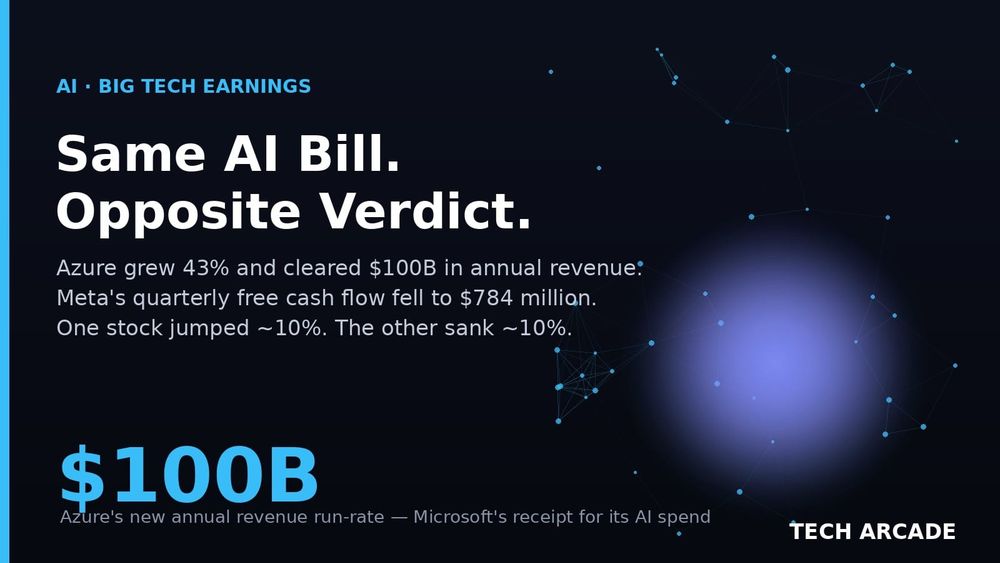

Two of the biggest companies on Earth reported earnings hours apart this week, and both told Wall Street the same thing: we are spending stupendous amounts of money on AI. The market's response was to shove one stock up nearly 10% and knock the other down about the same. Same bill, opposite verdict.
Here is the number to sit with. Meta pulled in more revenue than ever — up 28% year over year — and still walked away with $784 million in free cash flow for the quarter (Fortune). That is not a typo. A company that averaged roughly $12 billion of free cash flow per quarter over the prior two years generated less than a billion. The AI build-out ate almost all of it.
Microsoft, meanwhile, told a mirror-image story. Its cloud unit, Azure, grew 43% in the quarter and crossed $100 billion in annual revenue for the first time (Microsoft IR). Same AI spending frenzy — but investors could see exactly where the money was landing.
The thesis: in 2026, gigantic AI capex is no longer scary on its own. What terrifies the market is capex with no visible meter running on the other side.
🧠 Why This Matters
For two years the AI trade ran on faith. Build the data centers, buy the GPUs, and the revenue will come. This week was the first time the two paths diverged in public, on back-to-back afternoons, with hard receipts attached.
Microsoft reported $90.0 billion in quarterly revenue, up 18%, with cloud demand doing the heavy lifting (Microsoft IR). Its commercial backlog — contracts signed but not yet delivered — hit $678 billion, up 84%. That is a receipt. Customers have already committed the dollars; Microsoft just has to build fast enough to collect. The stock jumped close to 10% (Forbes), with some outlets clocking the intraday pop even higher (CNBC).
Meta's spending is just as real, but the payoff lives inside its own products — better ad targeting, more engaging feeds — rather than in a bill it can send a customer. When the free-cash-flow line collapsed to $784 million and management raised its spending plans again, the stock fell as much as 10% before recovering to about -7% (Fortune).
📊 Deep Dive
Strip out the narrative and line the two quarters up side by side. The revenue is growing in both columns. It is the cash — and where it is going — that splits them.
- Quarterly revenue: Microsoft $90.0B, up 18% · Meta up 28% year over year to roughly $60.8B (Forbes).
- The cloud meter: Azure grew 43% and passed $100B in annual revenue (Fortune). Meta has no cloud business — none of its AI spend gets re-sold to a customer.
- Free cash flow: Meta $784M for the quarter, down from a ~$12B quarterly average (Fortune). Microsoft kept posting tens of billions in operating income — Q4 operating income was $40.6B (Microsoft IR).
- Capex: Microsoft spent $35.8B on capital in the quarter (Microsoft IR). Meta spent $31.1B — nearly double the year-ago quarter — and lifted its full-year 2026 guidance to $130–145B (Fortune).
- The verdict: Microsoft up ~10%, Meta down ~7–10%, on earnings reported one day apart (CNBC).
Mark Zuckerberg spent part of the call flirting with the obvious fix — becoming a cloud landlord himself. He said the demand is there:
"We're getting a lot of offers for compute at a significant premium for what we paid for it." — Mark Zuckerberg, on Meta's earnings call (Fortune)
Then he talked himself back out of it, arguing Meta earns more by keeping the chips for its own models than by renting them out:
"It would be foolish to basically just sell all of the compute and take a short-term profit." — Mark Zuckerberg (Fortune)
⚠️ The Catch
Do not read this as Microsoft solved AI economics and Meta broke it. Microsoft's $678 billion backlog is a promise, not cash in the bank, and building against it burns capital now for revenue that lands later. Its own capex bill keeps climbing, and if Azure growth ever slows while the spending does not, the same "where's the payoff" question lands on Redmond's desk.
And Meta's math is not obviously wrong. CFO Susan Li told investors the company is "demand-constrained" — it has more profitable uses for compute than compute to go around (Fortune). If those AI-tuned ads keep lifting revenue 28% a year, the cash comes back. The market simply decided this week that it wants to see the receipt before it pays for the story.
🎯 What Happens Next
Watch three things. First, whether Meta actually stands up a cloud arm — Zuckerberg cracked the door open, and even a modest "rent the overflow" business would give the Street the meter it is asking for. Second, Microsoft's ability to keep Azure above 40% growth while capex runs north of $35 billion a quarter; the moment those lines cross the wrong way, sentiment flips. Third, the rest of the megacap AI spenders reporting into next week, now that investors have a fresh, unforgiving rubric: show the revenue attached to the silicon, or get marked down.
🧩 Bigger Picture
Combined, big tech is now committing on the order of hundreds of billions a year to AI infrastructure — Forbes framed this reporting cycle as a "$140 billion AI bill" splitting the field (Forbes). That spending is not slowing. What changed this week is the grading. The easy-money phase, where any AI capex number was cheered as ambition, is over. The new phase rewards plumbing you can bill for.
Microsoft has a cloud, so its AI spending shows up as someone else's invoice. Meta has feeds and ads, so its AI spending shows up as a bet on its own future. Both may pay off. Only one of them handed investors a number they could touch — and on Wall Street this week, a touchable number was worth about 20 percentage points of stock price.
The AI arms race didn't get cheaper. It just got a receipt requirement.
Sources
- Microsoft — FY26 Q4 earnings press release (Investor Relations)
- Fortune — Azure crosses $100 billion in annual revenue
- Fortune — Meta's free cash flow collapses; Zuckerberg hints at cloud business
- Forbes — The $140 billion AI bill just split Big Tech
- CNBC — Meta tanks, Microsoft jumps as the AI trade splits
- Axios — Meta and Microsoft report ballooning AI expenses