
AMD just did the thing chip companies dream about. Then the market shrugged and knocked nearly a tenth off the stock in the time it takes to microwave popcorn.
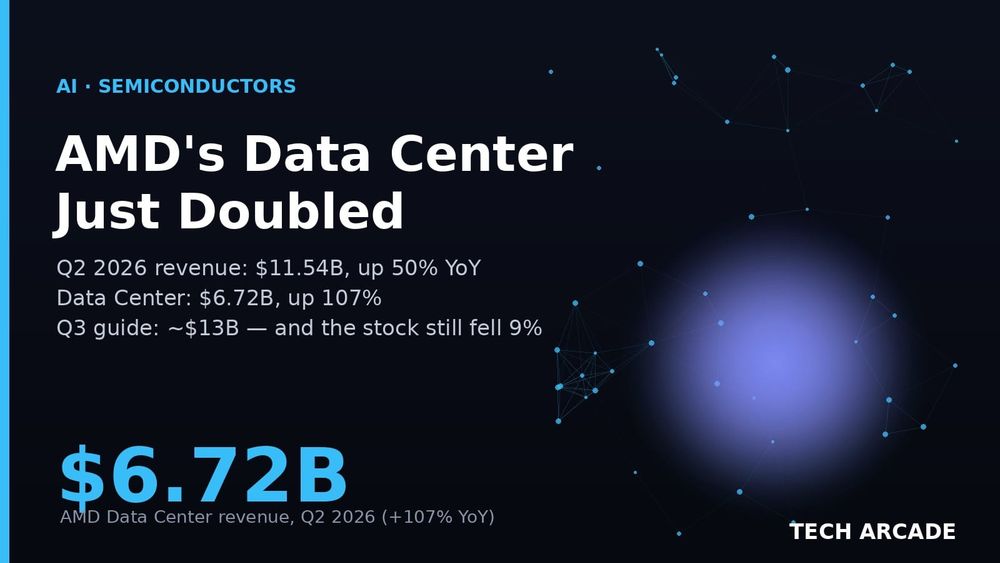
Here's the number that matters: $6.718 billion. That's what AMD's Data Center segment pulled in during the second quarter of 2026 — up 107% year over year, more than double what it made a year earlier (AMD press release, Aug 4, 2026). Total company revenue hit a record $11.536 billion, up 50%. Both the top and bottom lines beat Wall Street's estimates.
And in after-hours trading, the stock fell about 9% (Investing.com).
The thesis: AMD is finally landing real punches in AI silicon — and investors have decided that "really good" isn't the same as "good enough to catch Nvidia."
🧠 Why This Matters
For years, the AI-chip conversation had exactly one name in it. AMD was the perennial runner-up, the company with a credible roadmap and a fraction of the sales. That framing is getting harder to defend.
A Data Center business doing $6.7 billion a quarter — annualizing toward roughly $27 billion — is no longer a side project. It's now the largest slice of AMD's revenue, bigger than its PC and gaming chips combined ($3.841 billion) and dwarfing its embedded unit ($977 million). The center of gravity at AMD has moved, and it's sitting in a data center rack running AI workloads.
CEO Dr. Lisa Su put it plainly:
"We delivered an excellent quarter, with record revenue and profitability as Data Center revenue more than doubled year-over-year." — Dr. Lisa Su, Chair and CEO, AMD
The bigger tell is the market Su thinks she's chasing. AMD raised its forecast for the data-center AI accelerator market to roughly $1.4 trillion by 2030, growing more than 45% a year (Yahoo Finance). When the runway is that long, a quarter is a rounding error — which is exactly the disconnect between the results and the stock.
📊 Deep Dive
Strip out the noise and AMD's Q2 was a clean double-beat. Non-GAAP earnings came in at $1.66 per share against a $1.62 estimate, on a non-GAAP gross margin of 56%. GAAP net income was $2.297 billion. Management guided Q3 revenue to about $13 billion, plus or minus $300 million — call it 41% growth — comfortably ahead of the $12.52 billion analysts had penciled in (BigGo Finance).
So why the selloff? Scale, mostly. Here's how AMD's quarter stacks up against the company it's chasing:
- AMD Data Center revenue: $6.72 billion (Q2 2026), up 107% YoY
- Nvidia Data Center revenue: $75.2 billion (Q1 FY2027, ended April 26, 2026), up 92% YoY (StockTitan)
- The gap: Nvidia's data-center business is roughly 11x the size of AMD's — and still growing at nearly the same percentage rate
- AMD total revenue: $11.54 billion vs Nvidia total: $81.6 billion
That last line is the uncomfortable part. When the leader is 7x your size and compounding at 85%, doubling your own smaller number doesn't close the distance — it just keeps you in the race.
⚠️ The Catch
The regular session actually loved the print: AMD closed up 7% at $518.58 before earnings dropped. Then it gave back 8.94% after hours, to around $472.20 (Investing.com). Sitting near a 52-week high of $584.73, the stock had priced in perfection, and a merely great quarter left buyers looking for the exit.
The specific worry is timing. AMD's next-generation Helios rack-scale system — built around its MI450 accelerators — won't ship in volume this quarter. Management flagged modest shipments in Q3, a step up in Q4, and further growth into early 2027. Su said demand for Helios is running ahead of AMD's own forecasts, but "demand is ahead" and "we're shipping at scale" are different sentences, and the gap between them is where the AI ramp actually gets decided.
Then there's geopolitics. AMD noted an $800 million inventory charge in the prior-year period tied to U.S. export controls on its Instinct MI308 GPUs — a reminder that a meaningful chunk of the AI-accelerator market sits behind a policy wall that can move without warning. Tech Arcade takes no side on those trade rules; we just note that they show up directly on the income statement.
🎯 What Happens Next
Two dates now matter. First, whether Helios actually ramps on schedule through Q4 — that's the quarter that tells you if AMD's AI story is a step-change or a slow climb. Second, Nvidia's own upcoming results, which will reset the scoreboard AMD is measured against.
If AMD hits its ~$13 billion Q3 guide and Helios ships cleanly, the "distant second" label starts to look stale. If the ramp slips, expect more of exactly what just happened: strong numbers, sold anyway.
🧩 Bigger Picture
Zoom out and the read is almost boring in its clarity: the AI buildout is real, and it now has more than one credible supplier. A year ago you could argue AMD was selling roadmaps. This quarter it sold $6.7 billion of chips into that roadmap. Su also told investors the company now expects growth to "substantially exceed" its prior long-term target of more than 35%, and to blow past its old $20 EPS goal.
The market's reaction says something too. When a company can double a multi-billion-dollar business and still disappoint, the bar for the entire sector has quietly moved to somewhere near the ceiling. That's the environment every AI-hardware name is now selling into.
AMD spent a decade being the answer to "who's number two?" It just posted the kind of quarter that makes people stop asking — and the stock fell anyway. In this market, doubling your money is the price of admission, not the prize.
Sources
- AMD Reports Second Quarter 2026 Financial Results — GlobeNewswire (Aug 4, 2026)
- AMD Q2 2026 slides: data center revenue doubles, stock falls after hours — Investing.com
- Advanced Micro Devices Q2 Earnings Call Highlights — Yahoo Finance
- AMD Projects Q3 Revenue of $13 Billion — BigGo Finance
- NVIDIA Q1 Fiscal 2027 Financial Results — StockTitan