
For years, the humanoid robot business ran on a strange kind of faith: gigantic valuations, glossy demo videos, and almost no revenue to point at. On August 6, one company finally stapled a real, public number to the whole idea.
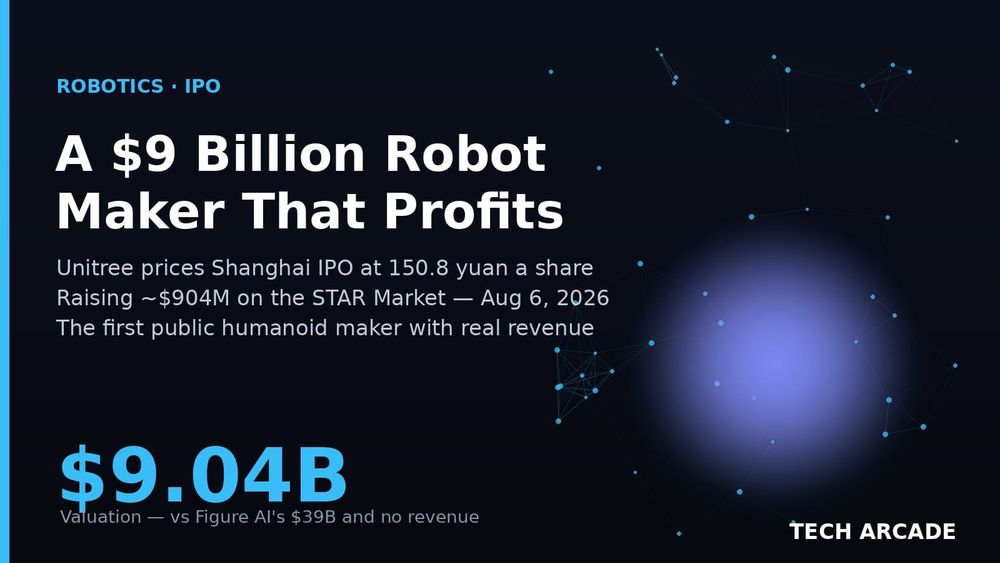
Unitree Robotics priced its Shanghai IPO at 150.8 yuan a share, valuing the company at roughly 61 billion yuan — about $9.04 billion — and raising close to $904 million in the process (Reuters, Bloomberg). It's the first pure-play humanoid maker to list on a mainland Chinese exchange, and the first one anywhere that arrives with a working income statement.
That last part is the whole story. Every other big name in humanoids is a promise. Unitree is a business.
The thesis: the market just got its first honest price on a humanoid robot company — and it turns out profit is worth about a quarter of hype.
🧠 Why This Matters
Humanoid robotics has been priced entirely on imagination. Figure AI, the U.S. poster child, has raised more than $1 billion and carries a $39 billion private valuation while shipping essentially no commercial revenue (The Robot Report). Tesla's Optimus isn't in production; Elon Musk has called it "the hardest product to scale manufacturing that we've ever made at Tesla" (Forbes).
Unitree walks in from the other direction. In 2025 it booked about 1.7 billion yuan (~$235 million) in revenue — more than quadruple the year before — and it did it at gross margins near 60% (Forbes). Now that it trades publicly, every rival's private valuation has something it never had before: a live comparison.
"From its first day of trading, every other humanoid valuation gets measured against a company that sells robots at a profit." — Forbes
📊 Deep Dive
Founder Wang Xingxing started Unitree in Hangzhou in 2016, at age 26, after a short stint at drone maker DJI (Forbes). The company built its name on four-legged robot dogs, then pushed into full-size humanoids that it sells to labs, factories, and researchers. It offered 40.45 million new shares — about 10% of its enlarged capital — on Shanghai's STAR Market (Reuters). Chinese AI firm DeepSeek came in as a strategic investor ahead of the listing (Caixin).
Here's how the humanoid field stacks up on the one axis that now has a public reference point:
- Unitree: ~$9.04 billion valuation, ~$235M in 2025 revenue, ~60% gross margins, ~5,500 humanoids shipped in 2025 — profitable (Forbes).
- Figure AI: ~$39 billion valuation, $1B+ raised, effectively pre-revenue (The Robot Report).
- Tesla Optimus: no valuation of its own, production not yet started, first lines being installed in Fremont (Forbes).
- UBTech: Hong Kong-listed since December 2023, ships over 1,000 full-size units a year, but loses roughly $700 million annually (Forbes).
Put plainly: Unitree is worth a quarter of Figure AI while being the only one of the group actually selling robots at a profit. The subscription window for retail buyers opens August 10 (Reuters).
⚠️ The Catch
Profitable doesn't mean bulletproof. Unitree's most recent quarter shows the strain of scaling fast: Q1 2026 revenue rose 68.5% to 422.8 million yuan, but adjusted profit fell 52.6% to just 40.3 million yuan as the company poured money into growth (Reuters). Growing the top line while the bottom line shrinks is exactly the tension public investors will now watch every quarter.
There's also geography. U.S. buyers accounted for 13.3% of revenue last year, and Unitree's own prospectus flags that "U.S. tariffs, limits on government purchases, export controls or the loss of existing approvals could hurt overseas growth" (Reuters). A robot company that depends on selling across borders is exposed to every twist in trade policy.
And the valuation moved fast. Just a week before pricing, the deal was being modeled around a $5.9 billion valuation; strong demand pushed the final print to about $9 billion (Forbes, Caixin). Fast-rising demand cuts both ways.
🎯 What Happens Next
Retail subscription opens August 10, and the real test is the first days of trading. If the stock holds or climbs, it validates the idea that a humanoid maker can be priced on earnings rather than vibes. If it sags, it tells private rivals their paper valuations may be running well ahead of what public markets will pay.
Either way, the benchmark now exists. Analysts described the listing as a scramble to raise money while capital is still flowing, before an expected shakeout thins the field.
"The swift listing underscores how Chinese embodied-AI startups are racing to raise capital in a cautious market before what many investors expect could be an industry shakeout." — Caixin
🧩 Bigger Picture
Humanoid robotics is at the stage the electric-car market hit a decade ago: lots of contenders, enormous valuations, and very little revenue to justify them. Unitree's IPO doesn't settle who wins. What it does is drag the whole category out of the demo-video economy and into the world of quarterly filings, where margins, shipments, and profit warnings are public and permanent.
The number to sit with is the gap: $9 billion for the company that makes money, $39 billion for the one that doesn't yet. Public markets and private rounds are now looking at the same industry and pricing it more than four-fold apart. One of those numbers is about to get tested in daylight.
For years, humanoid robots were valued on what they might someday do. Starting this week, at least one of them is valued on what it actually sold.
Sources
- Reuters (via KFGO): Chinese robot maker Unitree prices Shanghai IPO
- Bloomberg: Unitree seeks $904 million in first mainland robotic IPO
- CNBC: Unitree prices IPO at $9 billion valuation
- Caixin: Unitree prices Shanghai IPO at 61 billion yuan valuation
- Forbes: Unitree's IPO Will Set The First Public Robot Valuation Benchmark
- The Robot Report: Figure AI raises $1B in Series C funding