
Apple spent a decade and a reported fortune trying to build a car, then shelved the whole thing. One of the engineers who lived through that walked out, looked at the least glamorous corner of the economy he could find, and pointed his robots at it.
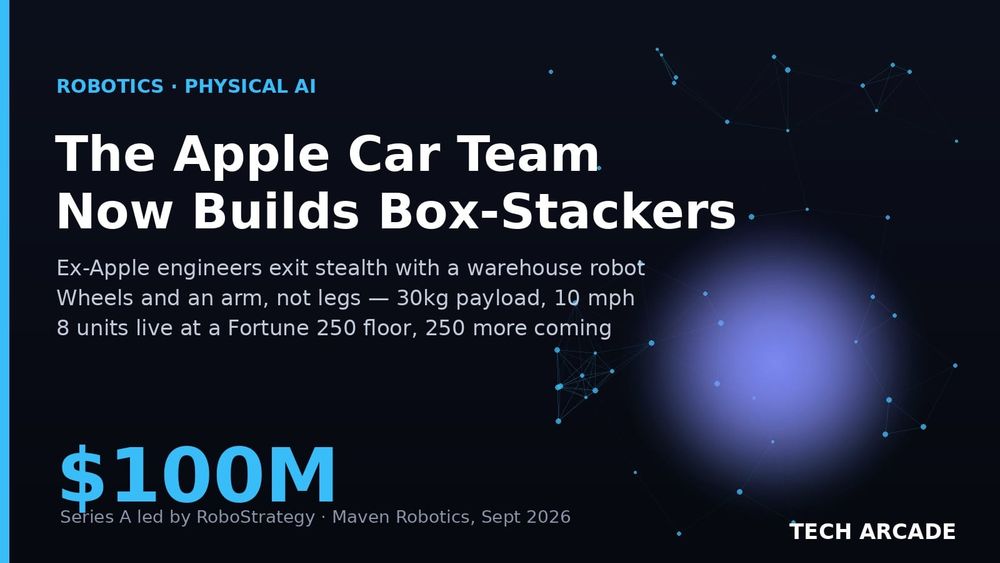
That corner is the loading dock. And on September 10, Maven Robotics came out of stealth with a $100 million Series A to build machines that stack boxes onto pallets (GlobeNewswire).
The round was led by RoboStrategy, a Nasdaq-listed robotics fund, with LocalGlobe, Vine Ventures and XTX Ventures along for the ride — on top of $18 million the company had already quietly raised (SiliconANGLE). The Santa Clara startup is only two years old.
Here's the bet worth understanding: while everyone else races to build a robot shaped like you, Maven is betting the money is in a robot shaped like a job.
🧠 Why This Matters
The hype cycle in robotics right now is humanoids — the two-legged, two-handed machines from Figure and Tesla that look like they wandered off a movie set. They demo beautifully. Investors have poured billions into them on the promise that a human-shaped robot can slot into any human-shaped task.
Maven is a quiet rebuttal to that. Its CEO, Hamza Derbas, spent roughly nine years inside Apple's special-projects group — the team behind the car that never shipped (AI Weekly). He and co-founder Khalid Derbas staffed up with veterans from Tesla, Rivian, Zoox and Cruise, then aimed all that autonomous-vehicle DNA at a much narrower problem than a self-driving car: moving a box from A to B, all day, without breaking.
The reason that's a $100 million idea is boring and enormous. Palletizing and tote handling alone is an $80 billion market, and Maven pegs the broader world of material handling and assembly at north of $1 trillion (GlobeNewswire). Nobody dreams about pallets. Everybody pays for them.
📊 Deep Dive
Maven's machine skips the legs. It's a wheeled base with a vacuum-gripper arm — closer to a smart forklift than a mechanical person. The specs are built for the warehouse floor, not the demo stage:
- Payload: the gripper arm lifts up to 30 kilograms — a heavy shipping box, over and over.
- Speed: the base rolls at up to 10 miles per hour across a facility.
- Uptime: Maven claims 99% or better across 16-hour working days — the number that actually pays the loan.
- Form factor: wheels and one arm, versus the humanoid crowd's two legs and two hands. Fewer joints, fewer ways to fall over.
- Traction: 8 robots are already running live at a Fortune 250 consumer-goods company, across multiple shifts a day (SiliconANGLE).
That last line is the tell. Eight robots isn't a fleet — but they're in a real facility, in production, not a lab. Maven's plan for the fresh cash is to build 250 third-generation robots and start early work on a fourth (SiliconANGLE). The target it wants you to remember: 100,000+ autonomous operating hours by the end of 2026, and more than a million by the end of 2027.
"Intelligent industrial robots promise an incredible future. If we can activate autonomous labor, we can build a world of infinitely elastic industrial capacity." — Hamza Derbas, CEO and co-founder, Maven Robotics
⚠️ The Catch
"Infinitely elastic industrial capacity" is a lovely phrase. A million operating hours by the end of next year is a promise, and promises in robotics have a way of slipping a year to the right.
The honest risk here isn't the technology — it's the gap between a robot that works eight times and a robot that works eight thousand times. Maven's own lead investor said it out loud:
"There's a huge gap between a robot that demos well and one that survives three production shifts a day, seven days a week." — Jack Pearson, Principal, RoboStrategy
When your backer is the one warning about the demo-to-production canyon, you know it's the whole game. Maven also hasn't disclosed a valuation, hasn't named its marquee customer, and is going up against entrenched industrial-automation giants that have sold warehouse machines for decades. Eight robots is proof of concept. 250 is proof of business. The company is being asked to jump straight from one to the other.
🎯 What Happens Next
Watch the operating-hours counter. Maven has handed you a scoreboard — 100,000 hours by December, a million a year later — and those are the numbers that either turn into a second, larger raise or into a cautionary tale. If a Fortune 250 floor keeps running Maven's arms across three shifts without a human babysitter, the reorders write themselves.
The near-term milestone is unglamorous: get those 250 units built and deployed, and prove the 99% uptime claim holds when the fleet is thirty times bigger. Manufacturing 250 complex robots is a supply-chain problem, not a software one — exactly the kind of thing an ex-Apple hardware team should, in theory, be good at.
🧩 Bigger Picture
Two philosophies of physical AI are now competing for the same dollars. One says: build a general-purpose humanoid that can eventually do anything, and eat the cost of a hard problem now. The other — Maven's — says: pick one brutally repetitive job, nail it until it's cheaper than a person, then expand outward, "one customer problem at a time," as Derbas put it (SiliconANGLE).
The humanoid camp has the imagination and the bigger checks. The Maven camp has something quieter and harder to argue with: a machine already earning its keep on a real dock, doing a job so dull that nobody will mourn handing it over. The $80 billion palletizing market doesn't care what shape solves it — it cares what shows up Monday and still works Sunday.
The robot revolution won't arrive on two legs. It'll roll in on wheels, carrying a 30-kilo box, and clock out at hour sixteen without complaining.
Sources
- Maven Robotics Raises $100M Series A — official press release (GlobeNewswire)
- Maven Robotics launches with $100M to scale its industrial robots (SiliconANGLE)
- Ex-Apple Special-Projects Team's Maven Robotics Exits Stealth With $100M Series A (AI Weekly)
- Maven Robotics Raises $100M in Series A Funding (The AI Insider)