

Some startups sell software. This one is trying to sell the periodic table an upgrade.
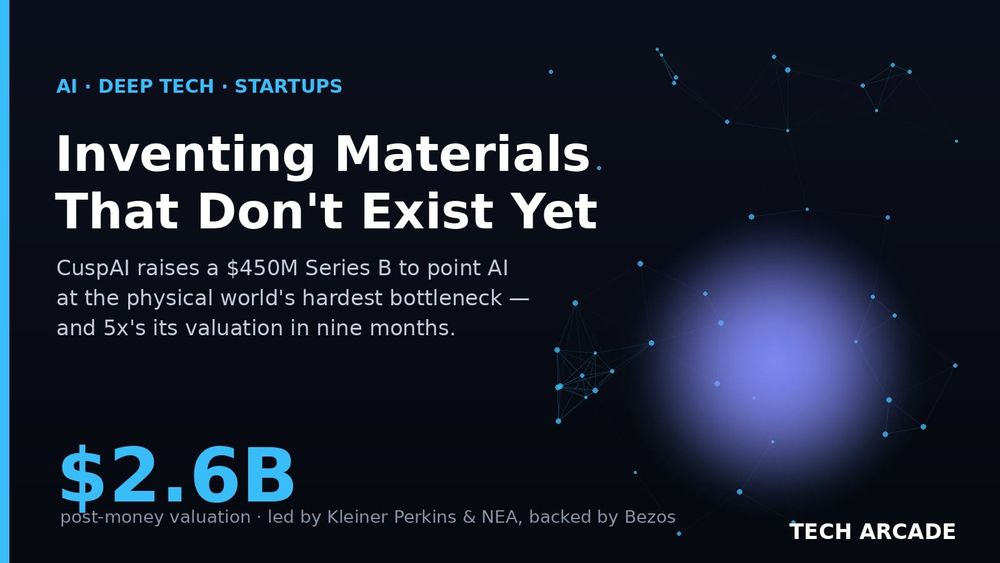
Let's get the number on the table first: $450 million. That's the Series B a five-year-old Cambridge lab called CuspAI just closed, at a $2.6 billion post-money valuation, to point artificial intelligence at the single most stubborn bottleneck in the physical economy — the fact that the materials we need for cleaner energy, faster chips, and cheaper batteries mostly don't exist yet (SiliconANGLE).
Here's the part that should make you sit up: nine months ago, CuspAI was worth $520 million. Today it's worth five times that (TechFundingNews). And the check was co-led by Kleiner Perkins and NEA, with a "significant contribution" from Bezos Expeditions — the money moving fastest doesn't want another chatbot.
The thesis: the next AI gold rush isn't in language. It's in matter.
🧠 Why This Matters
Everything you touch is a material someone had to find. The problem is that finding one the old-fashioned way — mix, heat, measure, repeat — can take a decade or two and burn through a fortune before anything useful falls out of the beaker. There are more possible stable compounds than there are stars in the observable universe, and humanity has characterized a rounding-error slice of them.
CuspAI's pitch is that AI can search that space the way a search engine searches the web: you describe the property you want — say, a compound that grabs CO₂ at low cost, or a semiconductor dielectric that runs cooler — and its MIRA platform works backward to the chemical composition and a synthesis route that could actually make it. The company claims this compresses years of lab work into roughly six months, a tenfold acceleration (TechFundingNews).
"If we don't make progress fast, the next 50 years of industrial progress will be constrained by a single challenge: the world needs materials that don't yet exist." — Chad Edwards, CuspAI CEO
📊 Deep Dive
Start with the founders, because they're the reason serious money showed up. CEO Chad Edwards is a chemist who helped scale the quantum-computing firm Quantinuum. His co-founder is Max Welling, one of the most cited machine-learning researchers alive — he co-invented the variational autoencoder and did a stint as a Distinguished Scientist at Microsoft Research (TechFundingNews). This is not two kids with a slide deck.
And the trajectory is genuinely vertical:
- Seed (June 2024): $30 million to build a "gen-AI search engine for new materials" (TechCrunch).
- Series A (Sept 2025): $100 million at a $520 million valuation (Fortune).
- Series B (July 2026): $450 million at $2.6 billion — bringing total raised to over $650 million (TechFundingNews).
- The muscle behind it: Meta's open-source atomic-simulation models (UMA) plus CuspAI's own molecular toolkit, kUPS, running on serious GPU horsepower.
The company didn't just take the money — it used the moment to launch an AI Materials Foundry, a research consortium of 45-plus members including Nvidia, Samsung, and Meta (SiliconANGLE). It already lists paying customers you've heard of: chip-tool giant ASML, plus Meta, Samsung, Hyundai, and Finnish chemicals firm Kemira (TechFundingNews). Roughly 65 people, spread across Cambridge, London, Amsterdam, Berlin, Tokyo, and Singapore.
"As AI transforms the physical world, new materials will open up new frontiers across semiconductors, energy." — Ian Buck, Nvidia
⚠️ The Catch
Now the cold water. A $2.6 billion valuation on a company that's roughly two years into commercial life is a bet on a future that hasn't arrived. AI can propose a molecule in an afternoon; the physical world still has to synthesize, test, and manufacture it at scale — and atoms don't care how confident your model is. The gap between "the model says this compound should capture carbon" and "here is a plant producing it by the ton" is where a graveyard of materials startups already lives.
There's also the uncomfortable pattern-match: five-fold valuation jumps in nine months are exactly the kind of move that looks like conviction in a boom and looks like froth in a bust. CuspAI hasn't disclosed revenue, and "45 consortium members" is not the same as "45 signed, scaled contracts." The technology is real and the science is credible — but the price assumes the flywheel spins fast, and materials science has humbled faster-looking companies before.
🎯 What Happens Next
Watch for a marquee win. CuspAI has been loud about carbon capture and next-gen semiconductor and battery materials, so the tell will be a single verified material — one that a partner like ASML or Samsung actually puts into a product. That's the moment the $2.6 billion either looks cheap or looks reckless.
Also watch the consortium. If the AI Materials Foundry turns into the default place where chipmakers and carmakers go to source novel compounds, CuspAI stops being a startup and starts being infrastructure — the AWS of atoms. The UK government's participation in this round suggests at least one nation is treating that outcome as strategic (Invezz).
🧩 Bigger Picture
For three years, "AI" has mostly meant words and pictures — models that remix what humans already made. CuspAI is part of a harder, more interesting turn: pointing the same techniques at the physical world to make things that have never existed. Google DeepMind's GNoME project has already flagged hundreds of thousands of candidate crystals; startups like this are racing to turn candidates into cash.
If it works, the prize isn't a better assistant. It's cheaper carbon capture, cooler chips, denser batteries — the actual bottlenecks standing between us and a cleaner, faster century. If it doesn't, it'll be the most expensive chemistry set ever funded. Either way, the smart money just told you where it thinks round two of the AI boom is headed: not at the keyboard, but in the crucible.
Software ate the world. Now it's coming for the raw materials.
Sources
- SiliconANGLE — AI materials science startup CuspAI raises $450M in funding
- TechFundingNews — From $520M to $2.6B in 9 months: Bezos Expeditions co-leads CuspAI's $450M Series B
- Invezz — UK government backs British AI startup CuspAI in $450M funding round
- Fortune — CuspAI raises $100 million for AI for chemistry
- TechCrunch — CuspAI raises $30M for a gen-AI-driven search engine for new materials