

A drone company that didn't exist four years ago just convinced some of the most disciplined investors in Silicon Valley that it's worth more than most publicly traded aerospace firms. And it did it with a pitch that sounds less like a startup deck and more like a wartime production order.
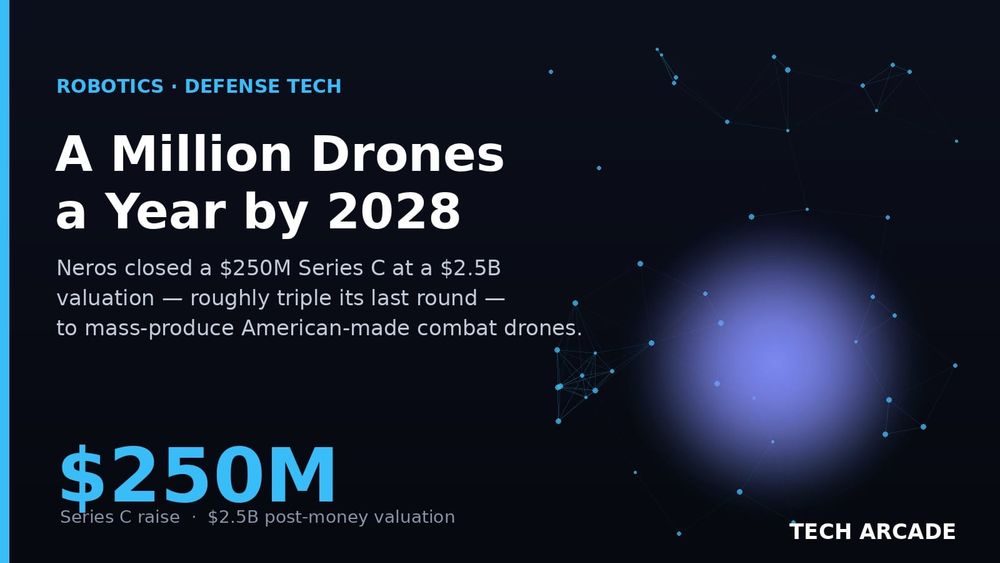
Let's get the number on the table first: $250 million. That's the Series C that Neros Technologies just closed, co-led by Sequoia Capital and the American Strategic Technology Fund. The round values the three-year-old company at $2.5 billion — roughly triple where it stood going in (Bloomberg).
Here's the part that makes the valuation make sense — or terrifies you, depending on where you sit. Neros isn't promising a better camera or a slicker app. It's promising volume: one million drones a year by 2028 (The Robot Report).
The thesis is blunt: in modern conflict, the drone is ammunition, and whoever can manufacture ammunition at scale wins.
🧠 Why This Matters
For most of the last decade, the drone conversation was about hobbyists and delivery. The war in Ukraine rewrote that. Cheap first-person-view (FPV) drones — the kind a teenager flies for fun — turned out to be devastatingly effective against tanks that cost thousands of times more. Suddenly the strategic question wasn't "can you build a great drone?" but "can you build a hundred thousand mediocre-but-good-enough ones a month?"
Neros was founded in 2023 in El Segundo, California, explicitly to answer that second question. Its co-founder and CEO, Soren Monroe-Anderson, is a former competitive FPV racing pilot who is barely old enough to rent a car. The company's whole identity is American-made mass production of attritable — read: expendable — drones.
"Our mission to produce 1 million drones per year hasn't changed... this gets our systems into war-fighter hands faster."
— Soren Monroe-Anderson, co-founder and CEO, Neros Technologies (The Robot Report)
The backdrop matters here. The global commercial-drone market is dominated by China's DJI, which by various 2025 estimates holds roughly 70–80% of the civilian market worldwide (The Drone Girl). U.S. and allied militaries have been trying to build a domestic supply chain that doesn't depend on that. Neros is one of the companies betting the money is about to flow — and, based on its investor list, it just got a lot of that bet funded.
📊 Deep Dive
The $250 million isn't going into R&D theater. Neros already ships two production platforms and says both are headed to combat theaters by the end of 2026:
- Archer AI — an FPV strike platform with autonomous features including Terminal Guidance and a GPS-denied "Position Hold" mode, built for the electronic-warfare reality where satellite navigation gets jammed constantly.
- Bandit — a counter-drone interceptor designed to knock down Class 2 and Class 3 enemy drones. In other words: Neros wants to sell you both the arrow and the shield.
How the round stacks up against Neros's own recent history and the broader robotics-funding surge:
- This round: $250M Series C, $2.5B post-money valuation (Crunchbase).
- Previous round: a $75M Series B in November 2025 — so the valuation roughly tripled in about nine months (The Robot Report).
- Investor bench: alongside Sequoia and the American Strategic Technology Fund, the round drew Valor Equity Partners, Interlagos, Allen & Company, Thiel Capital, Spark Capital, and Figma CEO Dylan Field (PR Newswire).
- The sector context: robotics startups pulled in more than $18 billion globally in the first half of 2026 alone, already past the full-year 2025 total (Crunchbase).
Neros also says it already holds contracts with the U.S. Army and Marine Corps, across all components of U.S. Special Operations Command, and with roughly half a dozen allied nations. That's the detail investors care about most: this is a company with revenue attached to signatures, not just a slide.
⚠️ The Catch
A million drones a year is a genuinely enormous number, and Neros hasn't publicly disclosed what it's producing today. The gap between "we have contracts and a target" and "we are shipping a million units annually" is exactly where hardware startups go to die. Manufacturing at that scale means supply chains, machined parts, motors, batteries, and chips — and a lot of the cheapest components in the drone world still trace back to the same Chinese supply base that Western militaries are trying to design out. Building an alternative supply chain is slow and expensive.
There's also concentration risk. Neros's customers are governments, so its fortunes rise and fall with defense budgets, procurement cycles, and politics. A $2.5 billion valuation assumes those contracts keep growing. If the appetite for expendable drones cools — or a competitor undercuts on price — that number gets hard to defend.
🎯 What Happens Next
Watch the deployment claim. Neros has staked its credibility on getting Archer AI and Bandit into actual combat theaters by the end of 2026. That's a testable, near-term promise, and it's only a few months out. Either the hardware shows up in the field or it doesn't.
After that, the whole story hinges on the factory. Expect Neros to spend heavily on domestic manufacturing capacity and to keep signing government contracts to justify the production line. If the U.S. and its allies formalize large-volume drone-procurement programs — the kind that guarantee minimum order quantities — Neros is positioned to be a prime beneficiary.
🧩 Bigger Picture
Neros is a single data point in a much larger shift: manufacturing has become the moat again. For years, the most valuable tech companies were the ones that owned software and let someone else own the atoms. Defense drones flip that. The scarce, defensible thing here isn't an algorithm — it's the ability to physically produce a million reliable machines a year on home soil.
That's why Sequoia, Thiel Capital, and a software CEO like Dylan Field are writing checks into a company that makes expendable aircraft. They're betting that the ability to build at industrial scale, on home soil, is about to be worth a premium — in drones, and in a lot of other things.
Neros just raised a quarter of a billion dollars on a promise measured in factory output. Now it has to go build the factory.
Sources
- PR Newswire — Neros Raises $250M Series C at $2.5B Valuation
- The Robot Report — Neros Technologies raises $250M to deploy its defense drones by the end of 2026
- Bloomberg — Defense Startup Neros Triples Valuation to $2.5 Billion
- Crunchbase — The Week's 10 Biggest Funding Rounds (Aug 8–14, 2026)
- Crunchbase — Robotics Startups Venture Funding Surges To Record Numbers In 2026
- The Drone Girl — DJI still dominates the 2025 drone market