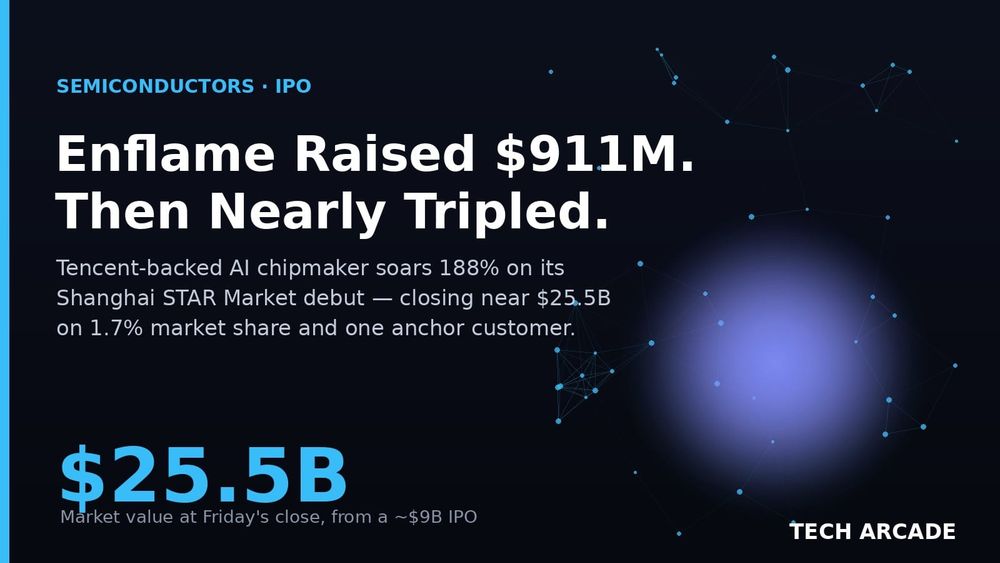

An AI chip company that holds about 1.7% of its home market just staged one of the loudest stock debuts of the year.
Let's get the number on the table first: $911 million. That's what Enflame Technology, a Shanghai-based designer of AI accelerators, raised when it listed on Shanghai's STAR Market on September 11 (6.12 billion yuan, priced at 142.18 yuan a share) (Bloomberg).
Then the market got involved. The stock opened at 410 yuan — up 188% before the first lunch bell — spiked as high as 475 (a 234% gain), and closed at 397, up 179% on the day (SCMP). Retail investors had bid for the public slice 4,073 times over. That's not a typo.
By the close, a company that eyed a roughly $9 billion valuation going in was worth about $25.5 billion (Caixin). Here's the thesis: the pop has less to do with Enflame's chips than with who owns them — and who can't buy the alternative.
🧠 Why This Matters
Enflame, founded in Shanghai in 2018 by two former AMD executives, Zhao Lidong and Zhang Yalin, builds accelerators for AI workloads (TechTimes). Its architecture is not GPU-based — it's closer in spirit to Google's TPUs or Huawei's Ascend line (Caixin).
The backdrop is what makes the debut worth your attention. U.S. export rules restrict Nvidia's top data-center chips in China, and Nvidia still commanded an estimated 55–60% of the Chinese AI accelerator market in 2025 despite those limits. Bernstein analysts project that share could slide toward 8% in 2026 as sanctions bite (TechTimes). When the incumbent's runway narrows, capital goes looking for whoever might fill the gap. Enflame's order book was, for one Friday, the answer.
"The appeal of the company lies in its position as one of China's leading cloud AI chipmakers, as well as Tencent's dual role as both a key customer and major shareholder." — analysts at Huajin Securities, including Li Hui (TNW)
📊 Deep Dive
Enflame ships two main products. The S60 is an inference accelerator already selling at scale; the L600 is a training-and-inference chip that's been fabricated but isn't yet a commercial product (Caixin). The financials tell a young-company story: revenue climbed from 301 million yuan in 2023 to 990 million yuan in 2025, while the annual net loss narrowed from about 1.7 billion yuan to roughly 1.2 billion. The company says it expects to turn profitable in 2026 or 2027.
Here's how the day itself broke down:
- Offer price: 142.18 yuan per share — the floor everyone bought in at.
- Open: 410 yuan, +188% — the headline number that traveled the world.
- Intraday peak: 475 yuan, +234% — the moment the frenzy topped out.
- Close: 397 yuan, +179% — still nearly triple, but off the high.
- Retail oversubscription: 4,073x, with individual investors allotted just 0.025% of what they asked for (SCMP).
Tencent's fingerprints are all over this. The internet giant holds roughly a 20% stake, and its position gained about 20% on the debut to a value of nearly 35 billion yuan (SCMP). Tencent is also, by a wide margin, Enflame's biggest customer.
⚠️ The Catch
That last point is the one to sit with. Tencent accounted for about 84% of Enflame's 2025 revenue, up from roughly 38% the year before (TNW). A single shareholder who is also nearly your entire customer base is a comfortable place to start and a precarious place to stay. If Tencent's buying slows, or it hedges toward other suppliers, the revenue chart does not look pretty.
Then there's the market-share math. That 1.7% figure comes from IDC data in Enflame's own prospectus (TechTimes). Even taken together, China's rival AI-chip startups — Cambricon, Moore Threads, MetaX, Biren and Enflame among them — likely hold under 15% of their home market. A $25 billion valuation resting on 1.7% share and one anchor customer is a bet on the future, not the present. As DGA's Paul Triolo put it, building around a non-GPU approach is a "high-risk form of strategic independence."
🎯 What Happens Next
Watch two things. First, whether Enflame can turn the L600 into real training revenue and pull in customers beyond Tencent — trial orders with other internet firms are reportedly underway (Caixin). Training chips are where the money and the difficulty both live.
Second, whether the STAR Market's appetite holds. Enflame priced at about $9 billion and closed near $25.5 billion in a session — a gap that says as much about investor demand as about the company. The next test is right behind it: DeepSeek has tapped CITIC Securities for its own Shanghai listing at a reported $75 billion valuation (Yahoo Finance). If Enflame's Friday is the template, that one will be loud too.
"Capital markets are therefore critical to help them scale up." — Goldman Sachs analysts, on China's semiconductor firms (TNW)
🧩 Bigger Picture
Strip away the ticker drama and Enflame's debut is a snapshot of a market being rewired by policy. Export controls created a gap where Nvidia used to sit, domestic capital is rushing to fund whoever might fill it, and public markets are pricing those companies for a future in which they win far more than 1.7%. Whether that future arrives is a separate question from whether the money is already moving — and the money is very much moving.
For everyone else — chip buyers, cloud builders, investors watching from outside — the signal is simple. When a supplier gets fenced out of a market this size, the vacuum doesn't stay empty. It fills with capital first and capability later, in that order.
Enflame sells 1.7% of China's AI chips today. On Friday, the market paid $25 billion for the other 98.3% it hasn't sold yet.
Sources
- Bloomberg — Enflame Raises $911 Million in Shanghai IPO Backed by Tencent
- South China Morning Post — Enflame shares soar 188% on Shanghai debut
- Caixin Global — Tencent-Backed AI Chipmaker Enflame Eyes $9 Billion Valuation in IPO
- Nikkei Asia — Chinese Nvidia challenger Enflame jumps 188% in Shanghai debut
- TechTimes — Enflame Soars on STAR Market Debut But Holds Just 1.7% of China AI Chip Market
- The Next Web — Tencent-backed chipmaker Enflame nearly triples in its Shanghai debut