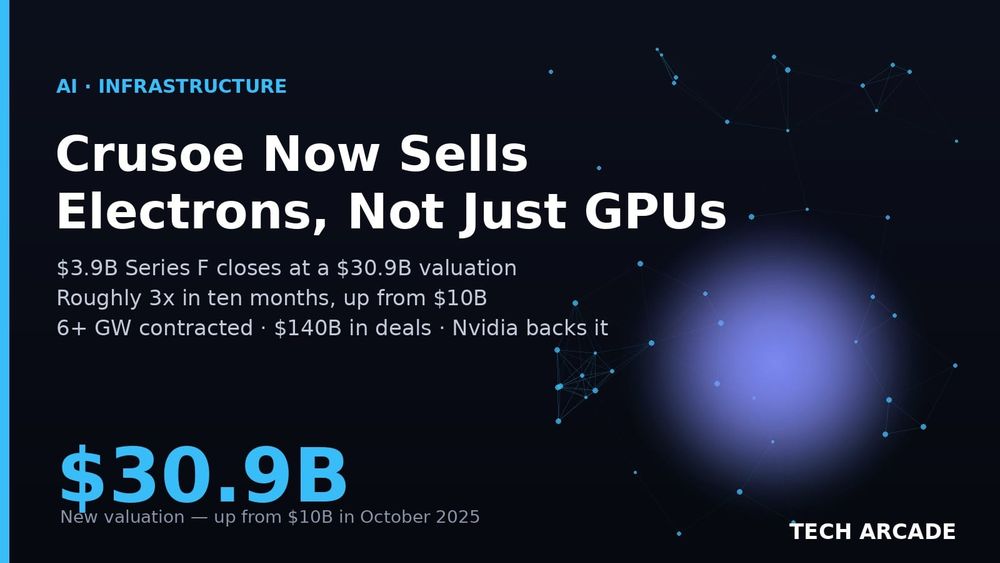

Ten months ago, an AI infrastructure company you may never have heard of was worth $10 billion. This week it closed a round that values it at $30.9 billion. That is roughly a 3x jump in under a year, and the check that got it there was a $3.9 billion Series F — one of the largest private raises of 2026 (TechCrunch).
The company is Crusoe. It started in 2018 burning stranded natural gas to mine Bitcoin, and it now sells compute to OpenAI, Meta, Microsoft and Oracle. The number to hold onto isn't the valuation, though. It's the $140 billion in total contracted value Crusoe says it has already lined up across its platform (Crusoe).
Here's the thesis: in the AI buildout, the scarce thing stopped being chips and became power — and Crusoe bet on owning the whole chain from the power plant to the GPU.
🧠 Why This Matters
Everyone talks about a chip shortage. The real bottleneck in 2026 is electricity. You can order GPUs; you cannot order a gigawatt of firm power to a patch of Texas dirt on a two-year timeline. The utilities can't build fast enough, and the grid interconnection queues are years long.
Crusoe's pitch is that it builds the power and the data center and rents you the compute on top. CEO Chase Lochmiller calls it controlling everything "from electrons to tokens."
"Getting there means controlling the infrastructure from electrons to tokens." — Chase Lochmiller, CEO, Crusoe (Crusoe)
If that vertical bet is right, Crusoe isn't renting servers — it's selling the one input the whole AI economy is short on. That's why investors handed it $3.9 billion.
📊 Deep Dive
The round was led by Atreides Management, Mubadala Capital and Valor Equity Partners, with Founders Fund, GIC, Nvidia, the Qatar Investment Authority, Radical Ventures and TPG all writing checks (TechCrunch). Yes — Nvidia, the company selling the chips, is also an investor in the company buying them. File that away for the next section.
Look at how far the numbers moved in ten months:
- Series E (Oct 2025): $1.38 billion raised at a $10 billion valuation.
- Series F (Sep 2026): $3.9 billion raised at a $30.9 billion valuation.
- Power contracted: 6+ gigawatts gross across data centers and cloud.
- Power live today: ~1 gigawatt delivered and operational.
- Total contracted value: $140+ billion across the platform.
- Cloud bookings: up 20x year over year.
- Headcount: 1,800+ employees across five countries.
The customer list is the part that makes the valuation legible. Crusoe built the Abilene, Texas campus where OpenAI trained its Astra system, and it counts Meta, Microsoft, Oracle, Cognition, Figure and Perplexity as customers (Crusoe). The single loudest contract: a $13 billion, five-year cloud deal with Jane Street, the trading firm (TechCrunch).
There's also a product angle worth knowing. Beyond the giant campuses, Crusoe makes "Spark" — modular data centers small enough to truck to wherever power happens to be available, instead of dragging power to the data center. When the grid is your constraint, a compute box that goes to the electrons is a genuinely different shape of business.
⚠️ The Catch
Start with that Nvidia line. Nvidia sells GPUs to Crusoe, then invests in Crusoe, which then buys more GPUs. Critics call this the circular financing pattern that's showing up all over the AI buildout, where the same dollars loop between chipmaker, cloud and model lab and inflate everyone's apparent demand. It works beautifully while compute demand keeps climbing — and it unwinds fast if it doesn't.
Then there's concentration. A huge slice of Crusoe's story rests on a handful of enormous customers, OpenAI chief among them. Contracted value of $140 billion is impressive; it's also a promise, not revenue in the bank. Only about 1 gigawatt of the 6+ contracted is actually operational today — the rest is steel, permits and power deals that still have to get built on schedule.
And Crusoe is spending into a rising political headwind. Data centers are now a live utility-bill issue, with lawmakers pushing to make large facilities pay the full cost of the grid upgrades they trigger rather than passing them to households. Cheap, fast power is exactly the thing getting more expensive and more contested.
🎯 What Happens Next
Crusoe has reportedly met with Goldman Sachs and Morgan Stanley about a possible IPO (TechCrunch), and the board additions read like an IPO-prep roster: Thomas Seifert, Cloudflare's CFO; infrastructure veteran Bill Stein; and JB Straubel, the Tesla co-founder who now runs Redwood Materials.
Watch two things. First, how fast that 1 gigawatt becomes 6 — execution on power delivery is the entire ballgame. Second, whether the marquee contracts convert into recurring revenue; Crusoe already says it has $100 million+ in contracted managed-inference ARR, a small but telling sign it's moving up the stack from raw capacity toward higher-margin services.
🧩 Bigger Picture
Crusoe is the clearest example yet of a shift in where AI money is pooling. The first wave enriched the chip designer. The second is enriching the people who can turn a power contract into a running data center — the plumbing, not the intelligence. Investor Antonio Gracias of Valor put the bet plainly.
"This team has delivered mission-critical AI infrastructure for several of the world's most sophisticated customers." — Antonio Gracias, Valor Equity Partners (Crusoe)
A crypto miner that pivoted to selling electrons to AI labs is now worth $30.9 billion. Whether that's vision or vertigo depends entirely on whether the tokens keep needing the electrons.
The chip shortage was a headline. The power shortage is a business model — and Crusoe just raised $3.9 billion betting yours runs on it.
Sources
- TechCrunch — Crusoe raises $3.9B to build massive data centers and modular 'AI factories' (Sep 17, 2026)
- Crusoe / GlobeNewswire — Crusoe Raises $3.9 Billion Series F (Sep 17, 2026)
- Crusoe Newsroom — Series F announcement
- The AI Insider — Crusoe Raises $3.9B Series F at $30.9B Valuation (Sep 19, 2026)
- Bloomberg — Crusoe Raises Over $3 Billion at $30 Billion Valuation (Sep 3, 2026)