
Cisco Posts Record $15.8B Quarter and $3.4B Profit… Then Cuts 4,000 Jobs to Chase AI
🔥 WHAT HAPPENED
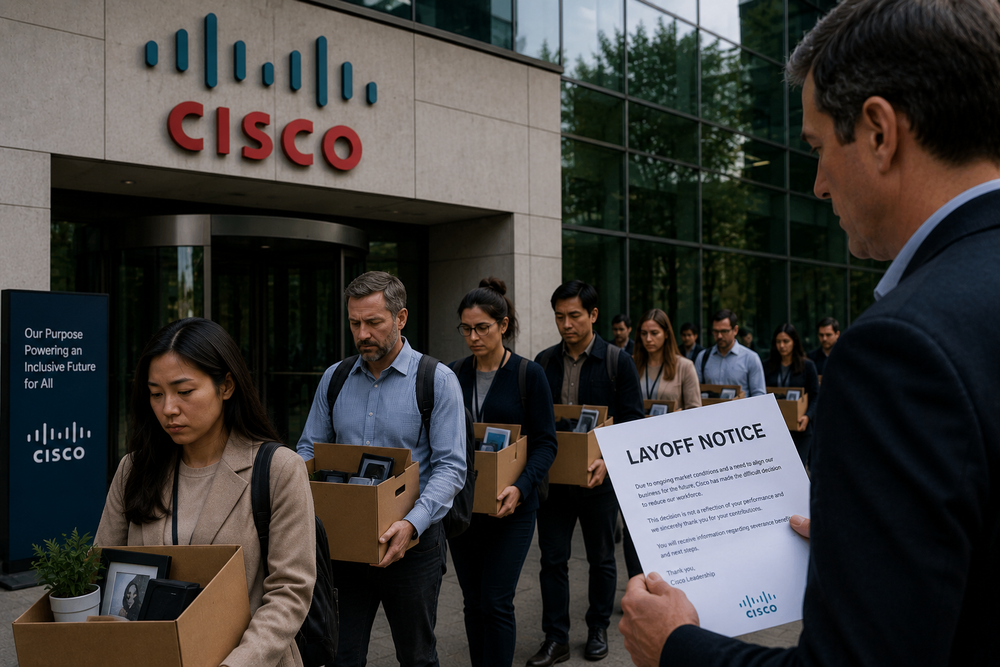
Cisco just pulled the most 2026 corporate move imaginable: reported its best-ever quarter — $15.84 billion in revenue, $3.37 billion in profit — and immediately announced it's laying off nearly 4,000 people.
CEO Chuck Robbins dropped the news Wednesday in an internal memo that's equal parts victory lap and pink slip. The company's networking revenue surged 25% year-over-year. Adjusted earnings per share of $1.06 beat analyst expectations of $1.04. The stock jumped 17% in after-hours trading — its biggest single-day pop since 2002.
And then: "We are making changes today that will result in the reduction of our overall workforce in Q4 by fewer than 4,000 jobs."
That's less than 5% of Cisco's roughly 86,200 employees. But it's the optics that sting — and the pattern that's becoming painfully familiar across Big Tech.
🧠 WHY THIS MATTERS
Cisco isn't laying people off because it's failing. It's laying people off because it's winning — just in different categories than before.
The company has booked $5.3 billion in AI infrastructure orders from hyperscalers so far this fiscal year. It raised its full-year AI order forecast from $5 billion to $9 billion. AI-specific revenue projections jumped from $3 billion to $4 billion. Hyperscaler demand for Cisco's networking gear is essentially printing money.
So why the cuts? Robbins spelled it out plainly: "The companies that will win in the AI era will be those with focus, urgency, and the discipline to continuously shift investment toward the areas where demand and long-term value creation are strongest."
Translation: old-Cisco roles (general enterprise networking, legacy hardware, management layers) are being cleared out to make room for AI-Cisco roles (silicon design, fiber optics, cybersecurity AI tools). The layoffs are a resource reallocation — brutal but strategic.
📊 DEEP DIVE
Let's look at the numbers, because they tell a layered story:
- Revenue: $15.84B (up 12% YoY, beat StreetAccount consensus of $15.56B)
- Net income: $3.37B (up from $2.49B a year ago)
- EPS: $1.06 adjusted vs. $1.04 expected
- Stock reaction: +17% after-hours (biggest since 2002)
- AI orders YTD: $5.3B, projected to hit $9B by year-end
- Q4 guidance: $1.16-$1.18 EPS on $16.7-$16.9B revenue (analysts expected $1.07/$15.82B)
- Restructuring cost: Up to $1 billion pre-tax, $450M expected in Q4
- Networking revenue: $8.82B (+25% YoY, beat $8.47B StreetAccount consensus)
- Security revenue: ~$2B (flat YoY, roughly in line)
The networking revenue spike is the headline here. Cisco's core switching and routing business — the one people wrote off as "legacy" a few years ago — is roaring back thanks to AI data center buildout. Every hyperscaler building a massive AI cluster needs Cisco's switches and routers to connect those thousands of GPUs.
On the product side, Cisco recently announced the Silicon One G300, a 102.4 Tbps switching chip designed specifically for gigawatt-scale AI clusters. It's set for commercial deployment in H2 2026 and promises 28% faster AI job completion. That's the kind of hardware that's driving hyperscaler demand.
⚠️ THE CATCH
This is the part that leaves a bad taste. Record profits + mass layoffs = a recurring theme across tech that's getting harder to stomach.
Cisco joins a long list: Microsoft, Meta, Amazon, Google, Oracle, Cloudflare — all posting strong numbers while trimming headcount under the banner of "AI restructuring." The justification makes sense on a spreadsheet but feels hollow to the 4,000 people whose jobs disappear the day after a record-breaking earnings call.
Robbins' memo tried to soften the blow. Affected employees get pro-rated FY26 bonuses, one year of access to Cisco U courses and certifications (AI, security, networking), and placement services that Cisco claims have a 75% success rate in finding participants new roles. Not bad as severance packages go — but it's still a layoff.
The optics headache: Cisco's stock surged 17% on the news of job cuts. That's the market saying "good, you're cutting costs to chase the AI gold rush." It's efficient. But it makes the human cost an asterisk on an earnings beat.
There's also a deeper question: how sustainable is this AI infrastructure spending? Hyperscaler capex is hitting insane levels — Meta alone is spending $60-80B. If AI demand softens or the ROI isn't as fast as expected, the networking buildout could cool. And Cisco would be left holding the bag after reshaping its entire workforce around it.
🎯 WHAT HAPPENS NEXT
Notifications start May 14 (today). The cuts will happen globally, rolling out in line with local labor laws. The $1 billion restructuring cost will hit mostly in Q4, with some spillover into fiscal 2027.
Cisco's Q4 guidance ($16.7-$16.9B revenue) blew past analyst expectations of $15.82B. If the company delivers, this will be the year Cisco fully shakes off its post-pandemic hangover and re-establishes itself as an AI infrastructure titan.
The key metric to watch: whether AI order momentum holds. $9 billion in AI orders for FY2026 is huge for Cisco — but it needs to convert those orders into recurring revenue, not just one-time hardware sales.
Also worth watching: the Cisco U retraining program. If Cisco can successfully transition laid-off employees into AI and security roles (either internally or elsewhere), it becomes a case study in humane restructuring. If not, it's just another company that tossed workers aside for a stock pop.
🧩 BIGGER PICTURE
Cisco's story is the AI infrastructure story of 2026 in miniature. Every major tech company is caught in the same dynamic: AI demand is real, it's exploding, and it requires massive reallocation of resources. But that reallocation has a human cost that quarterly earnings reports don't capture.
The networking giant spent years as Wall Street's boring uncle — reliable, unexciting, slowly declining. Now it's suddenly the hottest infrastructure play in tech, with a stock up 33% this year (vs. the Nasdaq's 14%). The AI buildout has given Cisco a second act.
But here's what makes this different from the dot-com era: Cisco's first peak came from selling picks and shovels to internet companies. Its second peak is the same playbook, but now the "shovels" are 102.4 Tbps switching silicon and data center-scale fiber optics. The company's finally competing with Broadcom, Marvell, and Arista — not just other enterprise networking vendors.
The question nobody's answering yet: when does the AI buildout shift from "build" to "operate"? That's when Cisco's networking gear becomes a maintenance story, not a growth story. For now, the build phase is in full swing — and Cisco is cashing in.
One practical example: A company building a 100,000-GPU AI cluster needs roughly 15,000-20,000 switches to connect them. At Cisco's pricing, that's a multi-hundred-million-dollar networking order — just for one cluster. Multiply by the 30+ hyperscaler clusters under construction globally, and the $9 billion AI order pipeline starts making sense.
📸 *Image: Data center network server rack with illuminated fiber optic cables — a fitting visual for Cisco's AI infrastructure pivot.*