
Every factory on earth runs on paper it can barely find. Decades of 2D drawings, spec sheets, CAD files, and revision histories, scattered across shared drives and filing cabinets and the memory of one guy who is about to retire. A Tokyo-and-Chicago startup called CADDi just convinced some of the world's biggest investors that untangling that mess is worth more than a billion dollars.
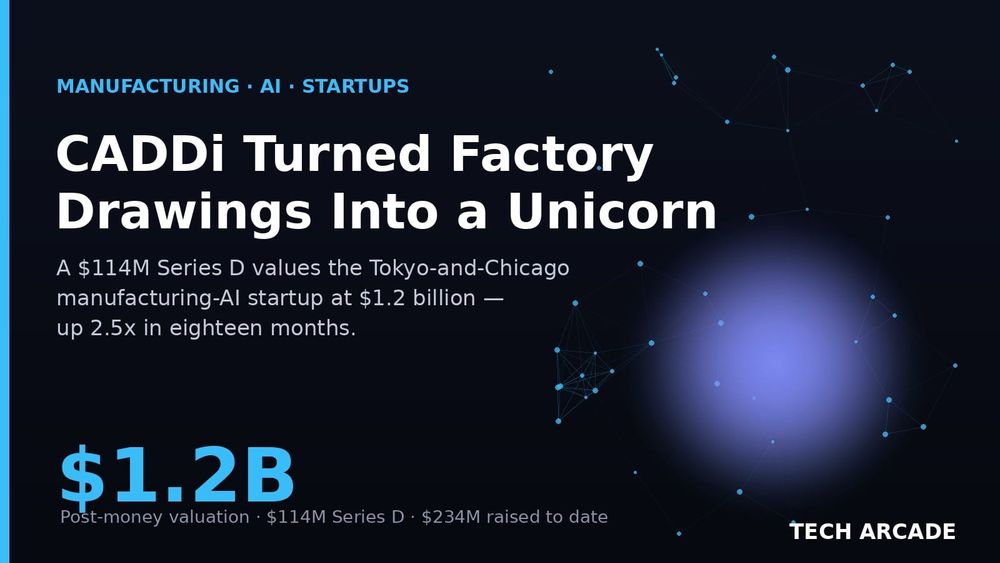
Let's get the number on the table first: $114 million. That's CADDi's Series D, and it values the nine-year-old company at $1.2 billion, up from $470 million in March 2025 (Fortune). The round pushes total money raised to $234 million and hands CADDi its unicorn card in a stretch when most software valuations are getting a haircut, not a bump.
The pitch is almost boring, which is the point. While the rest of the AI industry chases chatbots that write poems, CADDi is going after the least glamorous data in the economy — and betting the boring stuff is where the real money hides.
🧠 Why This Matters
Large language models are shockingly good at text and shockingly bad at a mechanical drawing. Ask a general-purpose model to review a bracket spec and it flails, because it was never trained to read the visual grammar engineers actually use. CADDi's cofounder and CEO Yushiro Kato puts it bluntly:
"I've never seen anybody who uses LLMs to do design reviews because it doesn't understand drawings or CAD." — Yushiro Kato, cofounder and CEO, CADDi (Fortune)
That gap is enormous. By CADDi's estimate, more than 80% of manufacturing knowledge lives in employees' heads rather than in any searchable system (Fortune). When a veteran engineer walks out the door, so does a chunk of the company's operating brain. CADDi's software reads, indexes, and links all that fragmented documentation — turning drawers of dead PDFs into something a factory can actually query.
The investor list tells you who thinks this is real. The round drew Moore Strategic Ventures, Coreline Ventures, Salesforce Ventures, Recruit Holdings' HR Tech Fund, and — tellingly — Woven Capital, Toyota's growth fund, alongside returning backers Atomico, Globis Capital Partners, and JPS Growth (Ventureburn). When a carmaker's own fund writes a check into your manufacturing-data platform, that's a customer disguised as an investor.
📊 Deep Dive
CADDi was founded in 2017 by Kato and Aki Kobashi, and now runs dual headquarters in Tokyo and Chicago. Its flagship product, CADDi Explorer (formerly Drawer), ingests CAD files, 2D drawings, and spec sheets and makes them searchable and cross-linkable. On top of that sit CADDi Agent and a stack of workflow tools, including a design-review product (Fortune).
The traction is what earned the valuation. Here's the shape of the business:
- $114M raised in Series D, at a $1.2B post-money valuation — roughly 2.5x the March 2025 mark.
- ~900 employees today, up from around 600.
- 22 countries served, with customers spanning more than half of Japan's 100 largest manufacturers.
- Sales doubling year over year, per the company (exact revenue undisclosed).
- Named customers include Yanmar, Subaru, Kawasaki, Mitsubishi, YKK, and Amerequip.
- $234M total raised to date across all rounds.
The fresh capital goes three places: building manufacturing-specific AI models that can genuinely parse 3D CAD and 2D drawings, expanding hard into North America, and hiring (The SaaS News). The Chicago headquarters isn't decoration — it's the beachhead.
⚠️ The Catch
A $1.2 billion valuation on a company that won't disclose revenue is an act of faith, however credible the growth curve. "Sales doubling" is a rate, not a number, and the founders declined to share the base (Ventureburn). Double a small number and you still have a small number.
There's a harder problem, too, and Kato names it himself. Software can speed up the thinking; it can't speed up the steel.
"Even if AI makes thinking ten thousand times faster and produces ten thousand times the theory, the upside from AI gets diluted in the physical world if it still takes four years to mass-produce cars." — Yushiro Kato (Fortune)
Manufacturing also moves slowly by temperament. Factory buyers don't rip and replace; they run pilots for a year and negotiate for two. Selling into that world is a grind, and CADDi is now trying to do it in a new continent against incumbents who already own the CAD file itself.
🎯 What Happens Next
Watch North America. CADDi's stronghold is Japanese industry, and cracking American manufacturers — with different tools, standards, and procurement habits — is the test that justifies the price tag. The company's stated ambition is to compress physical product development dramatically: it wants to help cut car development from four years to a matter of months by 2035 (Fortune).
Expect the AI-model push to be the story of 2027. If CADDi can ship a model that reliably reads a mechanical drawing the way a chatbot reads a paragraph, it moves from a smart filing system to something closer to an engineering copilot. That's a much bigger market — and a much harder build.
🧩 Bigger Picture
This round is a data point in a broader shift: money is flowing toward AI that touches the physical economy, not just the screen. The flashy consumer models get the headlines, but the durable value may sit in the unglamorous middle — the drawings, the supply chains, the tacit know-how that never made it into a database.
CADDi's bet is that the winners of industrial AI won't be the companies with the cleverest chatbot. They'll be the ones who finally digitized the knowledge that factories have been losing, one retirement at a time.
The smartest thing in the building was always the engineer nobody wrote down. CADDi just raised $114 million to finally take notes.
Sources
- Fortune — Exclusive: Manufacturing AI startup CADDi valued at $1.2 billion in $114 million funding round
- Ventureburn — CADDi Raises $114 Million To Fix Manufacturing's Biggest Bottleneck With AI
- The SaaS News — CADDi Raises $114M Series D
- Investing.com — CADDi raises $114 million Series D at $1.2 billion value
- Tech Startups — Startup Funding News Today, September 16, 2026