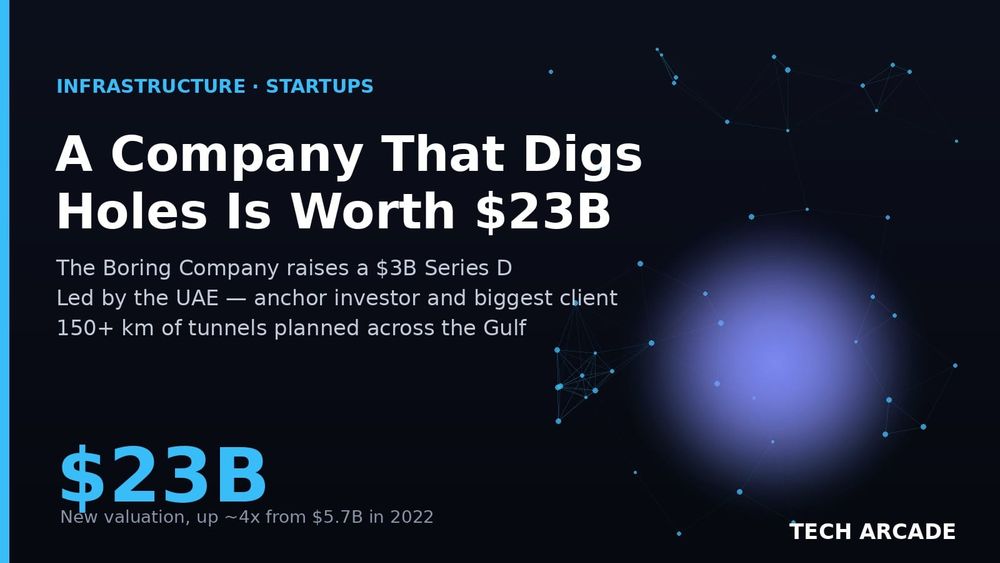

Start with the number that stops you: $23 billion. That's the new price tag on The Boring Company, Elon Musk's tunnel-digging outfit, after a $3 billion Series D led by the United Arab Emirates (TechCrunch). Four years ago this same company was worth about $5.7 billion when it raised $675 million back in April 2022 (Tech Startups). So the valuation just went up roughly 4x — for a business whose core product is a hole in the ground.
The lead check didn't come from Sand Hill Road. It came from a Gulf state that wants to line the underside of its cities with Teslas. The round reportedly targeted a $20 billion valuation as recently as July, then closed higher (TechCrunch).
Here's the thesis: investors aren't paying for tunnels in Las Vegas. They're paying for the option that Musk can pour concrete faster and cheaper than anyone else on Earth — starting with 93 miles of it under the desert.
🧠 Why This Matters
Infrastructure is the least glamorous corner of the tech world, and that's exactly why this raise is loud. While everyone else spent 2026 setting fire to money on AI data centers, a company that makes physical tunnels just quadrupled its valuation on the strength of a sovereign customer with a checkbook and a traffic problem.
The UAE isn't just an investor here — it's the anchor client. The Boring Company has committed to build more than 150 kilometers (93+ miles) of tunnel across the country, a scale that dwarfs anything it has finished to date (Electrek). When your lead investor is also your biggest order, the funding round and the revenue pipeline become the same sentence.
That's the bet in one line: a startup that has spent seven years mostly digging under one convention center just got the balance sheet of a national infrastructure program.
📊 Deep Dive
The money is going two places: scaling the machines, and delivering the Gulf. The flagship overseas project is the Dubai Loop, a pilot of about 6.4 kilometers (4 miles) with four stations, with construction slated to begin later in 2026 (Electrek). That pilot is the toe in the water before the 150-kilometer plunge.
Back home, the numbers are more modest than the valuation implies:
- Valuation: $23 billion now, up from ~$5.7 billion in 2022 — a roughly 4x jump in four years (Tech Startups)
- Raise: $3 billion Series D vs. $675 million in the 2022 Series C
- Vegas Loop: a 123-station network approved across Southern Nevada — including 19 stations greenlit this year — with more than 4 million passengers carried so far (Las Vegas Review-Journal, Electrek)
- Nashville: a ~10-mile "Music City Loop," with a state permit issued in February 2026 and boring already underway (TechCrunch)
- UAE: 150+ km committed, Dubai Loop pilot first
The investor list reads like a Musk reunion tour: alongside the UAE sit Andreessen Horowitz, Sequoia Capital, Temasek, Vy Capital, Human Capital, Valor Equity Partners, plus Gulf names Shamal Holding and Baron Capital (Electrek). Musk framed the mission with characteristic restraint:
"Defeating traffic is the ultimate boss battle. Even the most powerful humans in the world cannot defeat traffic."
— Elon Musk
⚠️ The Catch
Here's where the $23 billion needs an asterisk. The Vegas Loop, the company's showcase, is still mostly human-drivers ferrying passengers in Teslas through tunnels — the fully self-driving version only began testing in the tunnels in August 2025 (TechCrunch). Critics have long pointed out that "a car in a tunnel" is not obviously a transit revolution, and the project has drawn scrutiny over worker safety and environmental compliance (Yahoo News).
Then there's the gap between pitch and pour. Even a friendly write-up of the raise flagged the obvious risk: if the company "cannot execute on infrastructure speed and cost promises," 150 kilometers of planned tunnel is a lot of runway on which to fall short (Tech Startups). Four million riders is real, but it's a rounding error next to what a single subway line moves in a year.
🎯 What Happens Next
Watch Dubai. The 6.4-kilometer pilot is the proof-of-concept the whole valuation leans on — if The Boring Company can dig it on time and on budget, the 150-kilometer commitment starts to look like a schedule instead of a slogan. If it slips, the "faster and cheaper" story gets harder to tell with a straight face.
Second, watch autonomy. The entire economic case for tunnels full of Teslas gets dramatically better the day you can take the human driver out. Full self-driving in the tunnels is the hinge between "expensive valet service" and "actual throughput."
🧩 Bigger Picture
The through-line of 2026 has been sovereign money buying its way into Musk's orbit — and into hard infrastructure it can point to. A Gulf state anchoring a $3 billion round for tunnels is the same instinct that's driving the region's spending on chips, ports, and power: buy the physical layer, and buy it from the operator with the most aggressive cost curve.
It's also a reminder that not every richly valued startup is a chatbot. Somewhere under Las Vegas, a machine named Prufrock is grinding through rock and assembling tunnel rings, and investors just decided that's worth more than most public companies. Concrete, it turns out, still has a story.
The most expensive holes in the world just got a sovereign co-signer — now Musk has to prove a tunnel can move a city, not just a convention.
Sources
- TechCrunch — The Boring Company raises $3B in round led by UAE
- Electrek — Boring Company raises $3 billion Series D at $23 billion valuation, led by UAE
- Tech Startups — The Boring Company raises $3 billion, valuing Musk's tunnel startup at $23 billion
- Las Vegas Review-Journal — Vegas Loop approved for 19 additional stations, bringing total to 123
- TechCrunch — The Boring Company is finally testing Tesla Full Self-Driving in its Las Vegas tunnels
- Yahoo News — Musk's underground tunnels in Las Vegas face scrutiny over safety, environmental concerns