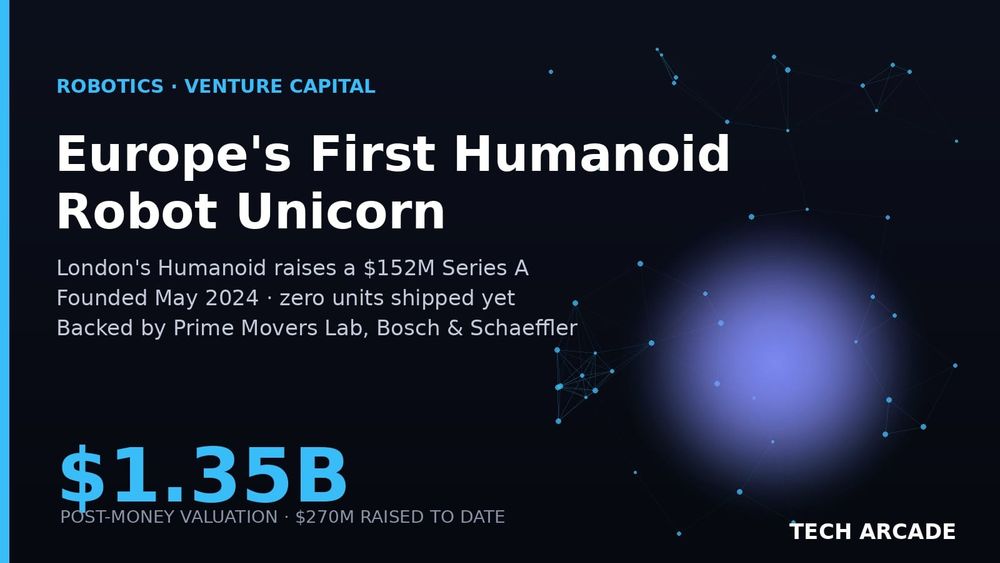

Here's a number that should make every robotics engineer spit out their coffee: $1.35 billion. That's the post-money valuation a London startup called Humanoid just pinned to itself after raising a $152 million Series A — roughly 26 months after it was founded, and before it has shipped a single commercial robot (Forbes).
The round, announced July 21, was led by Prime Movers Lab and pulls in a who's-who of industrial money: auto-parts giant Schaeffler, Bosch, Taiwan's Fubon Financial, and Aglaé Ventures — the investment arm of Bernard Arnault's LVMH empire (SiliconANGLE). It takes Humanoid's total funding to $270 million and crowns it, in the company's own words, Europe's first pure-play humanoid robotics unicorn.
Two years. Zero units shipped. A ten-figure price tag. Welcome to the humanoid gold rush, where the valuation arrives long before the robot does.
🧠 Why This Matters
For a decade, humanoid robotics was a Silicon Valley and Shenzhen story. Figure, Apptronik, and Tesla's Optimus in the US; Unitree and a swarm of startups in China. Europe — despite being the industrial heartland that invented the modern factory — had no billion-dollar contender. Now it does, and it's barely old enough to walk.
What makes Humanoid interesting isn't the founder's TED-talk confidence. It's who wrote the checks. Schaeffler and Bosch aren't tourist VCs chasing a trend — they run the factories these robots are supposed to work in. When your customer is also your investor and your contract manufacturer, you've collapsed three risks — demand, capital, and production — into one bet.
"In just two years, we've gone from an idea to becoming Europe's first pure-play humanoid robotics unicorn, partnered with some of the world's leading industrial companies."
— Artem Sokolov, founder and CEO of Humanoid
The thesis: Europe finally has a humanoid horse in the race — but it's being valued on purchase orders and pedigree, not on robots that actually work a shift.
📊 Deep Dive
Founded in May 2024 by Sokolov, Humanoid has stitched together a team of 50-plus engineers poached from Boston Dynamics, Sanctuary AI, Apptronik, and 1X — the entire humanoid brain trust, distilled into one London office (with outposts in Boston and Vancouver). Its flagship is the HMND 01, a wheeled work platform the company claims already moves at roughly 80% of human speed on some tasks, running on an in-house AI stack called KinetIQ — a four-layer system spanning fleet coordination, a vision-language model, an execution model, and a whole-body controller (TechFundingNews).
Here's how Humanoid's $1.35B stacks up against the field it just gate-crashed:
- Figure AI (US): ~$39B valuation, backed by OpenAI and Nvidia — running paid pilots at BMW (ValueAdd VC).
- 1X Technologies (Norway/US): ~$10B valuation, aiming its Neo robot at homes, not factories.
- Apptronik (US): ~$5.5B valuation on $935M raised, with Mercedes-Benz and GXO pilots.
- Unitree (China): ~$1.3B valuation — but it actually shipped 5,500+ humanoids in 2025, undercutting Western rivals at ~$16,000 a unit.
- Humanoid (UK): ~$1.35B valuation, $270M raised, 0 commercial units shipped.
Notice the odd one out. Unitree is worth roughly the same as Humanoid — and it moved thousands of robots last year. Humanoid's valuation is a bet on the next two years, not the last two.
⚠️ The Catch
That bet rests on paper. Humanoid says it holds pre-orders for 34,000 units worth $2.4 billion — an eye-watering pipeline, except pre-orders in this industry are famously soft, non-binding letters of intent that evaporate the moment a robot misses its spec (TechFundingNews). The one deal with real teeth is Schaeffler's binding commitment to deploy up to 2,000 units by 2032 — a six-year runway that tells you how slow "the future of labor" actually arrives (SiliconANGLE).
Then there's the timeline problem. The HMND 01 beta isn't due until Q4 2026, with CE safety certification targeted for next year. So the unicorn valuation covers a robot that hasn't been certified to legally work alongside humans in the EU yet. And the founder's origin story — that he personally seeded the company with $30 million after selling a family manufacturing business — is compelling color, but it's a self-reported narrative, not an audited fact.
"What we've accomplished in such a short time would typically take a decade."
— Artem Sokolov
Maybe. Or maybe a decade is how long these things take because physics, safety law, and factory reliability don't care about your Series A.
🎯 What Happens Next
Watch three dates. Q4 2026: the HMND 01 beta ships to pilot sites — the first moment reality touches the pitch deck. 2027: CE certification, or the lack of it, decides whether these robots can legally clock in across Europe. And 2032: the Schaeffler deployment target, the only hard number in the whole pipeline that someone has actually signed for.
If the beta impresses, expect a Series B at a wildly higher valuation within 12 months — that's the humanoid playbook. If it stumbles, Humanoid becomes a cautionary tale about paying unicorn prices for a demo reel.
🧩 Bigger Picture
Global startup investment hit a record $510 billion in the first half of 2026, and humanoids have become the sharpest expression of the AI trade's appetite for physical-world payoff (Crunchbase). Chatbots proved the software; robots are the bet that the same intelligence can lift, sort, and weld. That's a trillion-dollar labor market, and investors would rather overpay early than miss it entirely.
Humanoid's real significance is geographic. Europe's industrial giants just decided they'd rather build the robots that reshape their factories than import them from California or China. Whether that's visionary or defensive, it means the humanoid race is now genuinely three-way — and the incumbents are funding the insurgent.
A billion-dollar valuation for a robot that hasn't punched a clock isn't a bug in the humanoid boom — it's the entire business model.
Sources
- Forbes — Humanoid Raises $152 Million At $1.35 Billion Valuation: Europe's Newest Robot Unicorn
- SiliconANGLE — Humanoid raises $152M at $1.35B valuation to bring human-like robots into factories
- TechFundingNews — Humanoid raises $152M at $1.35B, becoming the UK's newest robotics unicorn
- Reuters via Yahoo Finance — Robotics startup Humanoid raises $152 million Series A round at $1.35 billion valuation
- ValueAdd VC — Humanoid Robots in 2026: Figure, Apptronik, 1X and Tesla Optimus Compared
- Crunchbase — Global Startup Investment Hit Record $510B In H1 2026