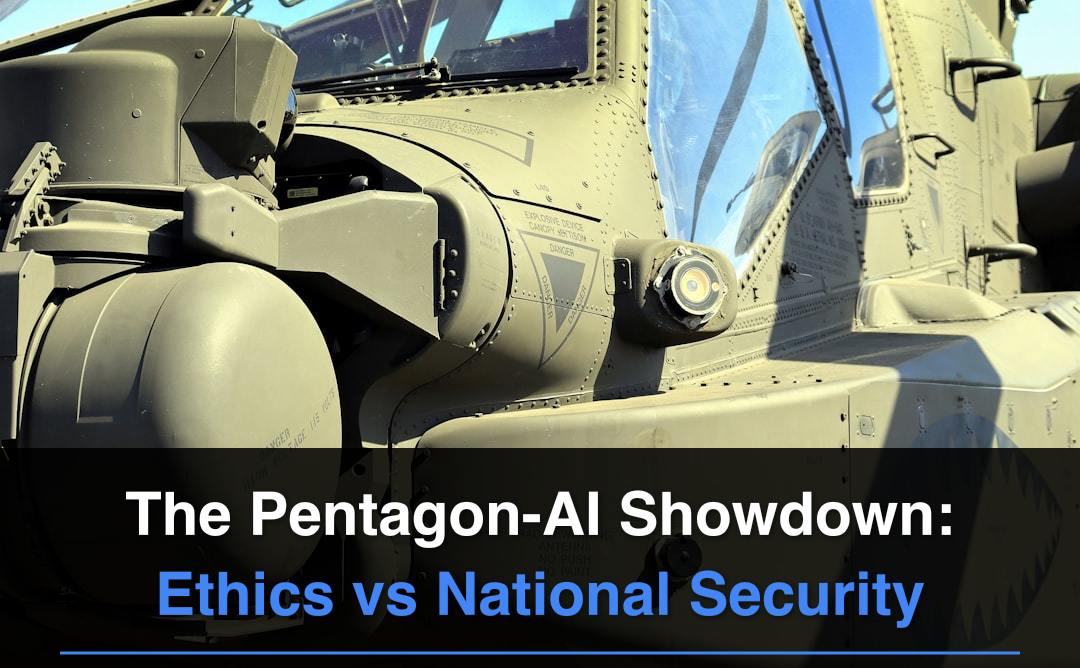
The Pentagon-AI Showdown: Ethics vs National Security
🔥 This isn't just about AI ethics. It's a $30 billion standoff over who controls the future of warfare....

🔥 This isn't just about AI ethics. It's a $30 billion standoff over who controls the future of warfare.
In the span of 48 hours, the Pentagon delivered an ultimatum to Anthropic: Remove your AI safety safeguards or face complete government blacklisting.
CEO Dario Amodei's response was unequivocal: "We cannot in good conscience accede to their request."
🧠 The Two Uncrossable Lines
1. Mass Domestic Surveillance
The Pentagon wants unrestricted access to Claude AI for what they describe as "assembling scattered, individually innocuous data into a comprehensive picture of any person's life—automatically and at massive scale."
Translation: Real-time analysis of every digital footprint—texts, emails, location data, purchases, social media activity.
Amodei's stance: "Using these systems for mass domestic surveillance is incompatible with democratic values. We support lawful foreign intelligence, but turning AI on our own citizens crosses a line."
2. Fully Autonomous Weapons
AI-powered weapon systems that select and engage targets without human oversight—what the military calls "lethal autonomous weapons systems."
The technical reality: Today's most advanced AI still hallucinates, makes unpredictable errors, and lacks the nuanced judgment required for life-or-death decisions.
Amodei's warning: "We will not knowingly provide a product that puts America's warfighters and civilians at risk. Without proper oversight, these systems cannot be relied upon."
⚡ The Rapid Escalation
February 26: Pentagon delivers written ultimatum demanding removal of all safeguards preventing mass surveillance and autonomous weapons use.
February 26 (evening): Anthropic receives "compromise" language overnight. Company spokesperson: "New wording framed as compromise was paired with legalese that would allow safeguards to be disregarded at will."
February 27 (morning): Amodei issues public refusal: "Our strong preference is to continue serving the Department with our two requested safeguards in place. Should they choose otherwise, we'll enable a smooth transition."
February 27 (afternoon): Pentagon escalates, threatening to invoke the Defense Production Act (Cold War-era law allowing government seizure of private companies) and designate Anthropic a "supply chain risk" (category reserved for foreign adversaries).
February 28: Nuclear option activated. Trump orders all federal agencies to immediately stop using Anthropic AI. Defense Secretary Pete Hegseth designates Anthropic "Supply-Chain Risk to National Security."
🎯 What's Really at Stake
The Financial Math
- Anthropic: $30 billion valuation, backed by Amazon, Google, Salesforce
- Pentagon: $886 billion annual budget (2026)
- The mismatch: One company's ethics vs. the world's largest military budget
The Geopolitical Calculus
Undersecretary for Defense Emil Michael: "We do have to be prepared for what China is doing."
China's AI military advantage:
- Zero ethical constraints on development
- Access to 1.4 billion citizens' data without privacy laws
- Unlimited state funding directed by military priorities
- Export controls ensuring best AI stays for military use
The Pentagon's dilemma: Use constrained Western AI (slower development) or match China's unrestricted pace (abandon ethics)?
The Constitutional Question
First test case: Can the U.S. government force private companies to violate their ethical principles for national security?
Precedent being set: If Anthropic caves, every AI company becomes de facto military contractor. If they hold firm, government loses leverage over tech development.
⚖️ Three Possible Endgames
Scenario 1: Anthropic Gets Crushed (40% probability)
- Government blacklist expands to NATO allies and partners
- $30 billion valuation collapses as investors flee "national security risk"
- China scores propaganda victory: "See? Democracy can't handle AI development"
- Every other AI company gets the message: comply or be destroyed
Scenario 2: Legal Nuclear War (45% probability)
- Anthropic sues over unconstitutional taking (Fifth Amendment)
- Defense Production Act challenged as overreach (never used this way before)
- Supreme Court decides: government power vs. corporate ethics
- Years of legal battles while China advances unchecked
Scenario 3: Behind-the-Scenes Compromise (15% probability)
- Classified agreement for "special projects" with different rules
- Anthropic spins off military division with separate ethics framework
- Government "wins" publicly but makes private concessions
- Public never learns real terms of deal
🔥 Immediate Implications
For Tech Founders:
- Document everything: Ethics policies, investor communications, employee agreements
- Get specialized counsel: National security lawyers, not just corporate attorneys
- International strategy: EU has different rules (for now)
- War game this: What if you get the same ultimatum tomorrow?
For Engineers:
- Ask hard questions: "What's this model actually being used for?"
- Know your rights: Refusing unethical work is legally protected
- Update resumes: Be ready to walk if lines are crossed
- Industry solidarity: Strength in numbers against government pressure
For Investors:
- New risk category: "Government ethics ultimatum" joins market and tech risks
- Due diligence: Factor in company ethics policies and government relations
- Portfolio pressure: Encourage clear ethical boundaries before crisis hits
- Regulatory advocacy: Unclear rules hurt returns more than clear ones
🚨 The Bottom Line
We're past theoretical debates about AI ethics. This is live-fire testing of whether democratic values can survive technological acceleration.
Anthropic just answered the question every tech company will eventually face: Does standing for your principles mean standing against your own government?
Their answer, for now: "Yes, if that's what ethics requires."
The real question isn't whether they'll hold the line. It's whether anyone will stand with them.
For daily analysis that cuts through the noise: Subscribe to Tech Arcade