
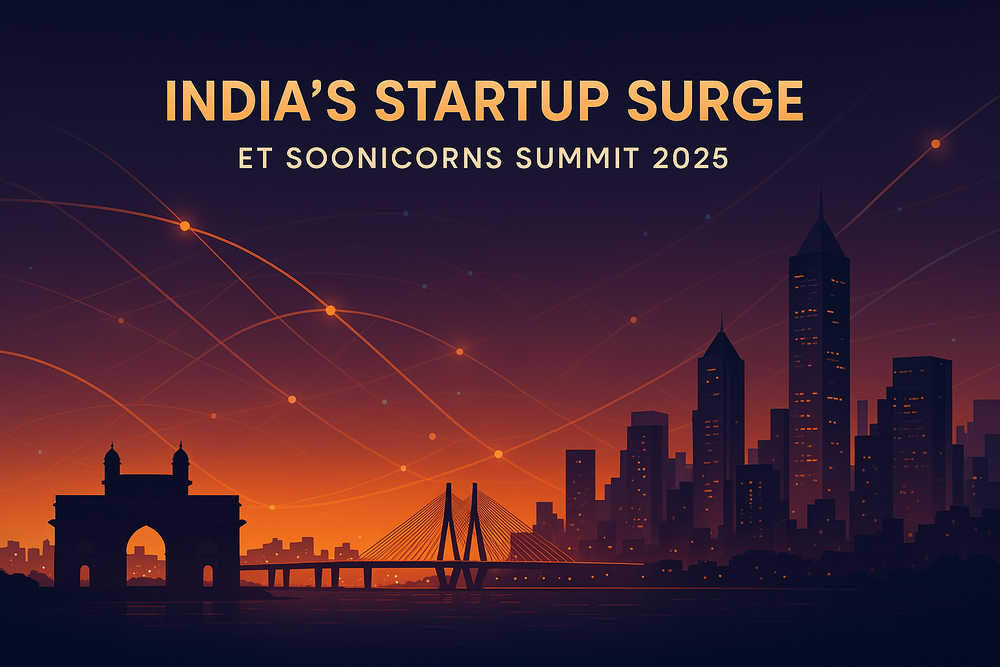

India’s startup landscape is entering a new chapter — one defined by scale, structure, and self-sustaining innovation. On 29 October 2025, the ET Soonicorns Summit 2025 Sundowner will take place in Mumbai, unveiling the Maharashtra Startup Report, a comprehensive look at how the state’s emerging ventures — often called “minicorns” (startups valued below $100 million) and “soonicorns” (on the cusp of unicorn status) — are accelerating growth across sectors. The Economic Times
What’s going on
Maharashtra, led by Mumbai and Pune, accounts for one of India’s most concentrated hubs of innovation. The forthcoming report, backed by The Economic Times and the Soonicorns Summit platform, is expected to map the next wave of Indian ventures gaining traction in AI, fintech, SaaS, cleantech, and healthtech, sectors that have drawn consistent investor interest despite global funding slowdowns.
The term Soonicorn has become shorthand for India’s deep bench of growth-stage startups, companies that have product-market fit, measurable revenue, and growing regional or international ambitions. As of 2025, India hosts more than 110 unicorns and nearly 200 soonicorns, making it the third-largest startup ecosystem in the world, behind only the US and China.
What’s notable about Maharashtra is its focus on ecosystem infrastructure: state-level innovation missions, dedicated startup policies, and university incubators like the IIT Bombay Research Park and Pune’s Venture Centre. These programs don’t just fund startups, they create the conditions for cross-sector collaboration, corporate partnerships, and technology transfer, something even mature ecosystems struggle to replicate.
Why this matters
- 🌍 The global centre of gravity is shifting.
While Silicon Valley and Europe continue to dominate venture capital flows, India’s maturing infrastructure and rapidly digitising population give it a unique late-mover advantage. The scale of consumer adoption: 800 million+ internet users and a growing middle class means many startups can reach profitability locally before expanding abroad. - 💸 Resilience in funding.
Even with tighter global capital markets, India saw more than $10 billion in startup funding in the first half of 2025. Local venture firms are raising domestic capital, reducing reliance on US LPs and insulating the ecosystem from external shocks. Maharashtra alone houses over 25% of India’s registered startups, signalling strong regional investment pipelines. - 🤝 Partnership and talent magnet.
For international founders, particularly in the UK and Europe, the Indian startup scene now offers partnership opportunities that go beyond outsourcing. From joint ventures in AI tooling to shared product development in fintech or climate tech, India is positioning itself as both a market and a collaboration hub. - 📈 Policy clarity and long-term vision.
India’s Startup India initiative, combined with state-specific programs like Maharashtra’s innovation policy, provides more regulatory clarity than many emerging markets. That stability attracts global investors who once hesitated due to policy unpredictability.
The bigger picture
For founders and investors watching global startup flows, India represents more than another “hot market” — it’s an experiment in scale-ready entrepreneurship, built on digital public goods like Aadhaar, UPI (digital payments), and ONDC (open commerce). These government-backed frameworks give startups plug-and-play infrastructure that Western counterparts often lack.
For European or UK founders, the lesson is twofold:
- Ecosystem architecture matters: government alignment, startup visibility, and structured pathways to capital accelerate maturity.
- Narrative and community-building are now part of the growth equation: Soonicorns Summit shows how India uses storytelling, data, and recognition to spotlight its next generation of scale-ups.
TL;DR
India’s startup ecosystem is no longer the “next frontier”, it’s part of the core global circuit. The ET Soonicorns Summit 2025 isn’t just a networking event; it’s a mirror of how emerging ecosystems are building scale, credibility, and international relevance from the ground up.