
Every AI headline this year has been about something that talks back to you. Chatbots. Copilots. Agents that write your emails and argue with your calendar. So here's a plot twist: the biggest European AI acquisition of the summer is about none of that. It's about tables. Rows and columns. The boring stuff in your spreadsheets and databases that actually runs the world.
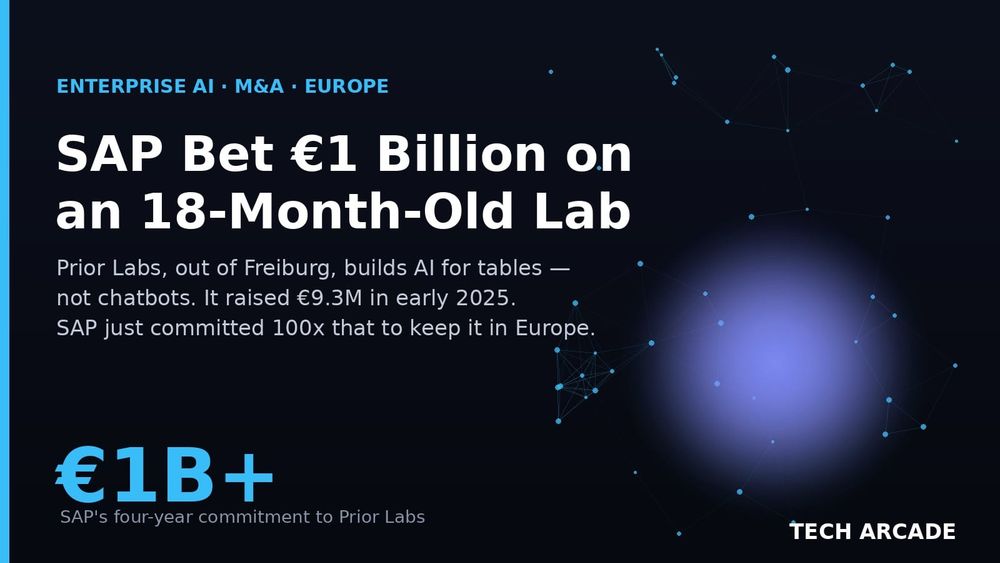
Let's get the number on the table first: over €1 billion — roughly $1.16 billion — is what SAP has committed to a startup that, eighteen months ago, didn't exist ($1.16B commitment, TechCrunch). On July 17, 2026, SAP closed its acquisition of Prior Labs, a Freiburg-based lab whose entire pitch is that the most valuable AI in your company isn't the one writing memos — it's the one predicting which customers churn and which machines break (SAP).
Eighteen months. From a research idea to a billion-euro frontier lab. That's the story.
The thesis: while everyone else races to build a smarter chatbot, SAP just bought the one team that made structured business data — the last unglamorous frontier of enterprise AI — actually work.
🧠 Why This Matters
Here's the dirty secret of the AI boom: almost none of the money pouring into large language models touches the data companies actually depend on. Your bank doesn't approve a loan by asking a chatbot. A railway doesn't schedule maintenance from a vibe. Those decisions live in tables — and until recently, AI was surprisingly bad at them.
SAP is the company that quietly runs the back office of the global economy — the ledgers, the supply chains, the HR systems of most of the Fortune 500. So when SAP says the structured-data layer is the prize, it's not theorizing. It's describing its own customers' most valuable asset.
"The greatest untapped opportunity in enterprise AI wasn't large language models; it was AI built for the structured data." — Philipp Herzig, Chief Technology Officer, SAP (TechCrunch)
That's a €1-billion way of saying the industry has been building the wrong thing — or at least, not the most useful one.
📊 Deep Dive
Prior Labs' breakthrough is a model family called TabPFN — a "tabular foundation model." Instead of predicting the next word, it predicts the next value: will this loan default, will this cell turn cancerous, will this train fail next month? It was published in Nature, set the state of the art on tabular prediction across hundreds of independent studies, and has been downloaded more than 3 million times as an open-source release (The Next Web).
The team behind it isn't random. Co-founder and CEO Frank Hutter is one of the pioneers of automated machine learning; the advisory board includes Meta's Yann LeCun (The Next Web). And the money math is almost comic. In February 2025, Prior Labs raised a €9.3 million pre-seed round led by Balderton Capital (Fortune). Roughly a year and a half later, SAP is backing the same team with more than a hundred times that.
Here's how SAP's bet stacks up against the AI story you already know:
- The prize: LLMs chase text, images, and audio. TabPFN chases the structured data — the spreadsheets and databases most companies still can't model well.
- The output: A chatbot writes you a paragraph. A tabular model tells you which loans default and which train fails next — decisions with dollars attached.
- The price of entry: €9.3 million pre-seed in early 2025 → a €1 billion-plus commitment by mid-2026. That's a ~100x escalation in eighteen months.
- The geography: Not Silicon Valley. Freiburg, Germany — SAP is planting a "globally leading frontier AI lab" on home European soil (SAP).
- The structure: Prior Labs stays an independent entity, funded — not absorbed — by SAP over the next four years.
"The most valuable AI in a business may not be the one that writes emails, but the one that predicts which loans default or which train fails next." (The Next Web)
⚠️ The Catch
A billion-euro commitment isn't a billion-euro check. SAP hasn't disclosed the actual purchase price; reporting pegs the up-front piece at "well over half a billion dollars in cash," with the remaining €1 billion-plus being investment spread across four years to scale the lab (TechCrunch). Big number, but staged — and contingent on the lab actually delivering.
There's also the awkward tension in buying an open-source darling. TabPFN's 3-million-download reputation was built on being free and public. Turn a beloved open project into corporate IP and you risk the community that made it valuable in the first place. And "stays independent" is a promise every acquirer makes — right up until the integration meetings start.
🎯 What Happens Next
Watch three things. First, whether SAP wires TabPFN-style prediction directly into its flagship products, so a finance team can forecast churn or default risk without hiring a data-science army. Second, whether the open-source releases keep coming, or quietly slow. Third, whether rivals — Salesforce, Microsoft, the hyperscalers — suddenly rediscover that tabular data is a category worth fighting over. A billion-euro validation tends to wake people up.
🧩 Bigger Picture
This deal is a bet that the next phase of enterprise AI won't be won by whoever has the chattiest model — it'll be won by whoever can turn the ocean of structured business data into predictions people actually trust. It's also a rare European power move: rather than watch its best AI talent decamp to California, SAP paid up to keep a frontier lab in Germany. In a year defined by ever-larger language models, the most interesting billion of the summer went to a team that decided the future was hiding in your spreadsheets all along.
Turns out the smartest AI in the building might not be the one that talks — it's the one that does the math.
Sources
- SAP — SAP Completes Prior Labs Acquisition (July 17, 2026)
- SAP — SAP to Acquire Prior Labs to Establish a Frontier AI Lab in Europe
- TechCrunch — SAP bets $1.16B on 18-month-old German AI lab
- The Next Web — SAP's €1bn bet on AI is about tables, not chatbots
- Fortune — Prior Labs' €9.3M pre-seed round for tabular-data AI
- Tech.eu — SAP acquires Prior Labs 18 months after launch in €1B+ deal