
Somewhere over Alaska's Kenai Peninsula in late August, a fleet of autonomous drones climbed into a bank of clouds, puffed out a trace of silver iodide, and — by the flying company's own tally — coaxed roughly 19 million gallons of extra precipitation out of the sky across seven flights in a single stretch (Runtime). No rain dance. No cannon. Just quadcopters and a chemistry trick older than color television.
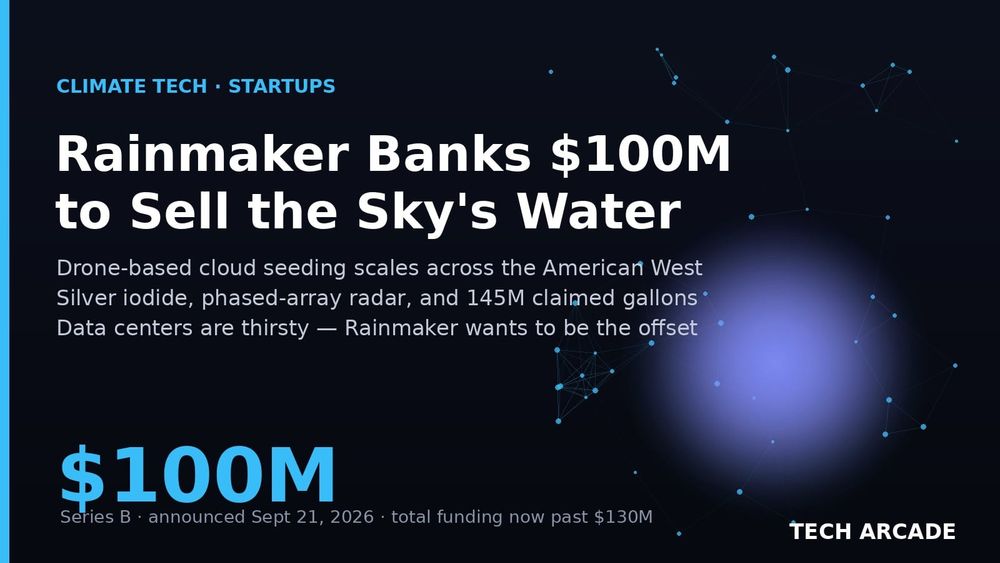
Let's get the number on the table first: $100 million. That's the Series B that El Segundo startup Rainmaker closed to scale up drone-based cloud seeding, announced September 21 (Fast Company). It pushes the three-year-old company's total funding past $130 million.
Cloud seeding itself is ancient by tech standards — people have been firing silver iodide into clouds since 1946. What's new is the pitch underneath the raise: that you can now measure the rain you made, fly the mission cheaply, and sell the water to the thirstiest customers in tech.
The bet in one line: Rainmaker thinks measurable, on-demand precipitation turns weather modification from folk science into an infrastructure business.
🧠 Why This Matters
The American West is running a chronic water deficit, and the newest heavy drinker in the room is the data center. U.S. data centers consumed an estimated 17.4 billion gallons of water directly in 2023 — more than triple the 2014 figure — and the power plants feeding them guzzle roughly twelve times more on top of that (Hoodline).
Every new AI campus that lands in Arizona or Utah arrives with a water question attached, and locals are increasingly the ones asking it. Rainmaker's move is to sell itself as the offset: fly the drones, thicken the snowpack, return the gallons to stressed aquifers. Whether that math actually closes is the open question — but the customer demand it's chasing is very real, and very well funded.
📊 Deep Dive
Rainmaker, founded in 2023 and run by CEO Augustus Doricko, doesn't make rain from a clear blue sky — nothing can. It flies weather-resistant quadcopters (nicknamed Elijah) up to 15,000 feet into clouds that already have the right temperature and moisture, and releases silver iodide, which acts as a seed for ice crystals that grow heavy enough to fall (Hoodline). The company's real trick is on the ground: a phased-array radar system called Eden that tries to prove the precipitation fell along the drone's flight path rather than by chance.
That attribution claim is the whole ballgame. Rainmaker says it logged 82 seeding patterns over four months in 2026 and connected its flights to more than 145 million gallons of additional water, operating across Utah, Idaho, Oregon, California and Colorado (Runtime). In Utah, it's become the backbone of the state's cloud-seeding program (Deseret News).
How the raise stacks up against the company's short history:
- Seed (2024): $6.3 million to get drones in the air.
- Series A (May 2025): $25 million, led by Lowercarbon Capital.
- Series B (Sept 2026): $100 million from NOA VC, Upfront Ventures, DCVC, Lowercarbon Capital and Dream Ventures.
- Total to date: north of $130 million in roughly three years.
Lowercarbon, which backed the Series A, framed the appeal in the plainest possible terms:
"Why should we run out of water when there's a trillion gallons of it floating over our heads?"
— Lowercarbon Capital, on its Rainmaker investment (Lowercarbon)
⚠️ The Catch
Here's the part the pitch deck moves past quickly: nobody is fully sure how well cloud seeding works. A 2024 U.S. Government Accountability Office review found that studies estimated additional precipitation ranging anywhere from zero to 20%, with results muddied by data gaps and the simple fact that you can't rerun the weather to see what would have happened without you (Runtime).
Studies estimated additional precipitation ranging from zero to 20%, constrained by data limitations and natural weather variability.
— U.S. Government Accountability Office, 2024 assessment
Then there's the politics. Cloud seeding has become a lightning rod: Tennessee banned the practice in 2024, and Florida classified it as a felony in 2025 (Hoodline). Critics like UC Riverside's Shaolei Ren note the technique only works when the atmosphere already cooperates, and Public Citizen's Tyson Slocum argues that spraying the sky doesn't fix the water intensity baked into a data center's business model. When you sell weather, everyone downwind becomes a stakeholder — and some of them reach for lawyers.
🎯 What Happens Next
Rainmaker says the $100 million goes toward a bigger research bench — radar meteorologists, machine-learning specialists, aerosol chemists — and testing biodegradable seeding agents it has already filed patents on (Fast Company). The strategic prize is turning one-off state contracts into recurring deals with water agencies, irrigation districts and, eventually, the hyperscalers looking to neutralize their water headlines.
The number to watch isn't gallons — it's attributable gallons that hold up to outside scrutiny. If Eden's radar data survives independent review, Rainmaker has a defensible product. If it doesn't, it has an expensive weather forecast.
🧩 Bigger Picture
This raise sits inside a broader surge: global venture funding for climate tech hit roughly $26 billion in the first half of 2026, up about 55% year over year, much of it chasing the water and power strain created by the AI build-out (Tech Startups). The same data centers driving record energy deals are now driving record interest in where the water comes from.
What makes Rainmaker notable isn't that it seeds clouds — governments have quietly done that for decades. It's that it's trying to attach a meter and an invoice to the rain, and investors just wrote a nine-figure check on the premise that the meter is real. The West doesn't need more optimism about water. It needs receipts.
Rainmaker raised $100 million to hand out those receipts. Now it has to prove the sky signed them.
Sources
- Fast Company — Startup Rainmaker just raised $100 million
- Runtime — Rainmaker raises $100M Series B for drone cloud seeding
- Hoodline — Rainmaker pitches cloud seeding to ease data center water fears
- PR Newswire — Rainmaker Raises $100M Series B
- Lowercarbon Capital — Abundance from Above (Series A)
- Deseret News — How Rainmaker became the heart of Utah's cloud-seeding program
- Tech Startups — Top Tech News, September 21, 2026