
🌧️ What happened
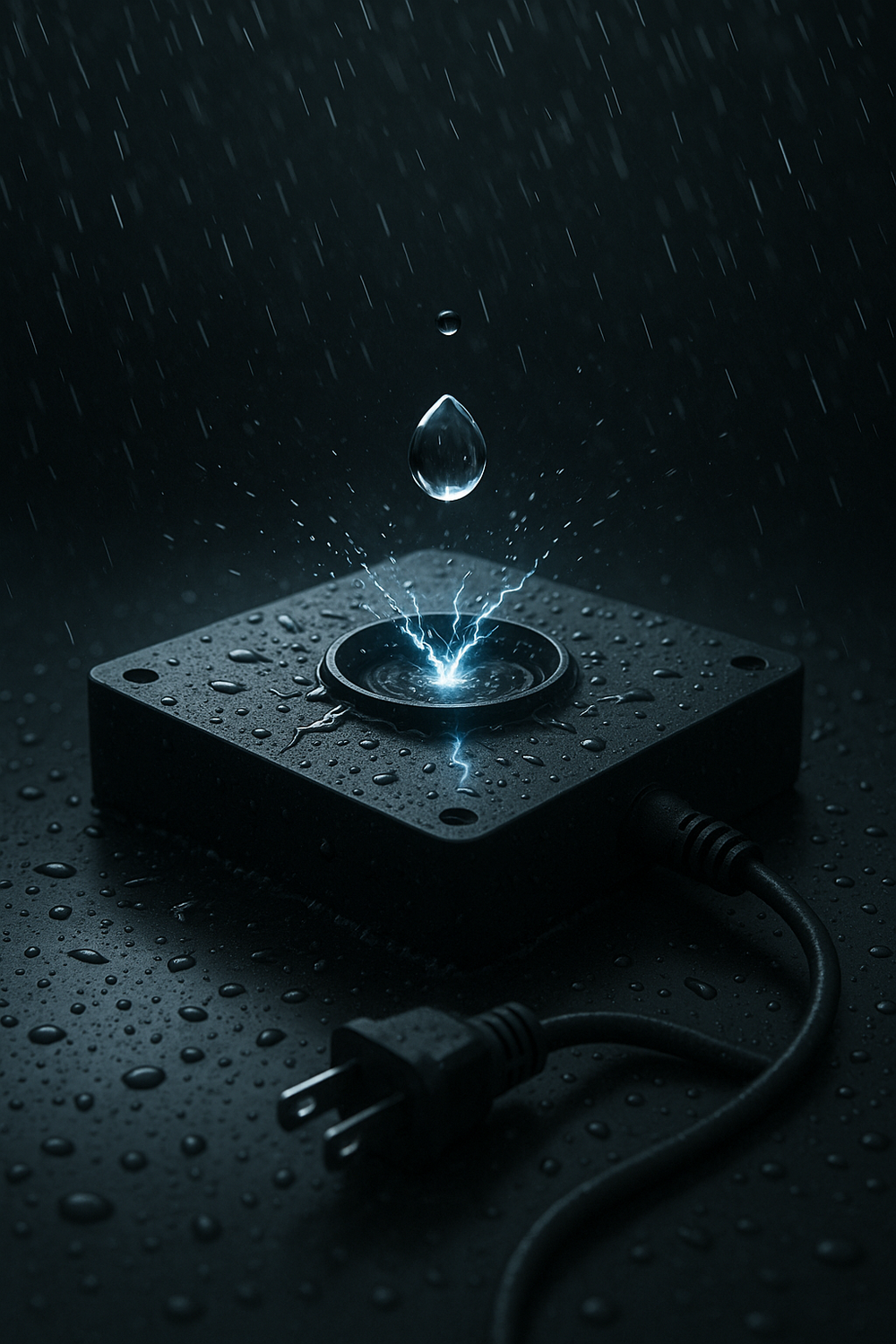
Scientists have built new devices that turn falling raindrops into electricity, pushing the idea of weather-powered energy a step closer to reality.
Two research teams, National University of Singapore (NUS) and Nanjing University of Aeronautics and Astronautics (NUAA), developed separate prototypes that harvest the tiny bursts of energy created when droplets hit a surface or move through a tube.
One design uses tall narrow tubes to enhance charge separation as droplets fall.
The other uses a floating film on water, with the water itself acting as the electrode. Both systems recently achieved some of the strongest performance ever recorded for raindrop-based power.
⚙️ How it works
NUS Plug-flow generator
- Raindrops fall through 30+ cm tubes, creating alternating slugs of water and air.
- This movement produces charge separation that gets captured as electricity.
- The setup achieved over 10 percent energy conversion efficiency, which is unusually high for this field.
NUAA Floating generator (W-DEG)
- A thin dielectric film floats above water.
- Droplets hit the top surface, while the water below acts as the bottom electrode.
- Each droplet can generate up to ~250 volts in lab conditions.
- A 0.3 m² prototype powered 50 LEDs and charged capacitors.
In simple terms: raindrop impact + surface charge + clever engineering = usable electrical pulses.
💡 Why it matters
For you: It’s a peek at micro-renewables that work when solar panels underperform. Rainy weather could one day power environmental sensors, small devices, or even parts of smart homes.
For companies: This opens the door to battery-free sensor networks, especially in places with heavy rainfall. Think environmental monitoring, agriculture, water-quality systems, and city infrastructure.
For the world: This adds a new angle to renewable energy — not to replace solar or wind but to fill gaps. Rain is unpredictable, but when it falls, it’s free, clean, and abundant.
⚠️ The reality check
This is not going to power your apartment. The power density is still low.
Big challenges remain:
- Real rainfall varies wildly, so performance outside labs is inconsistent.
- Materials need to survive long-term weather, biofouling, and debris.
- Storing the short electrical pulses requires efficient capacitors or batteries.
- Scaling from powering LEDs to powering anything meaningful will take years.
These devices are promising, but they’re at the early prototype stage, not commercial energy solutions.
👀 What’s next
NUS and NUAA teams plan to scale up their designs and test them outdoors across different climates.
Expect early adoption in:
- Reservoirs and lakes (floating sensor networks)
- Agricultural fields
- Smart-city drainage systems
- Coastal monitoring platforms
If researchers can improve durability and power density, raindrop energy could become a quiet, maintenance-free source for the world’s growing IoT ecosystem.