

Three years ago, Silicon Valley Bank collapsed in the space of 48 hours, and a generation of founders learned what it feels like to watch payroll money you thought was safe turn into a rounding error in a receivership. Into that hole stepped a startup bank named after a dwarven mountain from The Hobbit. It is now growing faster than almost anyone expected.
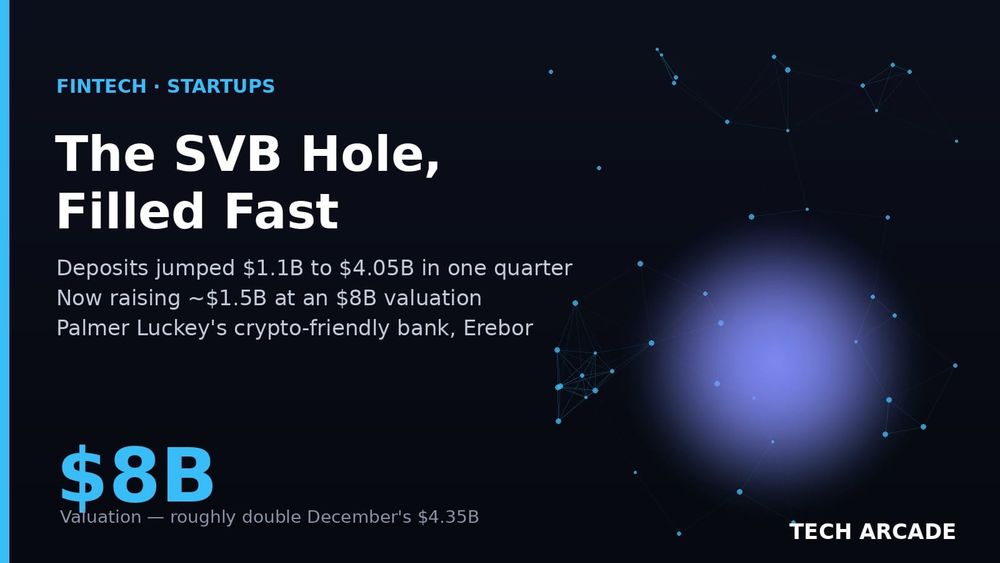
Here is the number to sit with: Erebor's deposits went from $1.1 billion at the end of March to roughly $4.05 billion by midsummer — a near-quadrupling in a single quarter (The Block). On the back of that, the bank is closing a fresh round of about $1.5 billion at an $8 billion valuation (Axios).
Eight months ago it was worth $4.35 billion. The price has roughly doubled while most of you weren't looking.
A bank that opened its doors this year is already being valued like a mid-cap fintech — because it is doing the one thing SVB used to do, on rails SVB never had.
🧠 Why This Matters
When SVB failed in March 2023, it wasn't just a bank going under. It was the plumbing of the startup economy springing a leak. Roughly half of all U.S. venture-backed companies banked there or nearby. For a weekend, founders genuinely did not know if they could make rent.
The lesson everyone took away was that startups, crypto firms, and defense contractors are underbanked — too weird, too volatile, or too regulated for the average regional lender to want. Erebor's entire pitch is that this "weird" money is a feature, not a bug. Co-founder Palmer Luckey — the man behind Oculus and the defense contractor Anduril — put his name and his network on a bank built specifically for the customers everyone else finds inconvenient.
The backers read like a map of a particular corner of the tech world: Peter Thiel's Founders Fund, Joe Lonsdale's 8VC, Katie Haun's Haun Ventures, and Lux Capital, which led last December's round (Cryptobriefing). When that crowd values a two-year-old bank at $8 billion, it is making a bet that the SVB-shaped hole is real, permanent, and worth owning.
📊 Deep Dive
Erebor — named for the Lonely Mountain in Tolkien, the dwarven stronghold stuffed with treasure — is run by co-CEOs Owen Rapaport and Jacob Hirshman, both alumni of the stablecoin issuer Circle (Disruption Banking). That pedigree matters, because the bank is built around a U.S. dollar stablecoin from day one rather than as a bolt-on. It describes itself, memorably, as a "farmers' bank for tech" — deposits and payments for AI companies, defense contractors, advanced manufacturers, and crypto businesses.
What's actually happened so far, by the numbers:
- Deposits: ~$1.1 billion (end of March 2026) → ~$4.05 billion (midsummer 2026)
- Valuation: $4.35 billion (December 2025) → ~$8 billion (August 2026)
- Current raise: ~$1.5 billion in new equity
- Prior raise: $350 million in December 2025, led by Lux Capital
- Launch capital: roughly $635 million
- Customers: nearly 400 added over three months
- Headquarters: Columbus, Ohio — chosen for its state banking rules
The regulatory path is the part that should make you raise an eyebrow. Erebor got preliminary approval from the Office of the Comptroller of the Currency in October 2025 and its full national bank charter in February 2026 — described as the first new national bank charter granted under the current administration (The Block). New national bank charters are famously rare. Getting one in four months, for a crypto-friendly bank, is its own kind of statement.
"When you build your entire banking infrastructure on stablecoins, you're inheriting all the risks of those underlying protocols."
— Mitchell Amador, CEO of Web3 security firm Immunefi (Disruption Banking)
⚠️ The Catch
Start with the obvious ghost in the room. SVB didn't fail because it banked startups. It failed because its deposits were concentrated in one volatile customer base that all moved at once, and its balance sheet couldn't absorb the run. Erebor is deliberately courting the same kind of concentrated, fast-moving money — crypto firms and startups whose deposits can swell and drain in a hurry. Quadrupling deposits in a quarter is thrilling on the way up. Deposits that arrive that fast can leave that fast too.
Then there's the business model itself. Erebor's crypto-collateralized lending — the plan to make money by lending against digital assets — has so far seen lower-than-expected demand (Cryptobriefing). A bank that can't lend profitably is just an expensive place to park cash. The stablecoin architecture that makes Erebor fast also, as Immunefi's Amador warned, imports whatever fragility lives in the tokens underneath.
And the optics are unavoidable. This is a bank founded and funded by people with large, active businesses of their own. Luckey has been pointed about it, saying that none of the bank's deposit growth this past quarter came from his own companies (The Block). That he had to say it out loud tells you the question is being asked.
🎯 What Happens Next
The near-term test is profitability. Erebor's leadership expects the bank to be profitable by the end of 2026 (Cryptobriefing). Watch that number. An $8 billion valuation on a bank still burning cash is a promise; an $8 billion valuation on a bank that turns a profit in its first full year is a franchise.
The fresh $1.5 billion buys runway and, more importantly, a bigger capital cushion — the thing SVB fatally lacked. Expect Erebor to use it to widen beyond crypto into the sturdier, stickier deposits of defense and advanced-manufacturing clients, where the money moves more slowly and the regulators sleep better.
🧩 Bigger Picture
Erebor is the sharpest example yet of a broader shift: the merger of Silicon Valley's founder class with the actual machinery of banking. For decades, startups were customers of banks. Now a slice of the industry has decided that if the incumbents won't serve the innovation economy properly, they'll go get a charter and do it themselves — stablecoins, crypto collateral, and Tolkien branding included.
That's a genuinely different animal from a neobank riding on someone else's charter. Erebor holds the real thing, regulated by the OCC, with a balance sheet it owns. Whether that ends in a durable institution or a cautionary tale depends entirely on whether its founders remember the lesson that created the opening in the first place.
SVB's treasure vault was real right up until the dragon woke up. Erebor took the mountain's name on purpose — now it has to prove it read the whole story.
Sources
- Axios — Palmer Luckey's Erebor nears $1.5B raise at $8B valuation
- The Block — Erebor eyes $8 billion valuation as deposits nearly quadruple
- Cryptobriefing — Erebor plans to raise $1.5 billion at an $8B+ valuation
- Disruption Banking — Can Erebor Replace SVB and Avoid the Same Fate?
- Bloomberg — Palmer Luckey's Erebor Bank Eyes at Least $8 Billion Valuation